


What really tells you how safe an airline is? Is it the price you pay for the ticket, the size of the plane, or the reputation of the brand? Most travellers have asked themselves some version of this question while booking a flight, especially when choosing between a budget carrier and a legacy airline. The truth is more complicated—and a new report from AirAdvisor, published in October 2026, tries to make sense of it. The 2026 European Airline Safety Index looked at 20 major European airlines, comparing the ten largest low-cost carriers with the ten largest mainline carriers based on 2025 flight volumes. The goal was not to declare any airline “unsafe” or “perfectly safe,” but to offer a comparative, data-driven look at how these carriers stack up across a range of factors. In the end, Greece’s Aegean Airlines took the top spot with a score of 89 out of 100, followed closely by Ryanair at 86 and Austrian Airlines at 85.5. The rest of the ranking included familiar names like Air France, British Airways, Lufthansa, easyJet, and Wizz Air, as well as smaller carriers like SunExpress and Pegasus. But beyond the final numbers, the report offers a refreshing reminder: safety isn’t as straightforward as price, brand, or even accident records alone.
The methodology behind the index is worth understanding, because it shapes everything else. AirAdvisor scored each airline out of 100 across six weighted categories, and no single factor dominates the entire picture. The heaviest weight, 40 percent, went to safety record, which was based on accidents published in the International Air Transport Association’s Safety Report from 2016 to 2025. That means a decade of data, not just one bad year or one lucky streak. The next category, certification and audit, carried 20 percent and looked at audit history plus International Civil Aviation Organization data on how effective each country’s aviation oversight actually is. Operational safety systems followed at 15 percent, while fleet age and technical profile counted for 10 percent, pilot training for 10 percent, and financial stability for the final 5 percent. The company said the scores for operational safety, fleet, training, and financial health were based on publicly available regulatory and company information. Importantly, AirAdvisor stressed that the index is “comparative and should not be read as a measure of whether any individual airline is safe or unsafe.” In other words, it’s not a verdict on which airline you should avoid. It’s a lens for understanding how different carriers manage risk, maintain their aircraft, and prepare their pilots—and why some airlines rise above the rest when you factor in all of that together.
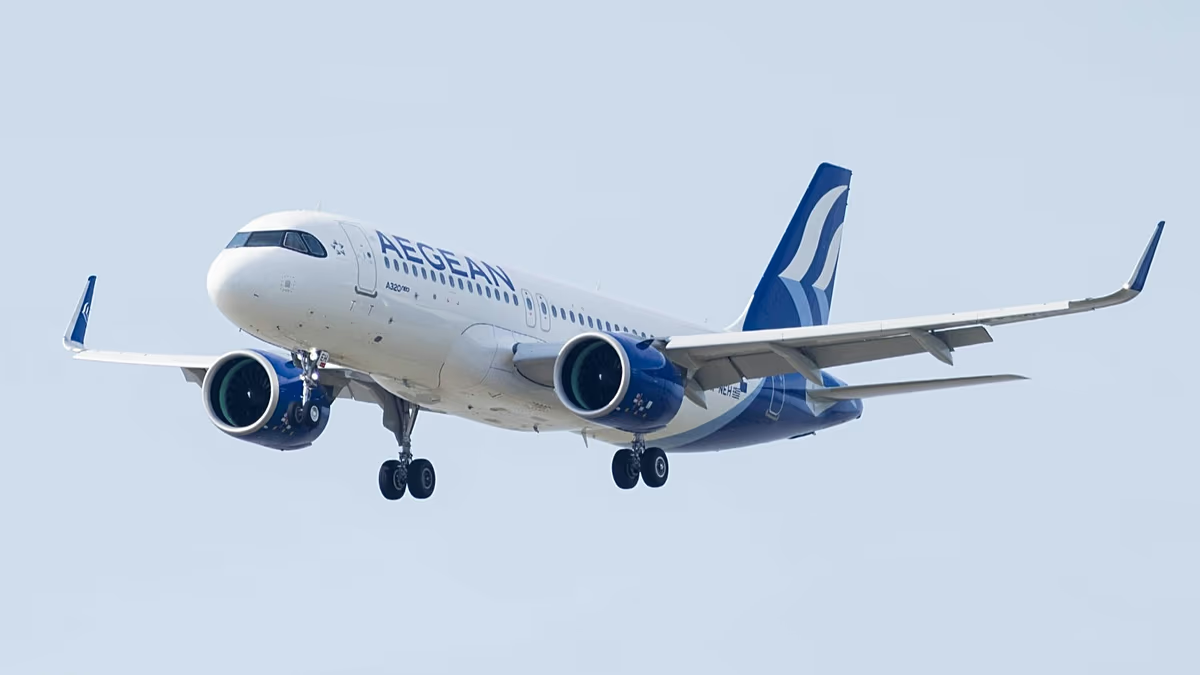
Aegean Airlines, the Greek flag carrier, may not be the biggest name in European aviation, but it earned the top score with an impressive combination of strengths. Aegean scored a perfect 40 out of 40 for its safety record, meaning it had no qualifying accidents in the ten-year period covered by the IATA report. That alone would have put it in good company, but Aegean also scored strongly in other areas: 13 out of 15 for operational safety, 9 out of 10 for fleet, and a perfect 5 out of 5 for financial stability. Its final score of 89 reflected not just a clean record but a well-rounded profile. What’s perhaps more interesting is what happened to other airlines with perfect safety records. British Airways, SAS, and Eurowings all also earned 40 out of 40 in that category, yet none of them made it into the top five. That’s the key takeaway from the methodology: a clean runway record is fantastic, but it’s not everything. An airline can go a decade without a major accident and still fall behind because of weaker scores in pilot training, fleet age, or financial stability. As AirAdvisor put it, a perfect safety record alone “was not enough to reach the top” because the index weighs six factors together. This is a useful reminder that aviation safety is not a single gold star—it’s a series of systems working quietly in the background, from maintenance hangars to flight simulators to balance sheets.
One of the more surprising stories in the report is how well low-cost carriers performed, especially given the common assumption that cheaper tickets mean skimpier safety. Three of the top five airlines in the index were low-cost carriers: Ryanair in second place, Norwegian in fourth, and SunExpress in fifth. Across the full study, low-cost airlines averaged 79.2 out of 100, while mainline carriers averaged 82.8—a gap of just 3.6 points. That’s a much smaller difference than many travellers might expect. Anton Radchenko, the CEO of AirAdvisor, told Euronews Travel that the data simply doesn’t support the idea that a budget ticket means accepting more risk. He pointed out that low-cost and mainline airlines have very similar accident records, and their safety management systems scored the same on average. “In other words,” he said, “the price of a ticket tells you very little about how safe an airline is.” If anything, low-cost carriers actually outperformed mainline airlines on one important metric: fleet age and technical profile. Low-cost carriers scored an average of 7.8 out of 10 in that category, compared to 7.1 for mainline airlines. Wizz Air and Pegasus both scored a perfect 10 out of 10, thanks to their young, modern fleets. Radchenko added, however, that a young fleet is not a safety rating on its own. “An older aircraft that is properly maintained can continue operating safely for decades,” he said. The point is not that new planes are automatically safer, but that fleet renewal can bring technological and efficiency advantages, and it’s just one piece of a much larger puzzle.
For those who love a good ranking, the full list makes for fascinating reading. At the very top, Aegean Airlines led with 89 out of 100. Ryanair followed at 86, and Austrian Airlines rounded out the podium at 85.5. Norwegian took fourth place with 85, and SunExpress came in fifth with 84.5. Then came a three-way tie for sixth place, with Air France, British Airways, and Iberia all scoring 83.5. Just behind them, Turkish Airlines and Lufthansa tied at 83, while KLM earned 82.5 and easyJet landed at 82. In the lower half, Eurowings and SAS both scored 81.5, followed by Wizz Air at 79.5, Transavia at 79, and Vueling at 77. Jet2 scored 73, SWISS managed 72.5, and Pegasus Airlines brought up the rear with 64.5. The range of scores is striking: from Aegean’s 89 down to Pegasus’s 64.5, there’s a gap of nearly 25 points. But even the lowest-scoring airline on this list is still a major European carrier operating under strict regulatory oversight. The index doesn’t say that Pegasus is dangerous, or that any of these airlines should be avoided. It simply shows that when you compare a wide range of operational and financial factors, some airlines present a stronger overall profile than others. That distinction is important, because rankings like this can easily be misinterpreted as a blacklist. In reality, the report is more like a report card with different subjects—some airlines ace the safety record test, others shine on fleet age, and the final grade reflects a blend of all of them.
So what should a traveller actually take away from all of this? For one thing, it’s worth letting go of the idea that paying more for a ticket automatically buys you a safer seat. The data from AirAdvisor shows that low-cost carriers can be just as safe as their legacy counterparts, and sometimes even more so in specific areas like fleet modernisation. It’s also worth remembering that safety is not a single number or a single event. It’s a daily, behind-the-scenes effort involving maintenance engineers, pilots, air traffic controllers, regulators, and financial planners. An airline with a clean accident record but weak financial stability could struggle to invest in training or new aircraft down the road. An airline with an older fleet might still be perfectly safe if its maintenance programme is rigorous. The report’s authors were careful to frame the index as comparative rather than absolute, and that’s exactly the right way to read it. European aviation is among the most tightly regulated and safest in the world, and every airline on this list is subject to continuous scrutiny. No ranking can capture every variable, and no index should be treated as the final word on whether a particular flight will be smooth, delayed, or incident-free. But what the 2026 European Airline Safety Index does offer is a thoughtful, humanising perspective: that safety is complex, that budget airlines deserve more credit than they often get, and that the next time you buckle your seatbelt on a low-cost carrier, you can do so with a little more confidence. The price of your ticket may determine how much legroom you get or whether you’re offered a snack, but it says very little about how well the airline takes care of you where it matters most.