


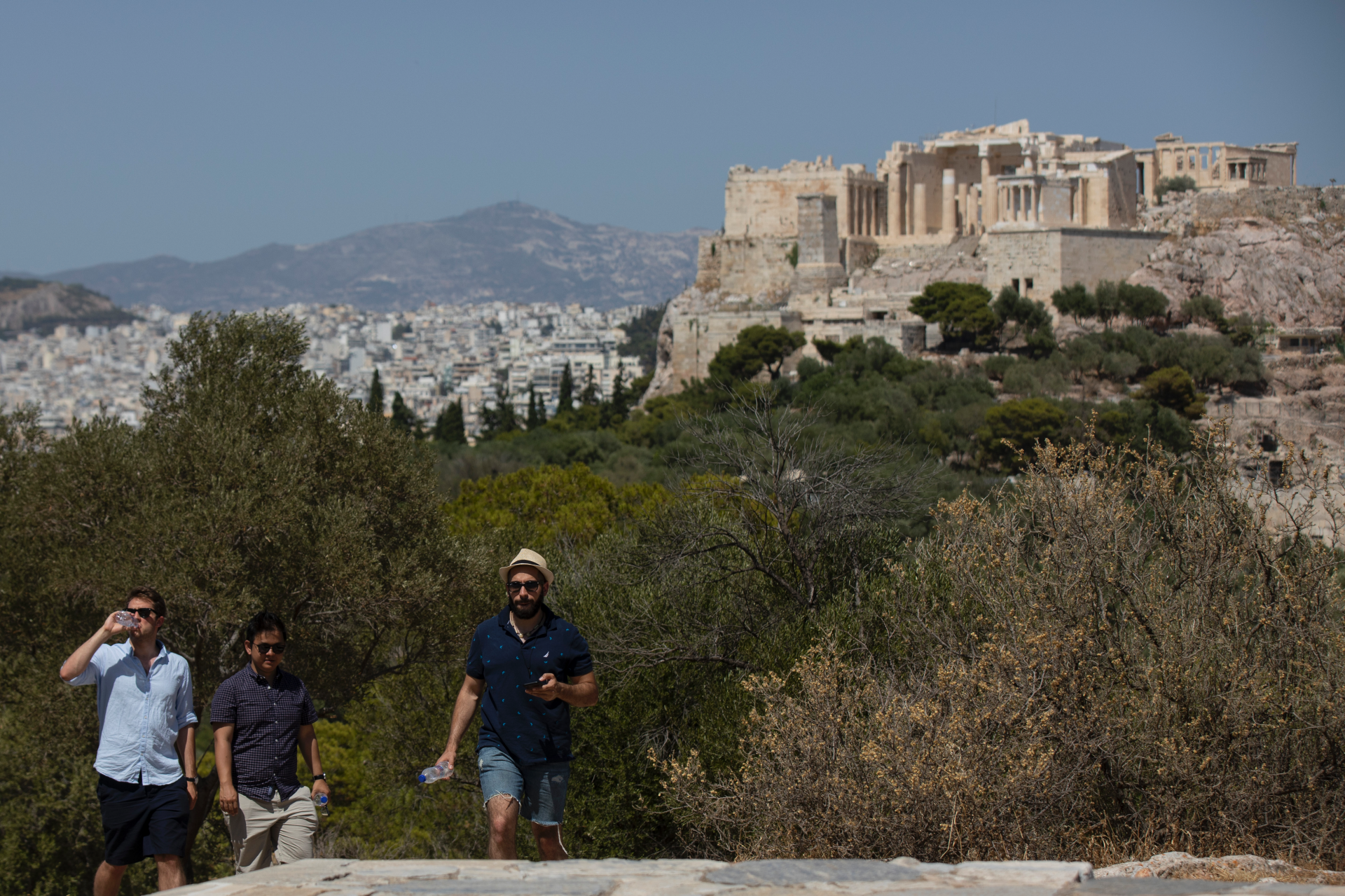
The early morning sun rising over the iconic Athenian skyline usually paints a picture of serene, timeless beauty, casting a soft, golden glow across the ancient marble columns of the Parthenon. For a 53-year-old man and his 48-year-old wife—a Greek-American couple visiting from the United States—this particular Tuesday morning was supposed to be the peaceful, reflective crown jewel of their journey back to their ancestral homeland. Greece was currently locked in the stifling grip of its first major summer heatwave of the season, with midday temperatures forecasted to soar well past a blistering 100 degrees Fahrenheit. Because of these extreme conditions, which had already prompted other international landmarks to slash visiting hours to protect vulnerable tourists, the couple decided to beat the heat by starting their excursion early. They arrived at the historic district shortly after the Acropolis opened its gates for the day at 8:00 a.m., set on enjoying a quiet walk along the scenic pedestrian street that wraps around one of the entrances to the ancient archaeological site and connects to the world-renowned Acropolis Museum. Holding hands and breathing in the crisp morning air, they joined a handful of other early-bird travelers, finding solace in the relative quiet of the stone-paved path before the inevitable rush of midday crowds. They felt entirely safe, wrapped in the protective embrace of a historic neighborhood that has welcomed dreamers, historians, and pilgrims for thousands of years, completely unaware that their quiet morning of cultural connection was about to be violently interrupted.
The tranquility of this historic promenade was shattered in an instant, proving how quickly a dream vacation can morph into a terrifying nightmare. Shortly after 8:00 a.m., a 60-year-old Greek man confronted the unsuspecting couple on the pedestrian pathway, brandishing a large knife with clear, violent intent. According to eyewitnesses and local Greek media reports, the assailant had been acting erratically in the moments leading up to the confrontation, wandering the ancient paths while brandishing his weapon and shouting incoherent threats at anyone who crossed his path. At least one panicked bystander had already attempted to call the police to report the developing danger, but the sheer speed of the unfolding crisis meant there was no time for law enforcement to intervene before the man turned his unprovoked aggression directly toward the Greek-American tourists. Without warning, the assailant lunged at the couple, transforming the peaceful walk into a desperate, chaotic struggle for survival. The physical vulnerability of the tourists was stark; they were caught completely off guard, forced to use their bare hands to ward off the incoming slashes of a razor-sharp blade. The screams of the victims and the shouting of terrified onlookers echoed off the ancient stone walls, permanently carving a memory of raw terror into a space typically reserved for wonder and historical appreciation.
The physical damage inflicted during the brief but brutal encounter was severe, leaving both victims bleeding on the historic walkway and in urgent need of immediate medical intervention. The 53-year-old husband bore the brunt of the assailant’s violent frenzy, suffering a deep, catastrophic laceration to his arm that severed major blood vessels and began bleeding profusely. Recognizing that the rapid blood loss was life-threatening, quick-thinking bystanders and arriving police officers acted with remarkable composure, immediately applying a makeshift tourniquet to his arm to stem the bleeding before professional paramedics could reach the scene. Meanwhile, his 48-year-old wife suffered a localized but painful stab wound to her leg as she tried to defend herself and her husband from the knife-wielding attacker. Within minutes of the emergency calls, the distant wail of sirens grew louder as local ambulance crews navigated the narrow streets surrounding the Acropolis to reach the wounded tourists. Both victims were stabilized at the scene before being rushed to a nearby hospital for emergency treatment; thankfully, medical authorities later confirmed that while the physical and emotional trauma was immense, neither of their injuries was considered life-threatening.
While paramedics worked tirelessly to protect the lives of the injured couple, local law enforcement officers moved swiftly to neutralize the threat and secure the surrounding area. Police officers detained the 60-year-old Greek suspect directly at the scene of the crime, preventing him from escaping into the labyrinth of streets in the Plaka district or carrying out further attacks on unsuspecting visitors. In the immediate aftermath, investigators scrambled to understand what could have driven someone to commit such a heinous act in front of one of the world’s most guarded cultural treasures. Preliminary reports from the Greek police ultimately pointed to a deeply tragic reality: the suspect did not appear to have any political, ideological, or personal motive, but was instead suffering from severe, unaddressed psychological issues. The violent outburst was deemed a random act of aggression fueled by a mental health crisis, showcasing a heartbreaking societal issue that often goes unnoticed until it spills over into public spaces. The suspect was held in custody and scheduled to appear before a public prosecutor on Tuesday to face formal criminal charges, leaving a community to grapple with the complex intersection of mental illness, public safety, and justice.
In a testament to the resilient and often uncompromising nature of global tourism, the gates of the Acropolis and the neighboring museum remained open to the public throughout the day, operating as if the morning’s violence had never occurred. Millions of tourists travel to Athens every year to witness the Parthenon, making the site an indispensable pillar of the Greek economy that cannot easily be paused, even in the wake of a shocking crime. Visitors arriving just hours after the stabbing climbed the historic hill under the scorching midday sun, mostly unaware of the blood that had been spilled near the entrance only hours prior. This juxtaposition of normal tourist commerce against the backdrop of a violent crime scene highlights the surreal bubble that travelers often inhabit, where the pursuit of leisure and historical appreciation continues uninterrupted by the harsh realities of local crises. At the same time, the day’s events unfolded alongside a crippling summer heatwave that had already forced several other landmarks to alter their operating hours, illustrating the multifaceted challenges—both natural and human—that modern tourism must constantly navigate.
For the recovering Greek-American couple, the journey toward physical and psychological healing is bound to be a long and challenging path. The U.S. State Department and the U.S. Embassy in Athens have been actively engaged in confirming the citizenship of the victims and coordinating consular assistance to ensure they receive proper medical care, legal representation, and repatriation support. This harrowing incident serves as a stark reminder of the fragile line between absolute safety and sudden, random peril, even in places that are globally celebrated as sanctuaries of culture. Yet, amidst the horror of the attack, there are powerful glimmers of human empathy and bravery: the quick actions of the bystanders who administered first aid, the rapid response of the Greek police who applied the life-saving tourniquet, and the medical staff working to mend their wounds. As this couple begins the slow process of rebuilding their lives after a vacation turned nightmare, their story remains a testament to the unpredictable nature of our world and the enduring strength of the human spirit to survive and heal.