



In the quiet chill of January 2020, before the world completely fractured under the weight of a global pandemic, Allie Coultas distinctly remembers the moment her husband, Eric, first mentioned a strange, subtle weakness spreading through his hands. It seemed like a minor nuisance at the time—the kind of negligible physical hiccup that an active, athletic thirty-three-year-old might easily brush off as a temporary strain from daily life. However, by the time March arrived and the first COVID-19 lockdowns shuttered doctor offices across the nation, that quiet weakness had transformed into an undeniable, persistent deficit. Forcing themselves to adapt to the new, digitized reality of telehealth, Eric dialed into video calls with healthcare providers, holding up grip-strengthening tools he had purchased in a desperate, self-guided attempt to reclaim his dexterity. Yet, instead of receiving a thorough clinical assessment, Eric’s alarming physical decline was hand-waved away by medical professionals who relied on easy assumptions rather than rigorous investigation; they repeatedly minimized his complaints, telling him that as a young, sleep-deprived new father bound to a sedentary desk job, muscle fatigue was simply par for the course. Trusting the clinical experts, Allie and Eric tried to silence their growing anxiety, but as the weeks bled into months, the dismissive explanations from the medical establishment became harder to swallow. Eric’s hand weakness worsened rapidly, yet despite consulting his primary care doctor multiple times during those chaotic spring months, his concerns were repeatedly sidelined without further diagnostic testing, leaving the young family to navigate an invisible, creeping threat entirely alone as the world locked down around them.
As the summer of 2020 warmed the landscape, the physical disconnect between Eric’s mind and his body became too glaring to ignore, shattering any lingering illusions that this was merely the fatigue of young parenthood. Eric had always lived an active life defined by movement, agility, and a deep, lifelong passion for motorcycling—a hobby that demanded acute balance, rapid reflexes, and steady physical control. Yet, on his beloved bike, things began to go terrifyingly awry; he started losing his footing, misjudging corners, and falling off his motorcycle with a frequency that defied his years of seasoned riding experience. At home, the heartbreak was even more intimate and devastating, transforming ordinary, joyful moments of fatherhood into agonizing reminders of his failing body, as Eric found himself physically struggling to lift up their giggling two-year-old son, Logan. Allie began to notice visible, unsettling signs of muscle wasting, or atrophy, sinking into the contours of his fingers, hollowed-out shoulders, and weakening arms, turning his athletic frame into a landscape of progressive loss. The tipping point arrived when Eric, trying desperately to run and reclaim control over his fading strength through sheer willpower, suffered repetitive, unexplained falls that left him bruised and shaken. By late summer, a deep, pervasive terror had set in, prompting Eric to bypass the restrictive virtual gates of telehealth and present himself directly to an emergency room, where an in-person examiner finally conducted a comprehensive neurological evaluation, immediately identifying alarming changes in his reflexes and motor pathways that had been completely missed through the glowing screens of previous remote consultations.
The devastating culmination of their desperate diagnostic search came in November 2020 when, during his first physical, face-to-face consultation with a specialist, Eric received the life-shattering diagnosis of amyotrophic lateral sclerosis, or ALS—a swift and merciless neurodegenerative disorder often referred to as Lou Gehrig’s disease. At just thirty-three years old, Eric was handed a clinical death sentence characterized by the rapid and irreversible decay of motor neurons in both the brain and spinal cord, a catastrophic process that systematically strips away voluntary muscle movement, speech, and eventually, the ability to breathe. Confronted with a diagnosis that carries no known cure and a grim survival window of just two to five years, Allie and Eric experienced an agonizing, out-of-body numbness, a paralyzing moment where their projected future disintegrated in an instant and left them wondering how this could possibly be their reality. Yet, before despair could fully take root in their hearts, Eric looked at his wife and made a legendary declaration of defiance, stating that with his remaining days of independent mobility, he wanted to embark on an epic, symbolic motorcycle ride to the Grand Canyon and back. It was a journey of absolute love and resilience; as Eric rode his motorcycle into the vast, open American West, feeling the wind against a body he knew was failing him, Allie and their toddler Logan traveled right behind him in a support RV, safeguarding his dream and capturing precious, final memories of freedom that would sustain them through the darker storms ahead.
For young Logan, who was merely a toddler of two when his father’s body first began to fail, the slow, cruel trajectory of ALS has been the ambient background of his entire childhood, making him one of the few children to grow up with a parent surviving far beyond the typical progressive timeline of the disease. Now an intuitive eight-year-old, Logan has watched his father navigate a disease that is statistically relentless, yet Eric’s rare longevity has allowed Allie and Eric to gently, carefully introduce the heartbreaking reality of his condition to their son in gradual, age-appropriate waves over the course of nearly six years. In the early stages of the disease, they explained the physical transformation through simple, gentle analogies, telling Logan that his dad’s muscles were simply very tired, and that the internal electrical wires connecting his brain to his limbs had become broken and disconnected. This gentle framing birthed bittersweet conversations, with a young Logan asking if his father would ever recover, or if the illness was contagious, before offering a deeply moving, intuitive comfort around the age of four when he sweetly whispered to his mother that his dad would run and walk again one day in heaven. Though Eric’s progressive paralysis stripped away his ability to teach his son tactile life skills like riding a classic bicycle or playing catch in the yard, his presence as a father remained fiercely, immovably intact, culminating a year ago in a heart-wrenching moment when Logan, sitting quietly with the profound awareness that only a child of chronic trauma possesses, matter-of-factly stated that ALS would eventually take his father’s life—safely voicing a terrifying truth that his mother had spent years dreading, but one that the boy had quietly synthesized through years of observant love.
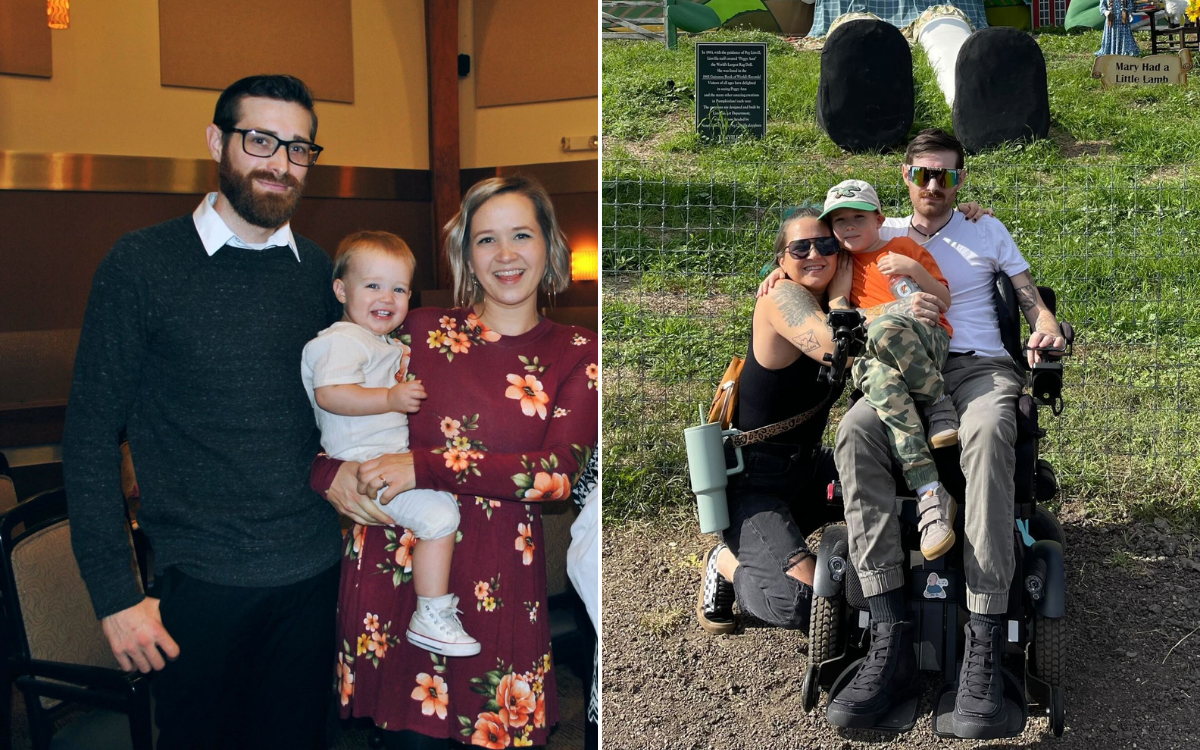
Today, the rhythm of daily life in the Coultas household is structured entirely around Eric’s fluctuating energy reserves, showcasing a profound adaptation to the physical limits imposed by a disease that has gradually confined him to a recliner. Eric, whose creative spirit remains completely untouched by his physical limitations, continues to express his deep inner world as a digital artist, utilizing advanced assistive computer technology that allows him to create striking, evocative artwork without needing the robust physical dexterity he once possessed. Some days are filled with the warm, familiar music of his voice, while other days are marked by a heavy, quiet stillness where speech is too exhausting, requiring Allie to step in with specialized care focused entirely on comfort, dignity, and symptom management. Because effective medical treatments for non-genetic variations of ALS remain tragically scarce on the global stage, their daily existence has become an exercise in radical presence, transforming their home into a sanctuary where clinical realities are balanced by a fierce, daily commitment to finding joy in the smallest pockets of time. Allie fiercely rejects the notion that a terminal diagnosis means the end of a meaningful existence, advocating through her own daily actions that even amidst the physical ruins of a progressive disease, deep connection, absolute laughter, and profound, enduring joy are not only possible but worth fighting for with every ounce of strength they possess.
By sharing the raw, unvarnished journey of their family’s struggle, Allie hopes to transform their private heartbreak into a vital public service, shining a harsh light on the dangerous systemic cracks in medical diagnostics that initially delayed Eric’s treatment. Her ultimate goal is not to instill fear or anxiety in others, but rather to serve as a passionate call to action, empowering individuals to fiercely listen to their own bodily warning signs and relentlessly advocate for themselves within a medical system that can often be dismissive or slow to react. Eric’s long and frustrating road to an ALS diagnosis, characterized by multiple medical professionals who repeatedly brushed aside his severe, life-altering symptoms as mere parental fatigue, serves as a sobering reminder of how easily early intervention can be compromised by clinical complacency. Allie’s voice has become a powerful instrument of awareness, urging patients and their loved ones to trust their intuition over a digital screen, to demand comprehensive, in-person evaluations when something feels fundamentally wrong, and to recognize that behind every clinical statistic is a human life that deserves to be seen, heard, and fought for until the very end.