


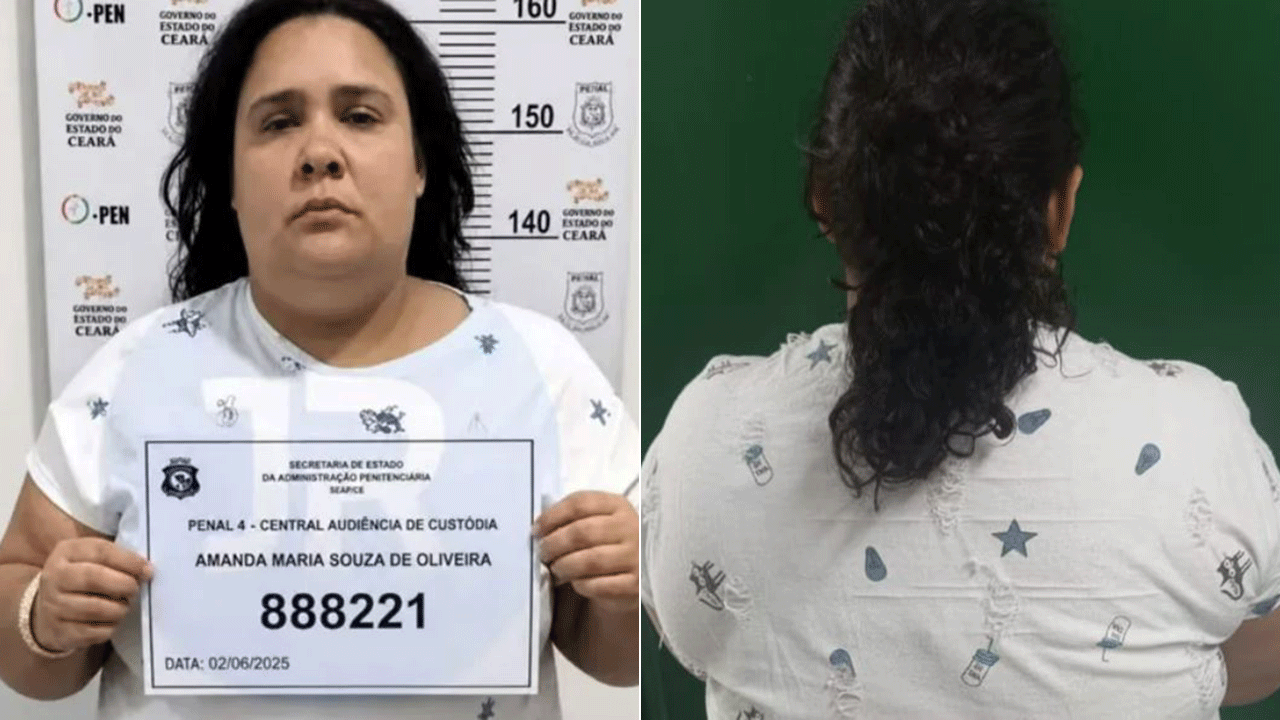
In the hushed, imposing corridors of the Court of Justice of Santa Catarina, Brazil, a verdict was recently handed down that reads less like a standard criminal conviction and more like the closing chapter of a profoundly unsettling psychological thriller. Amanda Maria Souza de Oliveira, a 37-year-old woman who has spent a staggering portion of her life in a state of deliberately induced arrested childhood, was found guilty of fraud and false identity. For fourteen entire months, this adult woman successfully infiltrated a foster family’s home, presenting herself as a vulnerable young girl who had fled a horrific life of abuse. The ruse was so complete, so meticulously executed, that she shared a household, shared meals, and shared an emotional bond with people who genuinely believed they were nurturing a traumatized child, utterly unaware that they were hosting a sophisticated adult impostor within their midst. The court’s ruling on Thursday brought a formal legal conclusion to a case that has captivated and deeply disturbed the nation, casting a harsh spotlight on the fragility of trust, the desperate caverns of the human heart, and the sheer, breathtaking audacity required to maintain such a massive, year-long deception. The judge’s sentence—one year, six months, and ten days in prison, followed by four months and eighteen days of detention—while undeniably real, feels almost anticlimactic when measured against the emotional wreckage left in the wake of her actions. It was not merely a crime of impersonation; it was a profound betrayal of the very instinct to protect, weaponizing the empathy of strangers who thought they were rescuing a soul from the darkness.
The mechanics of the deception are as chilling as they are fascinating, revealing a level of psychological commitment that borders on pathological. Oliveira did not simply claim to be a child; she became one in every observable detail. For years—specifically, an estimated fifteen years—she maintained an elaborate alternate reality, adopting a high-pitched, childlike voice that never faltered, regardless of the stress of the situation. She wove a detailed backstory of fleeing an abusive household, crafting a narrative that naturally tugged at the heartstrings of the foster family, who took her in without question. To explain away the physical inconsistencies that might have otherwise exposed her—the slight lines on a face that had lived through three and a half decades of sun and sorrow, the subtle maturity in her bone structure—she claimed that she had been cruelly forced to take hormones that artificially aged her appearance. This was not a simple one-off con; it was a fully realized, longitudinal performance. She had to remember every detail of her fabricated history, maintain the vocal pitch in her sleep, and control her mannerisms, laughter, and tears to match those of a much younger person. The foster family, who provided her shelter, food, and the emotional support she claimed to need, were not just victims of a lie; they were unwitting actors in a bizarre charade orchestrated by a master manipulator. When the truth finally shattered their reality, the emotional whiplash must have been staggering. The child they had tucked in at night, bandaged scraped knees for, and comforted during nightmares was, in fact, a grown woman who was likely older than some of the parents in their own social circle.
In the aftermath of the revelation, a complex legal and ethical battle has unfolded, foregrounding Oliveira’s defense, which is as controversial as the crime itself. Her lawyer, Lúcio Sousa, has presented a narrative that reframes the entire affair, arguing that his client’s actions were not born of malice, greed, or a desire to harm, but rather from a primal, desperate need to survive. “She admits that she invented an identity,” Sousa stated, emphasizing that this deceptive lifestyle was her only mechanism for coping with a shattered life. “It was the way she found to survive. But she has been a vulnerable person for more than 20 years.” He pointedly noted that Oliveira has lived on the streets, surviving a degree of hardship that most can scarcely imagine, and crucially, that there was no evidence of her obtaining any financial advantage. She did not rob the family, steal their valuables, or seek to exploit them economically. She sought, instead, an entirely different commodity: humanity’s most precious resource—love, care, and familial belonging. Sousa argued that without these elements of financial gain or material theft, the strict legal elements required to fully establish the crime of fraud were not present. This line of defense, however, walks a razor-thin line between legal legitimacy and the moral outrage of a public that sees her actions as a vile mockery of genuine foster children in need. The court, however, saw through the survival narrative to the core violation of the family’s trust, choosing to punish the deception itself, setting a precedent that such a prolonged manipulation of the foster system cannot be excused merely by a tragic backstory, no matter how horrifying that backstory might be.
When given the opportunity to speak, Oliveira did not attempt to justify her actions with grand legal theory or appeals to systemic failure. Instead, her words offered a raw, harrowing glimpse into the fractured psyche at the heart of this case. “Of course, I deceived people, I lied,” she admitted, her voice presumably still carrying that unsettling, practiced childish cadence. “But I didn’t intend to scam anyone.” This distinction is critical to understanding her mindset; she views her actions not as a con, but as a form of emotional time travel, a regression to a developmental stage where she was starved of affection. In a deeply tragic confession, she revealed her primary motivation: “There was a certain void in me, a need to have that kind of care, so I always sought it out.” This statement transforms her from a simple villain into a haunting figure of arrested development. Somewhere along the line, the woman we see today was a real child, likely deprived of the unconditional love and safety that should be the birthright of every human being. When that child reached adulthood, the internal void remained unhealed, and instead of seeking professional psychological help or building healthy adult relationships, she devised a maladaptive fantasy where she could finally receive the maternal or paternal care she craved. She essentially froze her emotional age at the point of her trauma, and then physically forced her body to play catch-up with a lie. Her desire to experience love was so powerful, so all-consuming, that she was willing to sacrifice her entire identity, her legal personhood, and her freedom to a fabricated childhood in the hope of filling that gaping emotional hole with the affection of a family who saw her as a victim, not a patient.
The Oliveira case reverberates far beyond the individual tragedy, exposing deep fissures in the social safety nets designed to protect society’s most vulnerable. Her success in fooling a foster family raises deeply uncomfortable questions about the vulnerabilities inherent in the system. How is it possible that a woman in her late thirties passed through whatever preliminary screenings or observations exist? While the foster family is certainly not to blame for opening their hearts, the case highlights the terrifying ease with which a determined adult can co-opt a system meant for children. It breeds a toxic cynicism, making legitimate foster parents second-guess the authenticity of every child they take in, and making bureaucratic intake processes even more invasive and suspicious. Furthermore, it highlights a societal blind spot regarding psychological trauma in adults. Oliveira’s case is not merely criminal; it is a textbook example of a dissociative or factitious disorder taken to an extreme, where the patient constructs an alternate reality to survive. The community and the courts were quick to label her a criminal, but the actual tragedy is that she likely needed intensive psychiatric intervention decades ago, not a prison sentence now. The foster family, too, becomes a victim of a broader societal failure—they acted with pure intentions and were punished for their kindness. This case forces us to look in the mirror and ask: in a world where an adult can fake being a child to experience love, who is truly responsible for that adult’s descent, and how can a justice system balance punishment with the desperate need for rehabilitation?
As the dust settles on the verdict, Oliveira’s legal team has already vowed to appeal, with Sousa promising to pursue “all appropriate legal measures and appeals before the higher courts” in a poignant statement on Instagram. But beyond the legal maneuvering, the aftermath leaves a trail of profound questions and lingering wounds. What happens now to the foster family? They must navigate the betrayal, the therapy, and the public scrutiny of having been fooled for over a year. What happens to Oliveira in the Brazilian prison system? Will she receive the psychiatric care that she so clearly needs, or will she simply be another forgotten inmate, trapped in a system ill-equipped to handle her unique brand of psychosis? The case defies simple moral categorization. She is simultaneously the perpetrator of a cruel hoax and a casualty of her own tragic history; she is both the woman who lied to a family for 14 months and the eternal child who just wanted someone to tell her they loved her. Her story serves as a dark mirror to our own society, where the need for connection can become so warped that it destroys the very avenue to it. She sought a childhood she never had, but in doing so, she forfeited the adulthood she could have built. As she begins her sentence, one cannot help but feel a profound sense of sorrow—not for the fraud she committed, but for the human being so broken that she had to pretend to be someone else, a younger self, just to feel the warmth of a parent’s embrace. The justice system has spoken, but the psychological cruelty of her existence is a tragedy that no court can ever fully adjudicate.