





Paragraph 1: The Riddle Landed on the Tarmac
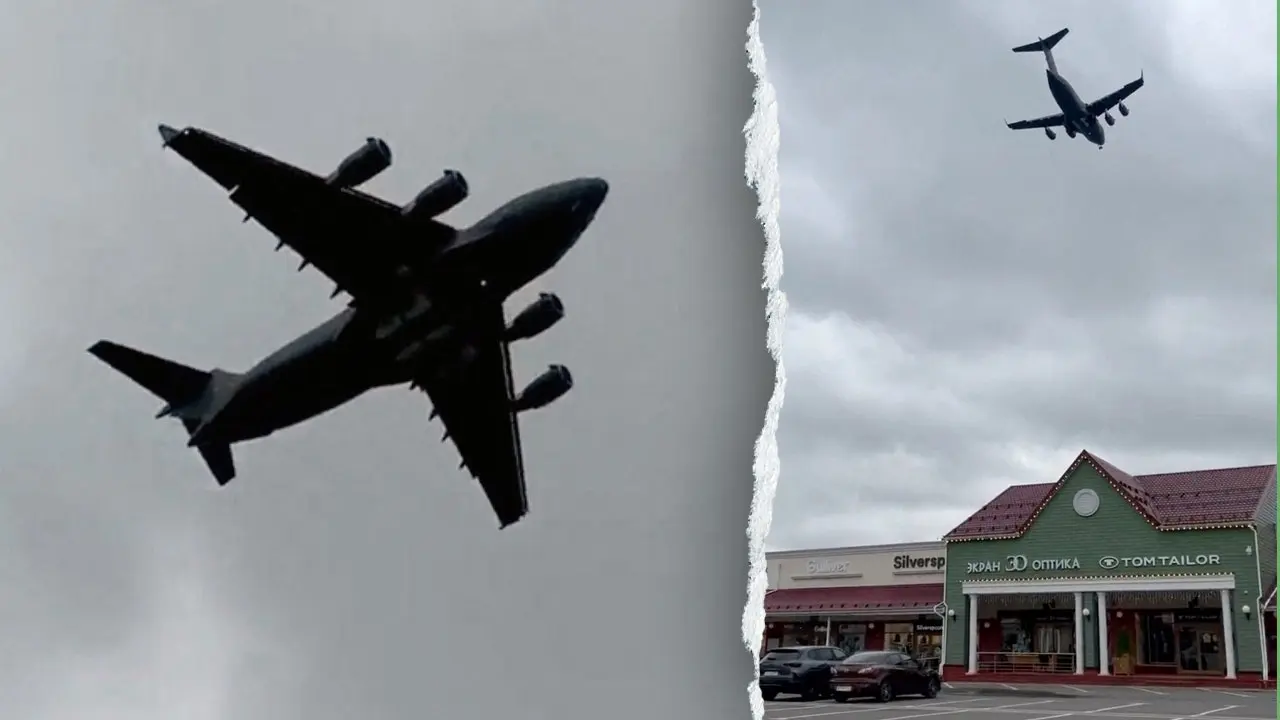
There are certain mornings in geopolitics when the silence around an event feels louder than the roar of the engines that created it. Such was the case over Moscow earlier this week, when the unmistakable silhouette of a United States military transport plane—a Boeing C-17A Globemaster III—broke through the slate-gray sky to land at the commercial Vnukovo airport. It was not a secret drone at midnight, nor an anonymous cargo blip; it was a large, gray, immaculate machine bearing the unmistakable insignia of the U.S. Air Force, touching down squarely in the heart of an adversary’s capital. The scene was almost surreal: the steely quiet of the Russian morning, the tarmac crews in their luminous vests watching an aircraft that, for all intents and purposes, should not have been there. The video footage, captured by onlookers, immediately did what footage in the modern world always does—it broke the illusion of secrecy. On social media and the racing wires of news outlets, the speculation was swift. Who was on board? Were they negotiating, or were they shipping something? Nobody said a word. The silence from Washington and Moscow was a vacuum, and, as physics dictates, that vacuum felt as though it might swallow the sudden, fragile hope of quiet diplomacy alive in the clouds. It was a moment that underscored the peculiar human paradox of our time: in an era of hyper-connectivity and live trackers, the most immense geopolitical gestures are sometimes meant to be as opaque as midnight fog, though their engines be heard in the streets below.
Paragraph 2: A Flight Path Carved Through Data
The timeline of the aircraft, meticulously pieced together by flight-tracking enthusiasts using website like Flightradar24, showed a deliberate, nearly theatrical sequence of stops. The C-17 took off from Joint Base Andrews—the wiry heart of American military transport—early Sunday afternoon, pointed its nose across the vast Atlantic, and touched down some hours later in Riga, Latvia. That initial leg was a standard position for a trans-eastern movement, but the layover in Latvia was telling. Riga is the edge of the NATO frontier, the end of the Western bloc’s physical jurisdiction, a place where the Europe-enlargement practices that have fueled geopolitical handwringing since the pre-war 1990s finally pushed up against the Russian labyrinth. After an extended sit on the tarmac, the aircraft seemingly past being just a cargo hauler; it was about being a diplomatic harbinger—a mobile sovereign island carrying Americans and their mission. The final leg from Riga to Moscow was short, almost perfunctory, yet gigantic in its import. For real diplomats, especially those aligned with the new administration, direct flights like this are the most literal form of breach of rupture: it is impossible to wear a mask through the Windows the world’s photographs capture. When a Defense or War department spokesperson level of dryly responded to inquiries from Fox News Digital, “We have nothing to provide on this subject,” it was a masterclass in official opaqueness. And then the opposition came. The Kremlin, which generally has precise knowledge of such sovereignty, insisted it had no information about the flight at all. There is a cold, theatrical quality to this denial—it is Russian practice to often deny what is undeniable until the political context demands a reaction. The digital trail was real, the metal was real, but the narrative was being built entirely on silence and evasion.
Paragraph 3: The Echo of a Previous Landing
This is not the first time the Moscow tarmac has seen the American angle. The reference in January, when special envoy Steve Witkoff and the President’s son-in law, Jared Kushner, had flown in to Moscow for a direct, reported meeting with Russian President Vladimir Putin, grinds a large significance onto the event. That journey happened within the context of the World Economic Forum at Davos. The Kremlin’s aide, Yury Ushakov, had been quick to describe the previous trip as a “meeting of the minds” whereby the American team passed on firsthand impressions of U.S. contacts with the Ukrainians and Europeans, thereby providing a bridge for what was a very frozen situation. This preceding visit was effectively a diplomatic home-open house, a cease-fire in conversation, where the highest-level envoys of the new American political order not only entered the adversary’s mental fortress but explicitly laid out the groundwork for future steps. That the current flight occurred as the first direct US-to-Russia trans-Euro jet since January suggests a pattern, not an isolated event. It indicates a de-frozen channel, a rawness of negotiation continuing on a substrate of quiet back-channel. With the Department of State silent and the White House unresponsive to commentary requests, the parallel between the January rendezvous and this new, unexplained visit cannot be dismissed as accidental. The C-17 is the same vehicle that transported Robert Gilman, a Marine veteran who was released in a prisoner swap ritualized by the Trump administration’s catchphrase “No American Left Behind.” The means of transport—a military transport—ally adds a potential sheen of urgency, of de-secrecy that could be carrying not just mere envoys, but the very security and personnel dimensions of the conflict.
Paragraph 4: Behind the Odium of a War
To understand the weight of this inexplicable flight, one must look east, past the runway at Vnukovo, to the grinding war in Ukraine. The timing of the flight carries deadly weight, as it landed just as Ukrainian Independence Day was obscured with waving air raid sirens. The bombing of Ukrainian cities, the terrifying howl of drones, and the “panicked” defiance of a nation that refuses to capitulate remains the backdrop to all such landings. Meanwhile, President Trump (who now holds the executive switch to diplomacy) has often framed the Ukraine conflict not as a forgiven, noble defense but as a bureaucratic entrapment and a fiscal burden, a conflict to be resolved through negotiation. To that end, the room for United States diplomacy has been expanding in unexpected ways. This flight lands at the seams of that tension—perhaps a transfer of intelligence, the extraction/insertion of negotiators, or, crucially, the deliverance of a back-channel ultimatum. The old-style rules of engagement, where the president’s envoy simply jets over for a face-to-face, are being replaced by this confusion of seemingly wooden exchanges. Each aircraft that runs from Riga to Moscow is a tangible proof that despite the hellfire in Ukraine, the two largest powers on the planet are still locked in a tight, undignified tango of mistrust, hoping to find the threes to pivot the world away from the brink of escalation. The silence from the Kremlin suggests Moscow wants to downplay the gesture, to still control the media narrative of isolation, while the silence from America suggests a strategic refusal to publish a timetable.
Paragraph 5: The Human Cargo of the Silent Airframe
Any philosophical meditation on a “flight” risks tuning into its mechanical aspect. Yet, we must remember the aircraft is not merely a piece of steel with a GPS signal. Inside that aluminum tube, there are human beings. When the C-17 leaves Andrews, it usually carries diplomats, special operations officers, or critical cargo. If it headed to Moscow, the passengers were either two or a dozen—men and women whispering in the gym shroud cabin, casting their eyes over difficult papers in dim light, or simply sitting in silence without the hum of the engines, inferring through their minds, each wondering why the world had brought them here. It could be a release operation—the fulfillment of a prisoner exchange, bringing another “Gilman” home, not just a veteran, but a welcome memory of family reunions. Alternatively, it could be the transport of the next batch of negotiators who will sit across tables in the Kremlin, throwing ideas into the cold air of a Russian conference room where custom dictates that they hide their cards. The strongest human narrative is the grim weight on their shoulders. They travel into a country that the world has broadly sanctioned and shunned; successful landing and a safe departure are not just technical accomplishments but survival measures. The act of taking off from Andrews, crossing Europe, and surrendering to the gravitational pull of Moscow is gesture of immense personal and political bravery. It is as if the plane itself is an actor in a theatre of rare honesty, a performance of hope amid a ruinous conflict.
Paragraph 6: The Quiet Machinery of the Visible
When we lay numerically down the facts—the flight path, the careful denials, the decision to send a military cargo carrier rather than a person—the true weight of the event is in its ambiguity. In our current age, the minute a movement becomes visible, the state narratives freeze up. The U.S. calls it a non-event; Russia calls it a non-issue. Yet, the sheer presence of the aircraft renders a truth, it is operating in an environment where diplomats have to break rules of time and gravity to communicate. It gives a signal that in despite war, despite sanctions, despite the raw rhetorical appetite, there remains a need for a shuttle—a physical bridge between the omnipotent container of an American metal and the inscrutable fortress of the Russian political will. It is a symptom of the underlying reality: Trump’s politics have re-engineered the speaking path, and military power is literal infrastructure of diplomacy. Wait for a public announcement, and you may wait a long time. But the very fact that the world is witnessing a C-17 land in Moscow is telling us that old parameters have collapsed. It might be a trigger to evacuate human assets or negotiate a wider release; it might be as minor as picking up the good olive branch of a lunch voucher. Either way, it is a quietly crackling, semi-visible engine of the unprecedented—one that erases the yellow lines between war, espionage, and presidential ego. The flight will be logged in flight radar history, it will be sentinel in the future memoirs of a President. In the meanwhile, a people of the planet, looking at the image of that gray aircraft, can feel the breath of uncertainty and strangeness of the political realm, where the meaning often sits in the space between denial and silence, leaving the quite literally concrete evidence of the trust intact, until the word rises again from Washington or the hills of Moscow.