





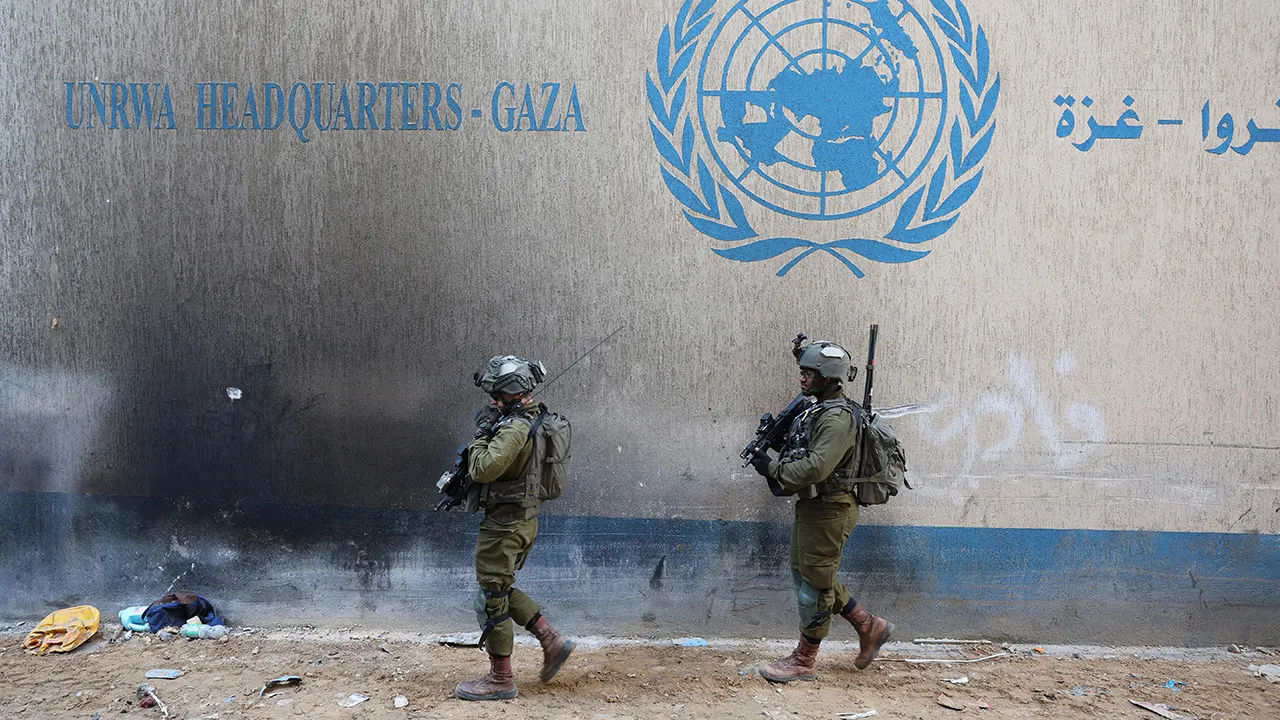
The delicate, highly volatile landscape of humanitarian aid in the Gaza Strip was thrown into further disarray when the United Nations Relief and Works Agency for Palestine Refugees in the Near East (UNRWA) announced the immediate termination of seventy of its staff members. Initiated by the agency’s ad interim Commissioner-General, Christian Saunders, this sudden and sweeping purge represents a desperate attempt to salvage the agency’s deeply battered reputation amidst relentless accusations of Hamas collaboration. For decades, UNRWA has functioned as a literal lifeline for millions of Palestinian refugees, serving as a surrogate state by providing food, education, healthcare, and shelter in one of the most densely populated and war-torn enclaves on earth. However, this massive dismissal highlights a profound and ongoing identity crisis within the organization. While UNRWA leadership insists that these firings do not represent a formal admission of guilt or a confirmation of the long-standing accusations leveled against their personnel, they acknowledge that the action was a necessary, preventative step designed to protect the immediate safety and security of both the refugees they are mandated to serve and the remaining humanitarian workers on the ground. By making this move, the agency is attempting to navigate an impossibly narrow tightrope: satisfying international donors and suspicious neighbor states who hold the purse strings and control access routes, while simultaneously trying to manage the immense local pressures of operating inside a blockaded territory where Hamas has held absolute administrative and military control for nearly two decades. The agency maintains that it has repeatedly implored Israeli authorities to share actionable intelligence and concrete evidence regarding the allegedly compromised staff members, claiming that these requests have consistently met with silence, thereby forcing UNRWA to act pre-emptively without the benefit of formal disciplinary hearings or standard due process. This preemptive measure, therefore, sits on a knife’s edge between a necessary protective action and an administrative sacrifice designed to quiet international critics.
The catalyst for this drastic administrative firing was a damning investigation conducted by the United States Agency for International Development (USAID), which sent shockwaves through the diplomatic and humanitarian communities when its findings were published on June 5. The USAID investigation did not merely paint a picture of passive negligence; instead, it outlined a deeply unsettling reality where the boundaries between civil humanitarian service and active, violent militancy had become thoroughly blurred. According to the report, more than one hundred UNRWA employees were referred for swift suspension or dismissal due to their intricate, active involvement in both the civil administrative apparatus and the lethal military operations of Hamas. The specific details compiled by the investigators are particularly jarring for a global community that funds these schools as sanctuaries of learning, safety, and hope. The investigation revealed that a deputy school principal was simultaneously serving as an al-Qassam deputy company commander within the infantry, while another school principal fulfilled the role of a combat squad leader for the notorious Khan Younis Brigade. Perhaps most horrifying for families who trusted these institutions was the revelation of a classroom teacher who maintained specialized expertise as a sniper for Hamas, along with numerous other educators who allegedly participated directly in the brutal October 7 terrorist attacks. This synthesis of educational leadership and militant command structure has forced a painful re-evaluation of how international relief funds are monitored and distributed, as classrooms intended to cultivate the next generation of doctors, engineers, and peacemakers were apparently being administered by individuals actively planning and executing acts of extreme violence. The psychological trauma for the civilian population, who viewed these UN-flagged compounds as the only safe zones untouched by the horrors of geopolitical conflict, is immeasurable. The realization that their children’s teachers and mentors were leading double lives as armed combatants has shattered the fragile trust that once bound the local community to its primary caretaker.
For the Israeli government and the Israel Defense Forces (IDF), these recent revelations are not a surprise, but rather the tragic validation of warnings they have been shouting to an often-skeptical international community for years. Israeli military intelligence has long argued that UNRWA is not a neutral arbiter of aid, but rather an active, structural extension of Hamas’s governing and military matrix. In the wake of the catastrophic October 7 attacks, the IDF compiled and published extensive evidence detailing how Hamas systematically exploited UNRWA’s vast physical infrastructure—using schools, hospitals, and warehouses as weapon deposits, command bunkers, and entry points for their subterranean tunnel networks. According to intelligence briefings released by the IDF, out of the more than twelve thousand UNRWA employees stationed within the Gaza Strip, roughly twelve percent—equivalent to at least 1,462 individuals—maintain active, documented memberships in Hamas or other designated Palestinian terrorist organizations. This narrative of systemic infiltration is echoed by some civilians inside Gaza, who have whispered to investigators that the agency has effectively become synonymous with Hamas management. In response to UNRWA’s attempts to frame the seventy firings as a protective measure rather than an acknowledgment of systemic guilt, Israel’s Foreign Ministry launched a biting critique across social media platforms, calling the agency’s statement a “cynical cover-up” that attempted to shift blame back onto Israel while conspicuously refusing to even mention the word “Hamas.” The ministry passionately argued that the responsibility to purge violent extremist elements from its ranks lies entirely with the United Nations, accusing UNRWA of willfully harboring terrorists, transforming its civilian facilities into insurgent headquarters, and ultimately operating as a functional arm of a terrorist organization. This fundamental disagreement highlights a deep chasm in perspective: where the international community sees a deeply flawed humanitarian vehicle that is too big and too vital to fail, Israel sees a compromised, hostile entity that actively prolongs the conflict by sheltering the very militants who seek its destruction.
From UNRWA’s perspective, however, the reality of operating a massive social safety net in an active combat zone is far more complex, gray, and devoid of easy moral choices. The agency’s leadership points out a fundamental limitation that critics often overlook: UNRWA is a humanitarian relief organization, not a sovereign nation-state, and it possesses absolutely no police powers, judicial authority, or intelligence-gathering capabilities. In the chaotic, highly pressurized environment of the Gaza Strip, distributing daily rations of flour, clean water, and life-saving medical supplies to millions of starving civilians requires negotiation and interaction with the de facto local authorities who control the streets, which has been Hamas since 2007. UNRWA argues that working within the existing societal framework is a brutal operational necessity; without some level of logistical coordination with local administrators, the entire aid distribution network would instantly collapse, resulting in a humanitarian catastrophe of unimaginable proportions. The agency asserts that it must rely entirely on the cooperation, goodwill, and intelligence-sharing of sovereign Member States—including Israel, which acts as the occupying power and holds absolute control over Gaza’s borders and airspace—to vet its massive workforce and maintain its strict mandate of political neutrality. For the thousands of honest, dedicated UNRWA employees who risk their lives daily under bombardment to feed hungry children, the systemic accusations cast a dark, demoralizing shadow over their genuine humanitarian sacrifices, leaving them caught between the crushing military power of Israel and the authoritarian, armed dominance of Hamas. These field workers, often local residents themselves, face the impossible daily choice of complying with local militant demands to ensure aid truck passage or facing direct physical threats. By failing to recognize this terrifying coercive reality, international critics overlook the sheer human cost borne by those who must operationalize compassion in a land ruled by fear.
This current crisis represents the culmination of a rapidly accelerating series of internal and external investigations that began in the immediate aftermath of the October 7 massacre. In January, when the initial, shocking allegations surfaced regarding UNRWA employees participating directly in the slaughter and kidnapping of Israeli civilians, the agency swiftly terminated twelve staff members in a bid to preserve its international funding, which was frozen by several major Western donors. In the months that followed, the United Nations Office of Internal Oversight Services (OIOS) launched a comprehensive independent probe into nineteen specific employees accused of complicity in the attacks. By April, the preliminary results of this grueling investigation revealed a fragmented picture: while the initial twelve had been terminated, one case was dismissed entirely due to a complete lack of credible evidence, while six other employees remained suspended under active, ongoing investigation. These internal trials have laid bare the extreme difficulty of conducting objective forensic investigations inside an active war zone where physical evidence is buried under rubble, witnesses are displaced or deceased, and communication channels are constantly severed. The slow, legalistic pace of these UN investigations has frequently clashed with the urgent security demands of Israel and the geopolitical patience of Western governments, creating a deeply dysfunctional humanitarian environment where aid delivery is perpetually threatened by bureaucratic gridlock and profound mutual distrust. The ongoing scrutiny has cast a long, paralyzing shadow over the agency’s internal culture, creating an atmosphere of intense paranoia and fear among honest staff members who worry that any administrative oversight or standard contact with local officials could be misconstrued as terrorist collaboration. Consequently, the mechanisms designed to ensure accountability have also contributed to a breakdown in operational confidence and speed. As investigators sift through digital records, encrypted messages, and eyewitness testimonies under the threat of airstrikes, the slow progress of justice serves as a stark reminder of how difficult it is to separate genuine humanitarian action from the deep-seated political animosities of the region.
The geopolitical fallout of this deep-seated institutional rot extends far beyond the borders of Gaza, reaching into the highest halls of power in Washington, D.C., and fundamentally threatening the future structural viability of Palestinian aid. The United States, historically one of UNRWA’s largest financial backers, has taken an increasingly hostile stance toward the agency, with political figures across the spectrum arguing that American taxpayers should no longer subsidize an organization so deeply compromised by hostile actors. The skepticism toward UNRWA is not a novel phenomenon; during the presidency of Donald Trump, the administration actively debated leveling severe, terrorism-related sanctions against the agency, and the current political climate has only hardened this resolve, as exemplified by prominent officials like Secretary of State Marco Rubio, who has openly characterized UNRWA as nothing more than a functional “subsidiary of Hamas.” As the international community grapples with these severe allegations and the subsequent mass firings, the ultimate victims of this political and military tug-of-war remain the millions of innocent Palestinian refugees who rely on UNRWA for their daily survival. The agency’s struggle to cleanse its ranks of militant influence while desperately trying to prevent a wholesale famine in Gaza represents one of the most complex, tragic humanitarian challenges of the modern era, raising the urgent, painful question of how to deliver life-saving aid to the vulnerable without inadvertently fueling the machinery of endless war. Without a viable, internationally trusted alternative to distribute food, run clinics, and manage shelters, the complete dismantling of UNRWA could trigger an unprecedented sociopolitical collapse in the region. Thus, the international community remains locked in a paralyzing debate, searching for a path forward that restores moral integrity and security without abandoning a civilian population that stands on the precipice of total exhaustion and despair. The human cost of failure is too high, yet the moral cost of complacency is equally intolerable.