


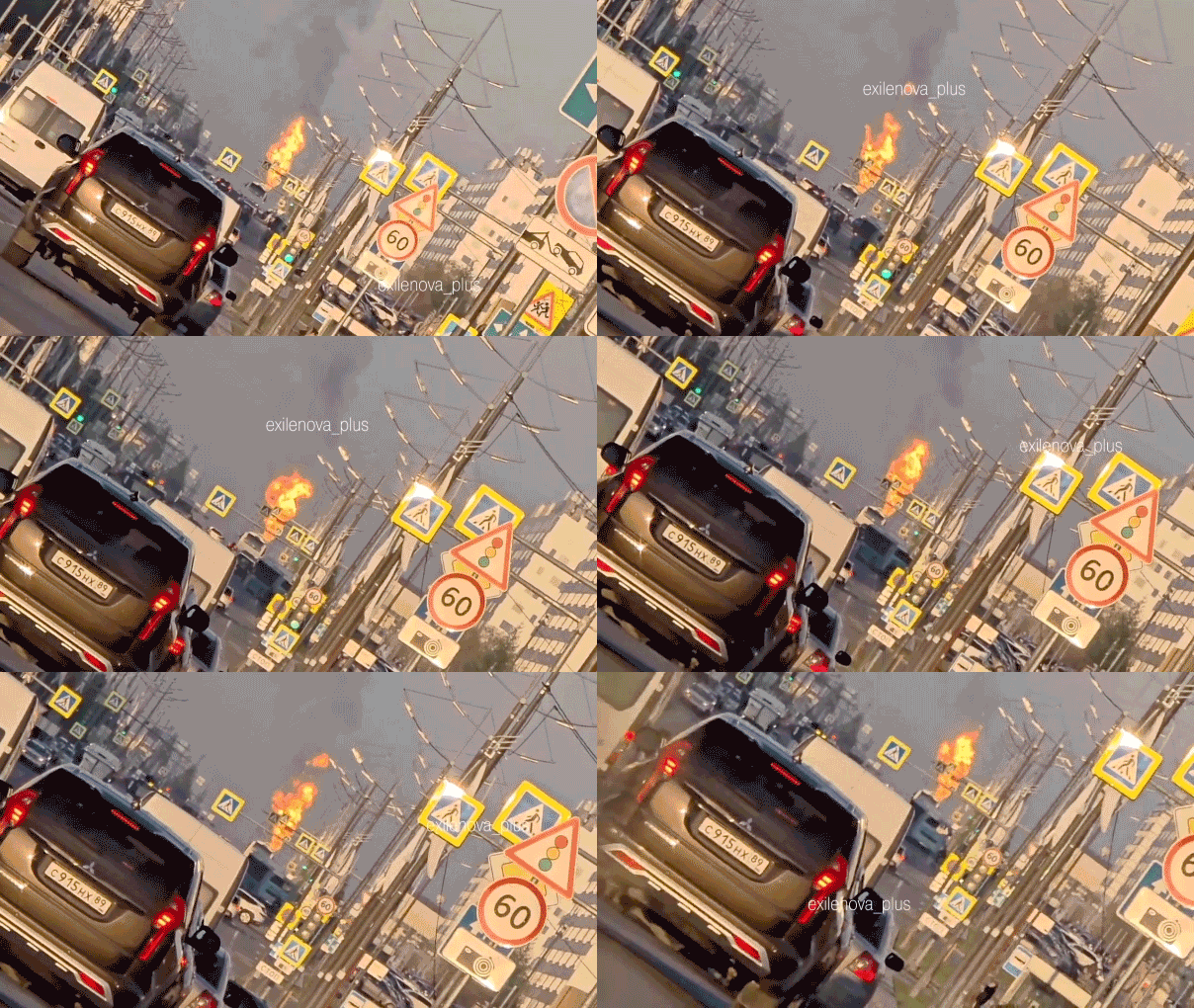
Wednesday began in Novy Urengoy like any other day in Russia’s Arctic north—bitter cold, endless industrial skyline, and the steady rhythm of pipelines carrying the country’s future. Then came the drones. Ukrainian UAVs struck deep into the Yamalo-Nenets Autonomous Okrug, a remote region that produces roughly 80 percent of Russia’s natural gas, igniting a fire at an industrial facility after Russian air defenses knocked the aircraft out of the sky. Regional Governor Dmitry Artyukhov confirmed the attack, saying falling debris started the blaze, but he stopped short of identifying the exact facility or quantifying the damage. The location alone was staggering: Novy Urengoy sits about 1,740 miles from Ukraine’s border, a distance that would require a drone to cross vast stretches of Russian territory, slipping past radar and air defenses designed to make such a journey unthinkable. A Ukrainian defense manufacturer, Fire Point, appeared to claim responsibility with a message dripping in dark humor: “Guess who covered more than 3,300 km and successfully hit the target.” The strike was more than a military operation; it was a statement. For years, Russian officials have assured their public that the war is far away, that the front lines are in Ukraine, that everyday life in Russia’s energy heartland remains untouched. That illusion took a direct hit along with the industrial facility. Artyukhov said there were no reported casualties, which may have limited the political fallout, but the symbolism was impossible to contain. This was the deepest Ukrainian drone strike inside Russia since the full-scale invasion began in February 2022, according to United24, and it landed in a region that fuels Russia’s war machine. Natural gas from Yamal generates enormous revenue for Moscow, and the infrastructure there is both a strategic asset and a national symbol. By reaching that far, Ukraine demonstrated that its drones could threaten the economic foundations of the war effort, not just military targets near the front. The attack also fit a pattern of escalating long-range strikes from both sides, a cycle that has made peace feel more distant even as Washington pushes for a deal.
All of this unfolded against a backdrop of frantic diplomacy. Speaking to reporters at Joint Base Andrews on Wednesday, President Donald Trump said he had just spoken with Russian President Vladimir Putin and described the conversation as “great.” He suggested that both Moscow and Kyiv might be ready to sit down and negotiate. “He is wanting to make a deal,” Trump said. “And if Zelenskyy is wanting to make a deal, that would be very nice.” When asked what was holding up an agreement, Trump pointed not to territory, sanctions, or security guarantees, but to the bitter personal animosity between the two leaders. “These are two people that hate each other,” he said, before adding that they were “two people that are tired of fighting.” The president’s optimism, however, was not reflected on the ground. Over the weekend, U.S. special envoys Steve Witkoff and Jared Kushner traveled to Moscow and Kyiv in an effort to breathe life into stalled negotiations. The Associated Press reported that their talks produced no breakthrough. If anything, the situation grew worse after the American delegation left Ukraine. Russia resumed major missile and drone attacks on Kyiv, killing five people and wounding 35 on Tuesday. The juxtaposition of high-level diplomacy and deadly bombardment captured the strange, brutal rhythm of the conflict: even as envoys shuttle between capitals, the weapons keep firing. Trump’s call with Putin suggested that Washington still believes a deal is possible, but the continued strikes underscored how far apart the two sides remain. Behind the scenes, European and American officials have struggled to calibrate their approach. The result is a strange paradox: while diplomatic channels remain open, both armies are trying to strengthen their bargaining positions through ever more ambitious strikes. Ukraine’s deep drone raids are partly about proving it can hit Russian infrastructure; Russia’s missile barrages are partly about reminding Ukraine of its vulnerability. Diplomacy, for now, seems to be running in parallel with violence, not replacing it.
Among Western officials, there is a growing recognition that talking to Moscow is both necessary and fraught. A European intelligence source told Fox News Digital that the simultaneous diplomacy and military escalation reflects a long-standing dilemma for governments trying to engage the Kremlin. “You have to talk, you have to explain,” the source said, arguing that communication is essential to prevent misunderstandings and unintended escalation. But the source also acknowledged that outreach can easily be misread. “Whenever you talk with them, they consider that this is a Western weakness,” the source said, a conclusion drawn in part from informal contacts with Russian officials. This is the uncomfortable arithmetic of diplomacy with Putin: an offer to negotiate can be seen not as a genuine attempt at peace, but as a sign that the other side is running low on resolve. The source added that Putin’s recent emphasis on Russia’s “military progress in Ukraine” appeared aimed at Washington, a way of projecting strength precisely when U.S. envoys were trying to revive talks. The message, intentional or not, was that Moscow does not need a deal on Western terms. This dynamic helps explain why Russian forces often escalate just as diplomatic efforts reach their peak. For Ukraine, too, the deep strikes into Russian territory are a form of signaling: they tell Moscow and Washington that Kyiv is still capable of inflicting pain, and that any peace agreement will have to account for Ukraine’s ability to defend itself by striking back. In this environment, every missile and drone is not just a weapon; it is a negotiating position. The challenge for Western leaders is to keep channels open without appearing desperate. That balance has proven elusive. Each round of talks has been followed by new attacks, and each new attack has hardened positions on both sides. Yet diplomats keep trying, because the alternative—unrestrained escalation—is too terrible to contemplate. The intelligence source’s assessment suggests that Moscow views every conversation as a test of will, and that it will only come to the table when it believes the costs of continuing are higher than the costs of compromise. So far, that moment has not arrived.
The relentless violence has exacted a devastating price on ordinary people, especially in Ukraine. The United Nations reported last month that Russian attacks killed or wounded more Ukrainian civilians in July than in any month since March 2022, with 437 people killed and more than 2,600 wounded. Those are not just numbers; they are families torn apart, homes reduced to rubble, and lives interrupted in the most brutal way imaginable. Since Russia launched its full-scale invasion in February 2022, the U.N. Human Rights Monitoring Mission in Ukraine has documented more than 16,800 civilian deaths and more than 51,000 wounded. The true toll is likely higher, as many casualties are still being counted and some areas remain too dangerous for investigators to reach. Moscow has repeatedly denied deliberately targeting civilians, insisting that its strikes are aimed at military and military-related infrastructure. But the pattern of attacks on residential neighborhoods, hospitals, schools, and critical infrastructure has made such denials difficult for many in the international community to accept. For Ukrainian civilians, the war has become a daily lottery: a drone can strike a residential building, a missile can hit a train station, a border crossing can become a death trap. The recent attacks on Kyiv and other cities have forced people back into underground shelters, disrupted power and water supplies, and deepened the psychological scars of war. Each new strike brings fresh waves of grief and anger, and the mounting civilian toll has become a central issue in any discussion of how the war should end. The United Nations’ numbers, grim as they are, only capture the moments when violence breaks through. There are also millions of internally displaced people, refugees scattered across Europe, and countless families living under the constant threat of attack. For them, “negotiations” is an abstract concept; what they know is the sound of air-raid sirens and the sight of rescue workers digging through debris. The human cost of this war is not just a statistic in a report—it is the reason why both sides feel so much pressure to keep fighting, and also the reason why ending the war has become so urgent.
Wednesday’s attack was not an isolated escalation. Ukrainian President Volodymyr Zelenskyy said Ukrainian forces had also struck targets around the Black Sea port of Novorossiysk, including a naval base, an oil-loading terminal, military port facilities, and warships capable of carrying cruise missiles. Russian authorities said four people, including a child, were killed and 29 were wounded in that assault. The Novorossiysk operation was another sign of Ukraine’s expanding reach and its determination to target Russia’s military and economic lifelines. At the same time, Russia continued its own long-range campaign. Russian drones struck the Starokozache border crossing between Ukraine and Moldova, killing two civilians and wounding three, according to Reuters. Another wave of attacks on Kyiv killed one person and wounded 14. These simultaneous strikes illustrate how the war has become a cycle of retaliation and counter-retaliation, with each side trying to inflict maximum damage on the other’s infrastructure, military capabilities, and morale. Ukraine’s deep strikes into Russia are partly a response to Russia’s relentless bombardment of Ukrainian cities, and they are also an attempt to change the calculus in any future negotiations. By hitting Novy Urengoy and Novorossiysk, Ukraine is showing that it can threaten the revenue streams that fund Russia’s war effort. Russia, in turn, is showing that it can continue to terrorize Ukrainian cities and border regions, regardless of diplomatic efforts. The result is a brutal equilibrium in which both sides are bleeding, but neither is willing to stop. Artem Zhoga, Putin’s envoy to Russia’s Urals Federal District, said a Ukrainian drone had attempted to strike a fuel-and-energy facility in Yamal, according to Meduza. The precise target remained unclear, but the choice of Novy Urengoy—a city built on natural gas—was unmistakable. About 80 percent of Russia’s natural gas is extracted in the Yamalo-Nenets region, making it a strategic prize as well as a symbol.
For now, there is no end in sight. The war has entered a phase where diplomacy and destruction seem to feed on each other. President Trump may see two exhausted leaders ready to make a deal, but the actions of both governments tell a different story. Ukraine is investing in longer-range drones and striking deeper into Russian territory, while Russia continues to launch massive barrages against Ukrainian cities. The personal hatred between Putin and Zelenskyy, which Trump identified as the main obstacle, is real, but it is only one layer of a conflict built on competing visions, territorial ambitions, and deep mutual mistrust. Every strike hardens the positions of the hawks on both sides, and every failed negotiation makes the next round harder. Yet the human cost of continuing is almost too high to bear. Ukrainian civilians are dying in numbers not seen in years, and Russian soldiers are being sent to a war that has already killed or wounded hundreds of thousands of people. In Novy Urengoy, residents may now look up at the sky with a fear they once thought impossible. In Kyiv, families spend their nights in subway stations. In border villages, people are killed simply for trying to cross a road. These are the realities that negotiators carry into every meeting, and the reasons why the world keeps hoping for a breakthrough even as the bombs keep falling. Perhaps the only certainty is that neither side can claim victory. Russia has failed to topple the Ukrainian government, and Ukraine cannot expel Russian forces from its territory by drones alone. The battlefield has settled into a grinding war of attrition, where gains are measured in villages and losses in thousands of lives. This is why external pressure matters. Washington’s renewed diplomatic push, whatever its flaws, reflects a recognition that the war cannot go on forever. But as the intelligence source noted, Moscow sees talking as a sign of weakness, which means that any eventual peace will likely be preceded by even more violence. The tragedy is that both sides seem to believe that one more strike, one more offensive, one more round of escalation will finally force the other to concede. That logic has already cost tens of thousands of lives, and it continues to shape every decision made in Moscow and Kyiv. In the end, the war will probably end the way it started: with leaders making calculations based on their own survival, their own ambitions, and their own fears. The people caught in between—the gas workers in the Arctic, the civilians in Kyiv, the wounded at border crossings—will have had little say in how it began and little control over how it ends. But they will be the ones who remember it longest, and who must find a way to live with the scars.