


# The Mud-Swallowed Tunnel: A Chronicle of Nepal’s Deadliest Landslide and the Desperate Fight for Survival
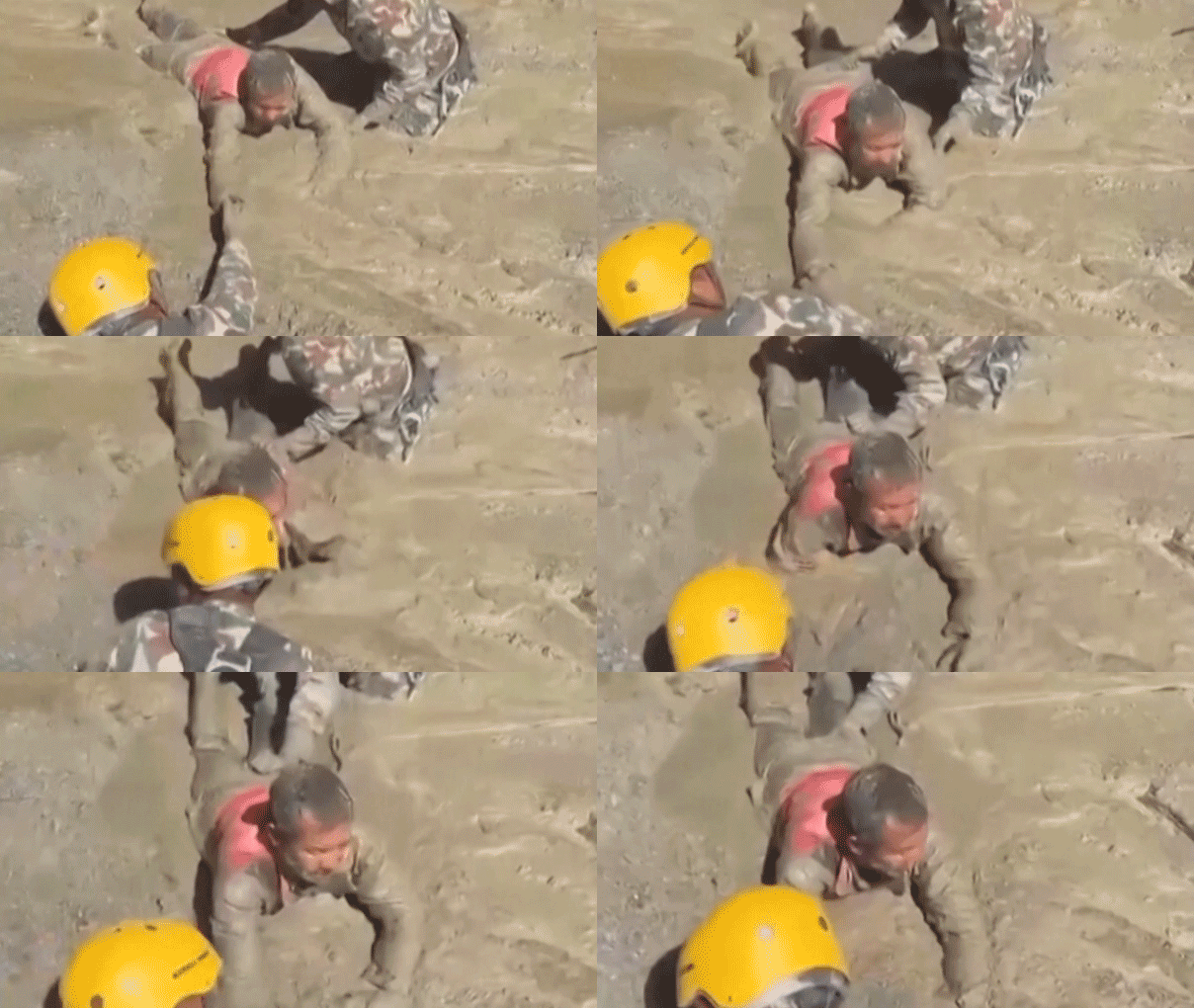
In the rugged, rain-lashed foothills of northern Nepal, a scene of unimaginable desperation unfolded that fateful morning in late August 2026. A catastrophic landslide, triggered by the sudden collapse of a glacial lake, sent a wall of mud, rock, and debris thundering down the steep valleys of the Rasuwa district, obliterating everything in its path. The most harrowing imagery to emerge from the disaster came not from the surface, but from deep within the earth. A stunning, heart-wrenching video released by the Prime Minister’s Office captured the frantic rescue efforts inside a hydropower plant tunnel, where a team of workers had been trapped, entombed in a suffocating slurry of mud and water. The footage showed rescue workers, covered head to toe in thick, grey silt, physically dragging their exhausted and traumatized colleagues out through the narrow, claustrophobic passageway. The tunnel, which minutes earlier had been a place of industrial routine, had suddenly become a coffin of wet earth, and the rescuers were fighting a desperate, exhausting battle against time, gravity, and the crushing weight of the sediment to pull every single soul back into the light.
The numbers emerging from that emergency operation painted a picture of both miraculous heroism and profound loss. According to an official Facebook post from the Prime Minister’s Office, the rescue teams had managed to pull 350 workers to safety from the mud-choked tunnel, a feat of extraordinary endurance given that the passage was saturated with thick debris that made movement almost impossible. However, the operation was far from over, as more than 100 people were still believed to be trapped inside the dark, flooded shafts, their fates hanging in the balance as rescue crews worked with shovels, ropes, and their bare hands. Beyond the confines of the tunnel, the devastation was equally vast. Authorities confirmed that an additional 533 residents had been moved to safety from the flooded and landslides-hit areas surrounding the Trishuli and Bhote Koshi rivers, which had overflowed their banks and inundated entire villages. The disaster had struck the valley with such ferocity that entire communities had been swept away in minutes, and the rescue operation was now a sprawling, multifaceted effort involving military helicopters, ground teams, and volunteers, all united by the grim determination to find survivors amid the wreckage of their former lives.
As the initial shock gave way to a somber accounting, the true scale of the catastrophe began to emerge, revealing a death toll that shook the nation. The Nepal National Disaster Risk Reduction and Management Authority (NDRRMA), in coordination with the Nepal Police, released the most recent estimates, confirming that at least 538 people had lost their lives in the deluge. The list of the missing was even more staggering, with up to 1,924 people unaccounted for on the Nepalese side of the border alone, according to the Associated Press. The disaster did not respect national boundaries, as the same glacial outburst flood swept across the border into the Chinese autonomous region of Tibet, where officials reported five confirmed deaths and an additional 558 people missing in the affected areas, including the town of Gyirong Port. Among the missing were individuals from many nations, including approximately 90 American citizens, according to the U.S. State Department, who were either residents, aid workers, or travelers caught in the path of the rampaging waters. This international dimension transformed the local tragedy into a global humanitarian crisis, forcing diplomatic channels to open in search of answers and aid.
The political and public reaction to the disaster was swift, though often marked by the raw, unfiltered emotion of a leader grappling with an incomprehensible catastrophe. During a press briefing, former President Donald Trump commented on the devastating power of the mudslide, describing it in stark, visceral terms: “That was a brutal… that was mud and water. It’s a mixture that nobody’s seen anything quite like that, where very powerful, strong, well-built buildings were wiped out like they were toothpicks.” His remarks echoed the sentiments of many who witnessed the videos of sturdy concrete structures being snapped and carried away by the relentless torrent. The U.S. State Department confirmed they were working closely with Nepalese authorities to locate the missing Americans, while simultaneously coordinating relief efforts. However, the frenzy of global news coverage meant that the Nepal tragedy was unfortunately interspersed with other catastrophic headlines from around the world, creating a confusing cacophony of crises. Initial reports mistakenly conflated the landslide with a 7.8 magnitude earthquake in the Philippines and a devastating quake in Colombia, leading to a chaotic news cycle where multiple disasters were being reported simultaneously, each demanding urgent attention and resources, though the Nepal situation remained the most dire in terms of sheer volume of missing persons.
Delving into the scientific causes of the disaster, the U.S. Geological Survey (USGS) provided a crucial explanation for the unprecedented scale of the destruction. In a detailed post on their website, they clarified that the catastrophic event was not merely a rain-induced landslide, but a glacial lake outburst flood (GLOF). On Wednesday morning, local time, on the 26th of August 2026, a massive chunk of glacial ice collapsed within the Langtang National Park, Nepal, near the border with China. This collapse sent a colossal wave of water and debris crashing into the Lhende Khola River. The USGS explained that this debris flow and flooding travelled nearly 100 kilometers downstream, impacting highly populated areas along the Trishuli and Bhote Koshi rivers, including Gyirong Port on the Chinese side. Preliminary media reports and satellite imagery analysis indicated that numerous buildings and critical infrastructure had been buried or destroyed. Perhaps most devastatingly, the flood severed the vital highway connecting China and Nepal, a crucial artery for trade and travel, effectively isolating the region and hampering the delivery of emergency supplies. The post underscored that the event was a stark reminder of the growing risks posed by climate change, as retreating glaciers in the Himalayas create unstable lakes that can breach with little warning.
In the aftermath of the mud and the misery, the focus shifted toward recovery and the long, arduous road ahead. The rescue workers, having pulled hundreds from the mud, faced the grim task of searching for the thousands still missing, their hopes dimming with each passing hour as the debris hardened into a concrete-like tomb. Fox News Digital reached out to the Nepalese Foreign Ministry and the U.S. State Department for further comment on the ongoing recovery operations, but both agencies remained focused on the immediate humanitarian response. The international community pledged aid, with various nations offering search-and-rescue teams, medical supplies, and financial assistance. Yet, the emotional scars of the disaster will be permanent. Survivors who emerged from the tunnel, covered in silt, spoke of the darkness and the suffocating silence, only broken by the desperate cries of their trapped colleagues. The image of the mud-saturated tunnel in Rasuwa will forever be etched in the nation’s memory, a symbol of both the ferocious unpredictability of nature and the indomitable spirit of human resilience. As the search continues for the 1,924 missing, the world watches with bated breath, hoping for more miracles but preparing for the somber reality of a tragedy that has redefined the meaning of a natural disaster in the high Himalayas. The rebuilding will take years, but the memories of that morning—the roaring water, the sinking buildings, and the heroes who descended into the earth to save their fellow citizens—will last a lifetime.