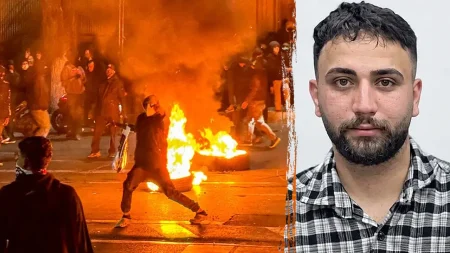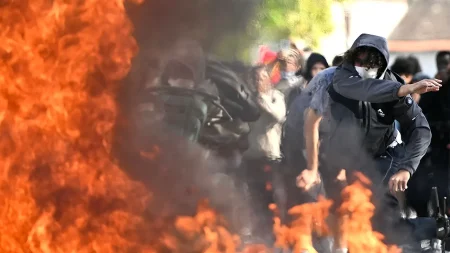




Brussels became the stage for another raw display of public frustration on Friday, as thousands of demonstrators filled the city’s streets to confront the Belgian government’s austerity agenda and the mounting pressure of everyday living costs. The demonstration was simultaneously deeply political and profoundly personal: people marched not just behind union banners, but with the weight of unpaid bills, soaring prices, and a feeling that the institutions meant to protect ordinary citizens were no longer listening. The scene in the Belgian capital was tense from the start. At the central railway station, dozens of protesters—many of them young, dressed in black, their faces hidden behind masks—broke away from the main crowd and turned destructive. They hurled rocks and firecrackers at police officers, igniting scattered fires ether in uncertain protest. One photograph from the day captured a man lighting an electric scooter ablaze, a surreal and worrying image of urban anger finding expression in flames. Riot police responded quickly, deploying tear gas canisters and shooting water cannons into the crowds until they scattered. The violence disrupted the wider city, leaving traffic snarled across Brussels and reinforcing an image of chaos. Yet what made the day even more complicated was thatolice said the people behind the unrest were not part of the anti-austerity demonstration itself. The peaceful protesters, union members, workers, students, families—these were the people who had come to be heard. The fringe group that turned violent, police explained, was unaffiliated with the larger movement, a separate current of rage surfacing beside an otherwise largely peaceful demonstration.
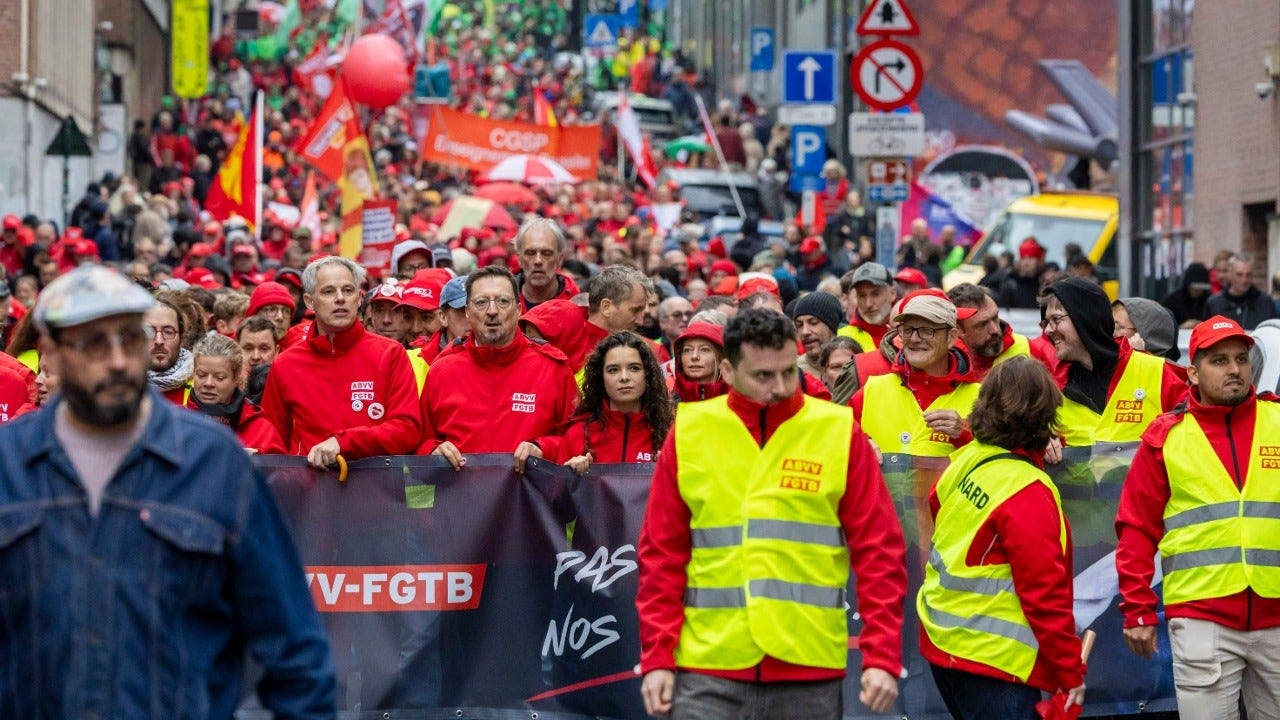
The violent clashes were only one layer of a complex day. The main anti-austerity demonstration, organized by two of Belgium’s largest labor unions, drew an estimated 30,000 participants—a powerfully sizable crowd by any measure. These were not rioters but citizens gathered to express a deep, growing anxiety about the direction of their country. The unions had called for a nationwide strike that lasted through the day, and a separate public-sector walkout was already planned for Monday, signaling thatthe labor movement expected the fight over austerity to continue beyond the streets. Union leaders were quick toccept distance themselves from the chaotic scenes, insisting thatthe broken windows, fires, and clashes did not represent their movement. They emphasized that those responsible were not affiliated with labor organizations, a distinction that mattered deeply to them. While the masked figures in black dominated news coverage, the vast majority of marchers dressed in red or green, walked peacefully through the city streets, chanting, carrying signs, and demanding thatthey be seen not as radicals, but as ordinary people trying to hold their lives together. It was a visual and symbolic contrast: the red and green of union solidarity versus the black-clad figures of rupture; the discipline of a demonstration versus the chaos of a riot; the plea for public support versus the scream of destruction.
At the center of the peaceful crowd was Marie Gobert, a single mother and social worker who had traveled toBrussels from Namur to take part in the march. Her profession alone spoke volumes: she spent her days trying to help others, supporting vulnerable people through difficult circumstances, yet she herself was struggling to keep her own household afloat. “I cannot make ends meet,” she told reporters, in a simple, devastating summary of life in a country whereeveryday costs keep climbing. For Gobert, the crisis was not an abstract policy debate. She spoke candidly about the concrete things worrying her most: the rising price of schools, public transport, and train tickets. These were not luxuries or indulgences; they were the building blocks of ordinary life, and each one was becoming harder to afford. When she looked around her country, she did not see prosperity or stability. She saw tension and anger beginning to simmer everywhere. Her words carried a broader warning, one that governments often find easier to ignore than to confront: “You can feel the social tension, you can feel anger starting to simmer everywhere.” She went further, expressing a heartbreaking frustration shared by many in Belgium’s streets: “The education system is being dismantled, and when young people want to speak out, no one listens to them.” For someone whose job is rooted in social solidarity, the disintegration of public institutions was not an ideological talking point but a lived trauma—something felt in overcrowded classrooms, in unaffordable transit, in youth who feel voiceless and despairing.
Education, in fact, was one of the most explosive undercurrents in the recent unrest. This summer, the government overseeing Belgium’s French-speaking community raised standard university tuition by roughly43% for the current academic year, moving it from €835 to €1,194. That single decision, presented as part of a broader austerity program, landed like a shockwave among students and families. For many young people, higher education had already been a financial stretch; this increase threatened to put university out of reach entirely. Students took to the streets in Brussels in June, clashing with police over the tuition hike and a broader set of grievances with the French-language education system. They spoke of overcrowded classrooms, where learning conditions had become almost untenable; of teachers stretched too thin to give students the attention they needed; of study materials so difficult to access thatthe promise of public education felt like it was quietly being revoked. The anger did not fade with the summer. Earlier this week, hundreds of students gathered in the eastern Belgian city of Liège, and local media reported that107 students were arrested. The image of more than a hundred young people being taken away by police did nothing tocool Germany? no Belgium; it hardened a growing narrative among students that authority was unwilling to listen and eager to punish. Austerity, they argued, was not just a matter of budget lines; it was a reordering of opportunities, with the heaviest costs falling on people who were already trying to climb.
This is the deeper human story behind the smoke and tear gas in Brussels. It is a story that extends far beyond one Belgian city or one political dispute. Across Europe and around the world, governments are wrestling with difficult budget choices, inflationary pressures, anda residue of anger left by years of economic instability. In Belgium, the persistent rise in the cost of living has collided with government efforts to tighten spending, and ordinary people have ended up caught in between. They are asked to accept cuts, to absorb price increases, to trust that austerity now will lead to stability later. But the words of demonstrators like Marie Gobert reveal a more skeptical mood: why should they bear the burden of adjustments they did not cause? Why should young people accept an education system thatfeels dismantled, transport that feels unaffordable, and jobs that feel precarious? The violence carried out by the masked few was easy to condemn, and union leaders were right to distance themselves from it. Yet dismissing all the anger would be a mistake. The flames that consumed an electric scooter in front of a train station were unacceptable, but they symbolized something that cannot be ignored: a combustible mixture of economic insecurity, political distrust, and generational despair. When people feel that no one is listening to them, they eventually stop speaking politely. Some sink into silence; others turn to the streets. A small number may turn to destruction. The challenge for Belgium’s leaders is not simply to restore order, but to address the disorder beneath the surface.
As the weekend approached, the mood in Brussels remained heavy. The main demonstration was over, but a public-sector walkout loomed on Monday, and the smell of tear gas still hung in some streets. No one expected the underlying tensions to evaporate. Labor unions, student groups, social workers, transit users, single mothers—all were waiting to see whether the government would adjust course, offer concessions, or simply dig in. The weeks ahead could bring more dialogue or more confrontation. What was clear was thatthe old assumption thatausterity could be imposed smoothly, without lasting social cost, had been shattered. In the heart of Europe, in a city that housed the institutions of the European Union, protesters were making a poignant plea: they wanted their country to work for ordinary people again. They wanted schools they could afford, trains they could ride, classrooms where their children could learn, and government that actually listened. Whether Belgian leaders would hear that plea, whether they would engage with the simmering anger instead of merely suppressing its symptoms, remained an open question. What was certain was thatthe people who marched, the workers who struck, the students who risked arrest, and even the masked provocateurs who set fires, had all succeeded in making the Belgian capital a place where a nation’s anxieties could no longer be ignored. The story of that Friday was not just about violence or public order. It was about a country trying to define what kind of society it wanted to be—and about the difficult truth thatwhen people feel unheard, the streets will always speak for them.