



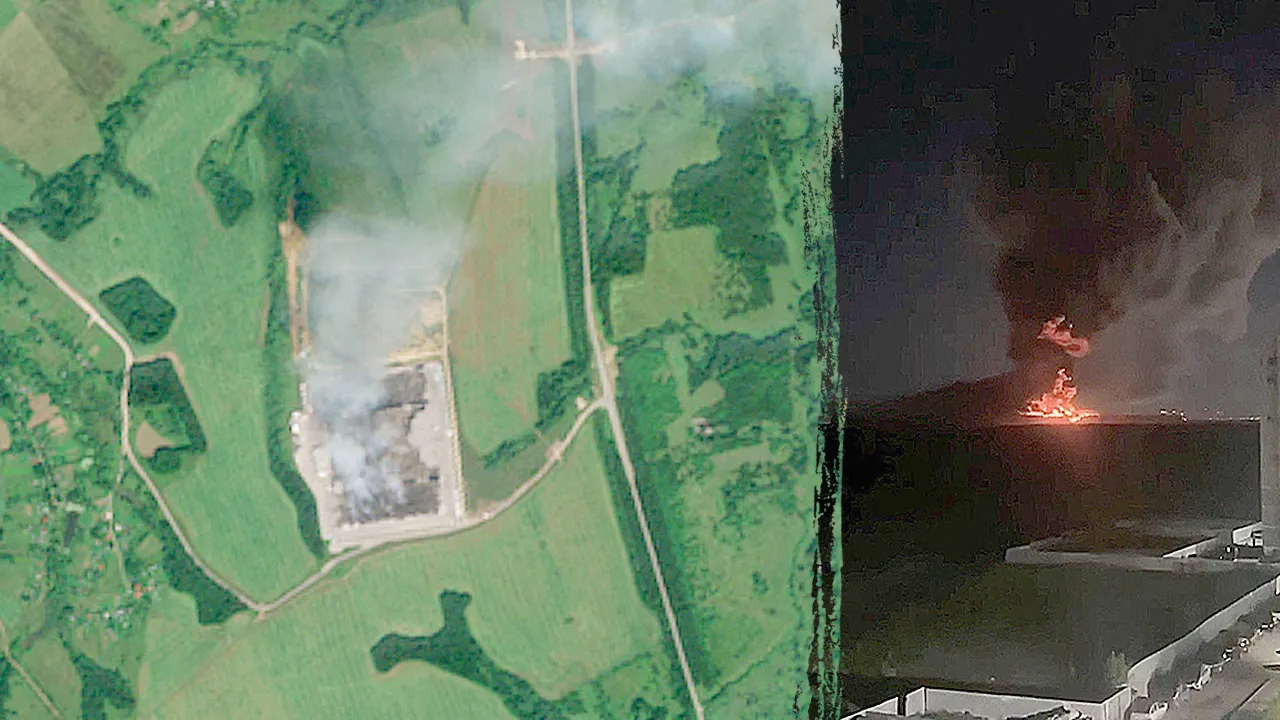
For months, the war in Ukraine has been something many Russians could try to keep at a distance, but the rhythm of daily life no longer allows that. On Thursday, far from the front lines, a Ukrainian drone struck an oil and petrochemical complex in Bashkortostan, and the blow ignited a fire at a Wildberries facility, the online retail giant often called “Russia’s Amazon.” Wildberries said the warehouse had been successfully evacuated and no goods were inside at the time of the strike, but the scene was still a vivid reminder that the conflict refuses to stay in the abstract. This was not a dramatic battlefield charge or a missile exchange somewhere on a distant flank. It was a bolt from above landing in the middle of a sprawling network that millions of ordinary people rely on for clothes, electronics, household goods, and the basic contours of everyday consumer life. For Russians, Wildberries is not merely a corporate giant; it is an integral slice of the modern shopping routine, a symbol of how much business sense collapsed after the Soviet era. To see a fire blackening part of that indispensable machine was also to see some of the last illusions about “special operations” safely away from home dissolve into smoke.
This specific strike was the latest in a frightening sequence directed at Wildberries facilities across the country, and it marks a new and uncomfortable kind of warfare. It began on July 18, when drones hit the giant fulfillment centers in the towns of Kotovsk and Elektrostal, reportedly killing seven people and injuring more than 60. That was followed four days later by attacks in Krasnodar and Nevinnomyssk, where fires broke out and 15 people were injured. These are not palaces or military headquarters. They are wholesale warehouses packed with boxes, delivery trucks, scanners, and workers rushing through shift after shift. Each attack tears into a piece of everyday Russian life as much as it gums up the supply chain. The economic consequences are staggering. Ukrainian media Pravda estimated total losses to Wildberries and its sellers at 600 billion to 800 billion rubles, or around $6 billion to $8.5 billion. Kateryna Bondar, a senior fellow at the Wadhwani AI Center within the Center for Strategic and International Studies, framed these operations not merely as military strikes but as “kinetic sanctions enforcement,” or an extension of economic coercion into physical reality. The broader goal, she says, is to steadily raise the cost of maintaining a war economy for Russia, making every decision about logistics risk, insurance, and investment, perhaps even loyalty, more expensive.
But the numbers and strategic calculations only serve to tell the story; the human dimension is what makes this grip. Only 5 to 7 percent of sellers on Wildberries have insured their goods, Bondar said. In other words, a tiny portion of the small online merchants whose entire livelihood depends on the platform has any safety net. When a strike puts a warehouse out of operation, they do not just suffer bad publicity. They are suddenly staring at dozens of product containers gone forever, unpaid salaries, canceled orders, or late deliveries, while trying to manage the void of safety. Bondar warns that with roughly 27 percent of the giant’s warehouse capacity reportedly now out of operation, the damage is cascading across tens of thousands of small businesses, causing the entire logistics sector to face the classic “wartime risk” dilemma in an economy not built for war. She also points to a psychological effect that is maybe even more powerful than the financial blow. Listening to videos recorded by witnesses, she says, she hears fear, shock, anger, and, perhaps most telling, disappointment in the Russian air defense system. It is the sense of betrayal by the enormous war machine that ordinary citizens are told will keep them safe. If big and protected facilities cannot be protected, what does that mean for the rest of them?
Wildberries’ founder and CEO, Tatyana Kim, has answered with fury. In a July 31 video address, she described the strikes as a “terrorist attack” and asked, “Why our warehouses, of all places? Attacks against us are attacks against hundreds of millions of people in ten countries at once.” Her point was not merely about damage; it was about a global network of partners. She said entrepreneurs in Russia and partner countries, including China and Kazakhstan, have suffered billions in losses. Kim argued that Wildberries cannot be held responsible for covering all the losses, and expect the merchants to bear the financial burden. Bondar warns that this may push many sellers to rethink how they do business at all. When the confidence in your platform is broken and the hard indicators show a serious amount of the warehouse no longer exists, a merchant may want to diversify away, shorten inventory cycles, demand prepayment from buyers, and increase insurance to survive. There is a new living reality of placing a price tag on risk. Even if you manage to sell something in the Russian market behind a storefront, you have to account for the fact that the very infrastructure upon which it lives can be turned into a battlefield overnight.
The Ukrainian strategy is not simply to hurt a single company, but to push the war into a realm where business can no longer ignore it. Bondar suggests that Kyiv’s leadership views these warehouses not as innocent consumer properties, but as distribution nodes for dual-use goods, including body armor, helmets, fiber optic cables for FPV drones, and navigation components. They also see the platform as one of the channels by which sanctioned goods and materials have been able to flow around to support Russia’s war effort. There is also a sense of reciprocity—or perhaps retaliation—given Russia’s continual attacks on Ukraine’s civilian logistics infrastructure, including the Nova Poshta and Ukrposhta postal and delivery networks. To Moscow, the strike may be a necessary counterstroke by a weaker enemy. To Ukraine, it is justified punishment: you have made civilians fair game in my country, so I may bring the same rules to yours. Kim, meanwhile, is in a grim position. As Russia’s richest woman, with a fortune estimated at about $7 billion, she was once powerful enough to assume that a business network like hers would operate above the fray. But the current events expose the edge of karma. Unless she is entirely in the hands of the Kremlin than it appeared, and unless her luck laces through the toughest hidden layers of privilege, the state has shown itself remarkably quiet while her warehouses burn. Bondar put it simply: “Kim matters to the Kremlin less as an individual than as an asset already absorbed into its clan system. The current strikes expose the limits of her political protection.” There is no compensation, no special guard, no air-defense system to protect the warehouse; all Kim has received was a tax deferral. The message to the rest of the Russian business elite is unmistakable: proximity to the top no longer safe, and private businesses are expected to absorb the costs of war.
This is a strange new world for workers and warehouse managers as well. Wildberries has introduced a controversial policy restricting workers’ cellphone use, official justified as an air-defense measure. But Bondar sees it as a struggle for control of the ledger. For a few weeks, workers were filming the attacks and sharing them online, and the raw footage made the destruction and the war’s impact on ordinary Russians impossible to hide. It is one thing to have drones silenced into the country; it is another thing to see how many people on the ground in a faithless shop were in a moment of war and showed that no matter how smooth the air-conditioning that keeps commerce flowing, there is suddenly no longer safe. The phone ban, Bondar argues, also creates a safety risk: if workers do not have devices when the next attack comes, they have no way to call for help. But the real fear seems to be blurred. Wildberries cannot harden its massive warehouses or build its own missile defense, so it holds the one thing it can control: what gets recorded. In a war where images are often as important as territory, making the battle invisible to the people at home is to claim victory against part of the enemy. But you can’t unsee what is already out there, and the fear is now woven into the floor of every process as the nation stares at the sky.
The strike Thursday in Bashkortostan was the latest long line of signs that the boundaries between front and home have twisted. If you were a Wildberries be a consumer, it is quite possible that a package you were expecting is missing, late, or will never show up. If you are a merchant and you are reading this high, your goods and savings may have been destroyed in those fires. If you are a warehouse worker, you step into a glossy, organized, utilitarian space that can be a greeting place at any moment. What was once a merely eccentric realization—Ukrainian drones can strike far beyond the frontline—has now been embedded in the everyday lives of millions of Russians as e-commerce itself becomes the target. Wildberries has survived, of course, because it has to. But the confidence that products, jobs, and the steady routines of a stable economy would remain outside the reach of this war is gone. The new equilibrium is not a pause but a mixture: work and violence, commerce and conflict, resilience and fear all mixed together in one unexpected modern tragedy. As Bondar argues, that was the intention all along: to make each attack so dangerous that the nation’s ministry of war becomes inextricable from the consumer’s shattered order. The Kremlin may talk about the special military operation, but to the families who lost loved ones, the small merchants thrown into ruin, the security guards who died, and the child who wanted an easy package from the online shop, it is simply an expensive, permanent storm that no platform or payment plan can make whole. The only prayer is that someone, in the ruins of all this economics and strategy, will decide that the cost is too high or vice versa.