


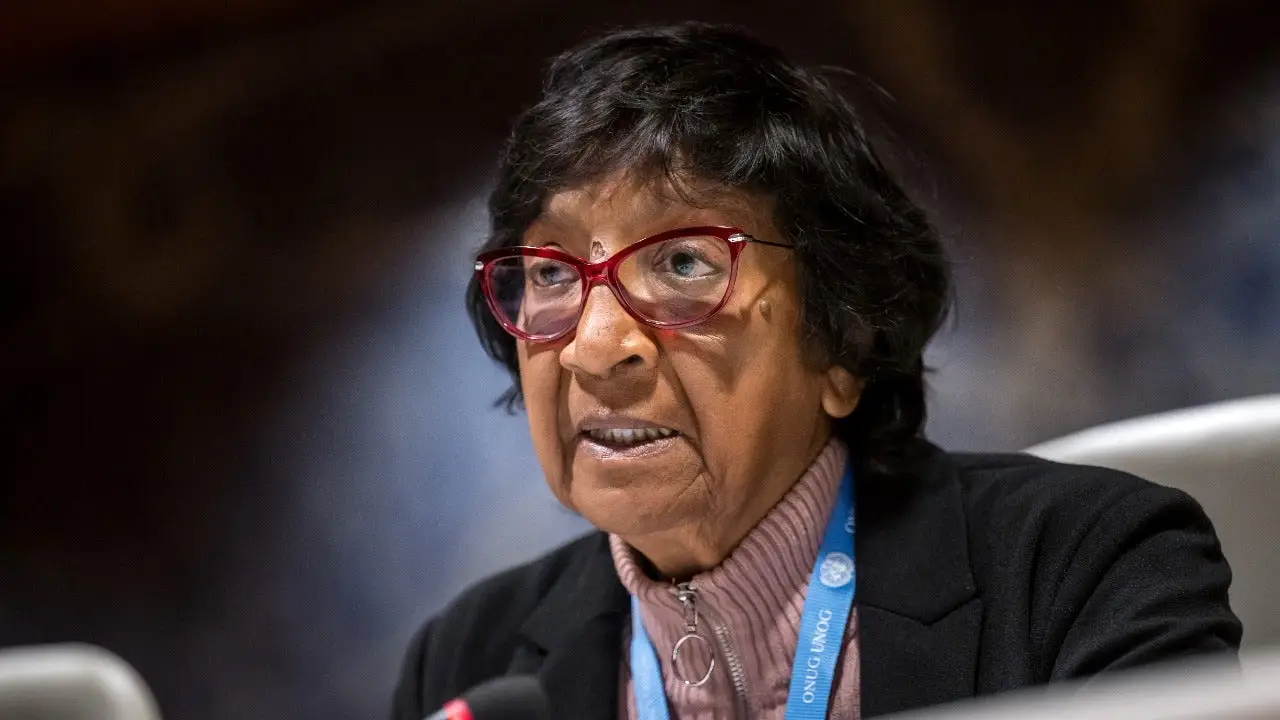
She was eighty-five years old when the world’s most prestigious peace prize finally found her, and yet Navanethem “Navi” Pillay did not seem like someone who had been waiting for recognition. For more than half a century, she had been moving through the rooms where justice is supposed to live — courtrooms, tribunals, commissions, and the quiet corridors of international law — often as the first woman, the first non-white person, the first voice from the margins to speak with authority. On Friday, the Norwegian Nobel Committee announced that Pillay had been awarded the Nobel Peace Prize for “her efforts to promote peace and international law,” an acknowledgment that felt both overdue and deeply timely. The committee’s citation was careful and deliberate, grounding the award not merely in one woman’s biography but in a broader argument: that strong international judicial institutions must be able to enforce the rule of law if there is any hope of mediating the growing number of wars and conflicts across the globe. It also noted, with a note of quiet alarm, that political attacks against judges and against international law itself are becoming more commonplace. In other words, the prize was as much a defense of the fragile architecture of global justice as it was an honor for Pillay. And in a world where courts are increasingly accused of overreach or dismissed as instruments of powerful nations, the choice of Pillay was a statement: that the law, however imperfect, remains one of humanity’s best shields against atrocity.
Pillay’s most recent and most controversial role came as chair of the UN Independent International Commission of Inquiry on the Occupied Palestinian Territory, established in 2021 after an eruption of tensions between Israelis and Palestinians. In September 2025, nearly two years after the Hamas-led attacks of October 7, the commission issued a devastating conclusion: that Israel had committed genocide against Palestinians in Gaza, and that Prime Minister Benjamin Netanyahu and then-Defense Minister Yoav Gallant had specifically incited genocide. “It is clear that there is an intent to destroy the Palestinians in Gaza through acts that meet the criteria set forth in the Genocide Convention,” Pillay said after the report’s release. The findings were immediately rejected by Israel as “distorted and false,” and they ignited a firestorm of criticism from supporters of Israel who saw the commission as biased and politically motivated. Nitsana Darshan-Leitner, president of the Israel-based Shurat HaDin Law Center, which has led protest campaigns against Pillay in Geneva, cast doubt on the Nobel Committee’s decision. “A peace prize should honor those who build peace, not those accused of turning Israel into a defendant in a campaign of political delegitimization,” she said. “What peace, exactly, has she brought? The Middle East remains engulfed in conflict, and the region is nowhere near the peace this prize supposedly celebrates.” It was a sharp reminder that Pillay’s career has never been uncontroversial; she has always been willing to name what she sees as injustice, even when that means standing against powerful governments and their allies.
Long before Gaza, long before the Nobel, Pillay was a child of apartheid. She was born in South Africa’s Natal province to a Tamil Indian family, growing up in a world where the color of her skin dictated where she could live, study, and work. In 1967, she founded her own law firm, becoming the first non-white person to do so in her province — a quiet act of defiance in a legal system designed to enforce racial hierarchy. For the next twenty-eight years, she worked as a defense attorney representing anti-apartheid activists, using the law to chip away at the legal architecture of white supremacy. In 1973, she won a landmark case securing political prisoners on Robben Island, including Nelson Mandela, the right to consult with lawyers. It was a victory that mattered not just in courtrooms but in the damp, cold cells where Mandela and others had been held for years, cut off from the outside world. When apartheid finally fell and Mandela became president, he did not forget her. In 1995, he nominated her to the High Court of South Africa, making her the first non-white woman to serve on that bench. Her tenure there was brief, because the United Nations called her to a different kind of duty that same year: she was elected to serve on the International Criminal Tribunal for Rwanda, a body created to hold accountable those responsible for the genocide that had torn the small African nation apart just a year earlier. It was a brutal education in the depths of human cruelty, and Pillay was thrust into the middle of it.
At the Rwanda tribunal, Pillay helped shape some of the most important legal precedents in the history of international criminal justice. She was integral to the case against Jean-Paul Akayesu, the mayor of the Rwandan town of Taba, who was found guilty of inciting fellow Hutus to murder, rape, and torture thousands of Tutsis. The ruling was historic not only because Akayesu was convicted, but because the court declared that rape constituted a crime against humanity and could amount to genocide when committed with the intent to destroy a targeted group. For centuries, sexual violence had been treated as an inevitable byproduct of war, a private crime, or simply a trophy taken by victors. Pillay’s work in Rwanda helped change that legal reality forever. “Rape had always been regarded as one of the spoils of war,” she said after the verdict. “Now it is a war crime, no longer a trophy.” Those words carried the weight of her own moral clarity, and they resonated far beyond the courtroom in Arusha. They gave survivors a language of justice, and they gave prosecutors a tool to hold perpetrators accountable. It was not abstract law; it was law that recognized the particular suffering of women and girls, and it was law that refused to look away from the sexual violence that so often accompanies genocide. Pillay’s own background as a woman who had fought against apartheid and who had seen how oppression works on the ground gave her a unique perspective, and she used it to ensure that the tribunal did not forget the gendered dimensions of atrocity.
In 2003, Pillay became a judge on the International Criminal Court, an institution that has frequently been attacked by President Donald Trump and other critics as illegitimate, biased, or powerless. She served there for five years before becoming the UN’s High Commissioner for Human Rights in 2008. In that role, she was often outspoken, sometimes inconvenient, and always unflinching. During the 2014 Gaza War, she condemned both Israel and Hamas for their conduct, saying both sides likely violated international law. She also made a pointed comment that angered many in Washington and Jerusalem: she criticized the United States for providing funding to Israel’s Iron Dome missile defense system, saying that “no such protection has been provided to Gazans against the shelling.” It was a stark moral comparison, and it highlighted the asymmetry of protection and vulnerability that has defined so many conflicts in the Middle East. Pillay’s critics saw her comments as evidence of anti-Israel bias; her supporters saw them as the words of someone willing to speak truth to power, no matter whose feelings were hurt. What cannot be denied is her consistency. She has never confined her criticism to one side. She has condemned Hamas for firing rockets at civilians, and she has condemned Israel for military operations that she believes violate international law. She has challenged the United States, Israel, Burma, and many others. She has not built her career on being comfortable, and she has certainly not built it on being liked. Her notion of peace has never been the absence of conflict; it has been the presence of accountability.
Today, Pillay continues her work as an ad hoc judge on the International Court of Justice, where she is hearing a case accusing Burma of committing genocide against the Rohingya, a predominantly Muslim minority in the Southeast Asian country. The case is ongoing, and it is yet another example of her lifelong commitment to using the law as a tool for the oppressed. At eighty-five, she shows no signs of slowing down, no willingness to retire into quiet obscurity. The Nobel Peace Prize, whatever its critics may say, is a recognition of a career that has been dedicated to the proposition that law can be a force for good in a world that often seems dominated by violence and vengeance. It is also a challenge to the rest of us: to defend the institutions that hold war criminals accountable, to resist the erosion of legal norms, and to remember that peace is not just the absence of bombs but the presence of justice. Pillay’s life has been a testament to that idea, from the dusty courtrooms of apartheid South Africa to the marble halls of the International Criminal Court, from the hills of Rwanda to the refugee camps of Gaza. She has not always been right, and she has certainly not always been popular, but she has always been on the side of the law — and, she would argue, on the side of the voiceless. In awarding her the peace prize, the Nobel Committee has chosen to honor not just a woman, but an ideal: that even in the darkest times, justice can be more than a dream. It can be a verdict. It can be a sentence. It can be a life.