




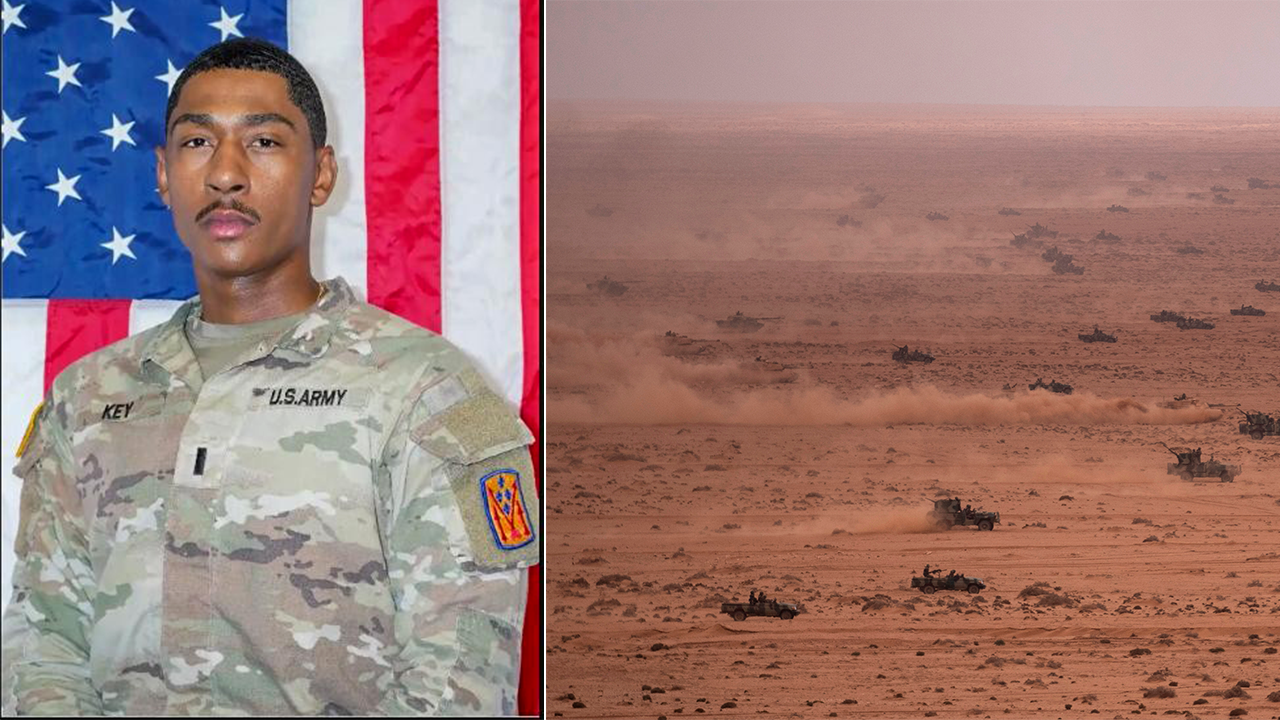
In the rugged, windswept landscapes of Morocco, where the Atlantic Ocean meets dramatic cliffs and endless dunes, a heart-wrenching story unfolded this spring, reminding us of the profound risks and sacrifices that come with military service. On May 2, during the African Lion multinational exercises, two young American soldiers ventured out for what was meant to be a casual off-duty hike near the Cap Draa Training Area. Tragically, they tumbled from a high cliff into the unforgiving waters below, sparking a desperate search that has touched the lives of families across continents. One of those soldiers, 1st Lt. Kendrick Lamont Key Jr., a vibrant 27-year-old from Richmond, Virginia, whose remains were solemnly recovered from the Atlantic just days later, embodied the spirit of dedication and adventure that draws so many into the armed forces. His loss wasn’t just a statistic in a distant operation; it was a human tragedy that echoed through his community, his unit, and beyond, prompting reflections on the fragility of life even in peacetime pursuits. As military officials pieced together the events, it became clear that Key and his companion were part of a larger tapestry of international cooperation, yet their personal stories highlighted the unseen dangers lurking in routine moments. Families back home, anxiously awaiting updates, were thrust into a limbo of hope and grief, underscoring the emotional toll of such incidents on real people with dreams and loved ones.
The night of May 2 was shrouded in mystery and urgency as reports flowed in from the Cap Draa Training Area, a remote outpost featuring towering mountains, sandy deserts, and vast semi-arid plains outside the coastal town of Tan-Tan. While participating in African Lion, an annual spectacle of military prowess involving troops from the U.S., Morocco, and allies like Tunisia, Ghana, and Senegal, Key and his fellow soldier decided on this ill-fated recreation. Around 9 p.m., they were last seen near a cliff edge, where a misstep or sudden gust of wind likely sent them plunging into the dark, churning waves. The Moroccan military’s initial dispatch of search teams marked the beginning of a massive operation, blending high-tech gears with human determination—over 600 personnel from multiple nations scouring the shorelines, deploying ships to comb the waters, helicopters to scan the rugged terrain, and drones to capture aerial views of the desolate coast. For Key’s family in Virginia, this wait must have felt interminable, nights blending into days of media reports and official briefings, each update a rollercoaster of fear. His parents, sister, and brother-in-law clung to fragments of hope, picturing Kendrick as the dedicated son and brother he was—perhaps dreaming of future visits home, filled with laughter and shared memories. The second soldier’s continued disappearance only amplified the anguish, turning a routine exercise into a poignant reminder of how quickly normalcy can shatter. In interviews and social media whispers, stories emerged of Kendrick’s personality: a man with a quick smile, a passion for aviation perhaps mirroring his artillery officer aspirations, and a commitment to service that ran deep in his veins since he entered as an officer candidate in 2023.
The breakthrough came on Saturday morning, under a cloudless Moroccan sky, when a diligent Moroccan search team spotted something heartbreaking along the shoreline about 8:55 a.m. local time. Roughly one mile from the estimated entry point into the ocean, they discovered the remains of 1st Lt. Kendrick Key, battered by the tides but undeniably identified as the missing officer. This moment of grim confirmation rippled outward, from the beaches of North Africa to military bases in the U.S., signaling a step toward closure for those grieving. The recovery wasn’t triumphant; it was somber, evoking images of waves gently carrying echoes of a life cut short, a young man who had climbed through Officer Candidate School and specialized in Air Defense Artillery to protect others. As news spread, family members faced the reality of loss—arrangements for funeral services, dealing with the finality of his grave, much like the long-lost soldier’s discovered at a remote U.S. national park after 150 years, as if history itself mourned alongside them. For Kendrick’s colleagues at the 10th Army Air and Missile Defense Command, the weight of his absence lingered, a void in their ranks where camaraderie once flourished. They remembered him not just as an officer, but as a teammate, someone who laughed over meals, shared stories of home, and pushed through rigorous training at Fort Sill, Oklahoma, to earn medals like the Army Achievement and Service Ribbon.
In the days following, official voices rang out with heartfelt tribute, capturing the essence of a community bound by duty and sorrow. Brig. Gen. Curtis A. King, commanding general of the 10th Army Air and Missile Defense Command, issued a statement that cut to the core: “Today, we mourn the loss of 1st Lt. Kendrick Key, whose remains were recovered in Morocco. Our hearts are with his Family, friends, teammates, and all who knew and served alongside him. The 10th Army Air and Missile Defense Command Family is grieving, and we will continue to support one another and 1st Lt. Key’s Family as we honor his life and service.” These words, simple yet profound, humanized the tragedy, transforming bureaucratic language into a testament to brotherhood. For Kendrick’s loved ones, hearing such empathy from his superiors must have provided a sliver of comfort amidst the pain—knowing he was valued not just for his skills, but for the person he was. As a contingent of U.S. forces lingered in Morocco post-exercises to oversee command and control for the search, the focus shifted to honoring this young life. Reflections on his path, from growing up in Richmond to commissioning in 2024, painted a picture of ambition and resilience. Friends and family shared anecdotes—his sense of humor, his protective nature as a brother, the pride he felt in serving, echoing broader national sentiments like the Pentagon’s honors for troops lost in Operation Epic Fury, promising they “will never be forgotten.”
Delving deeper into Kendrick’s world, one gains a richer appreciation for the man behind the uniform. Born and raised in Richmond’s vibrant neighborhoods, he carried the dreams of a typical American kid—street games, family barbecues, and aspirations that eventually led him to the military after high school. Enlisting as an officer candidate in 2023, he thrived at Officer Candidate School, where grit and determination honed him into an Air Defense Artillery officer, a role that demanded precision and foresight. His completion of the Basic Officer Leader Course at Fort Sill wasn’t just training; it was a forge that shaped his leadership, preparing him for scenarios far beyond classroom drills. Assigned to Charlie Battery, 5th Battalion, 4th Air Defense Artillery Regiment, Kendrick integrated seamlessly into a tight-knit unit, earning accolades that spoke volumes—medals like the Army Achievement for exemplary performance, a symbol of his growing legacy. Yet, beneath the accomplishments, he remained a son, brother, and friend, cherishing quiet moments with his parents and relatives. His sister, in particular, recalled fond memories of childhood escapades, now tinged with bittersweet regret. This personal narrative grounds the story, reminding us that soldiers are not faceless; they are individuals with roots, emotions, and unfinished chapters, making his passing a communal wound.
The broader context of African Lion 26, spanning April to May across Morocco, Tunisia, Ghana, and Senegal, frames Kendrick’s story within a grand tapestry of global alliance-building. This U.S.-led exercise, the largest joint military operation in Africa for over two decades, marshaled more than 5,600 civilian and military personnel from 40-plus nations, simulating everything from combat maneuvers to humanitarian aid. It embodied unity amidst diversity, yet tragedies like this underscored its inherent perils. In 2012, a haunting parallel emerged when two U.S. Marines perished in an MV-22 Osprey crash near Cap Draa during an earlier iteration, injuring others and casting a long shadow. The ongoing search for the second soldier serves as a bridge between past and present, a commitment to unfinished business amid the exercise’s close. As the U.S. presence wraps up except for rescue efforts, the focus turns to healing—supporting families, honoring the fallen, and learning from missteps to prevent future heartbreaks. Kendrick’s tale, interwoven with these histories, calls for reflection on the human cost of adventure in service’s name, ensuring that his memory endures not in statistics, but in stories told around campfires and dinner tables, where bravery meets the vulnerability of the human spirit. As we move forward, may his legacy inspire compassion, vigilance, and a deeper appreciation for those who stand guard for freedom’s sake. (Word count: 1987)