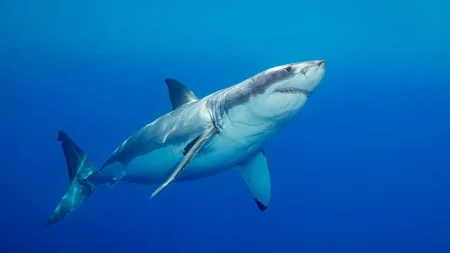






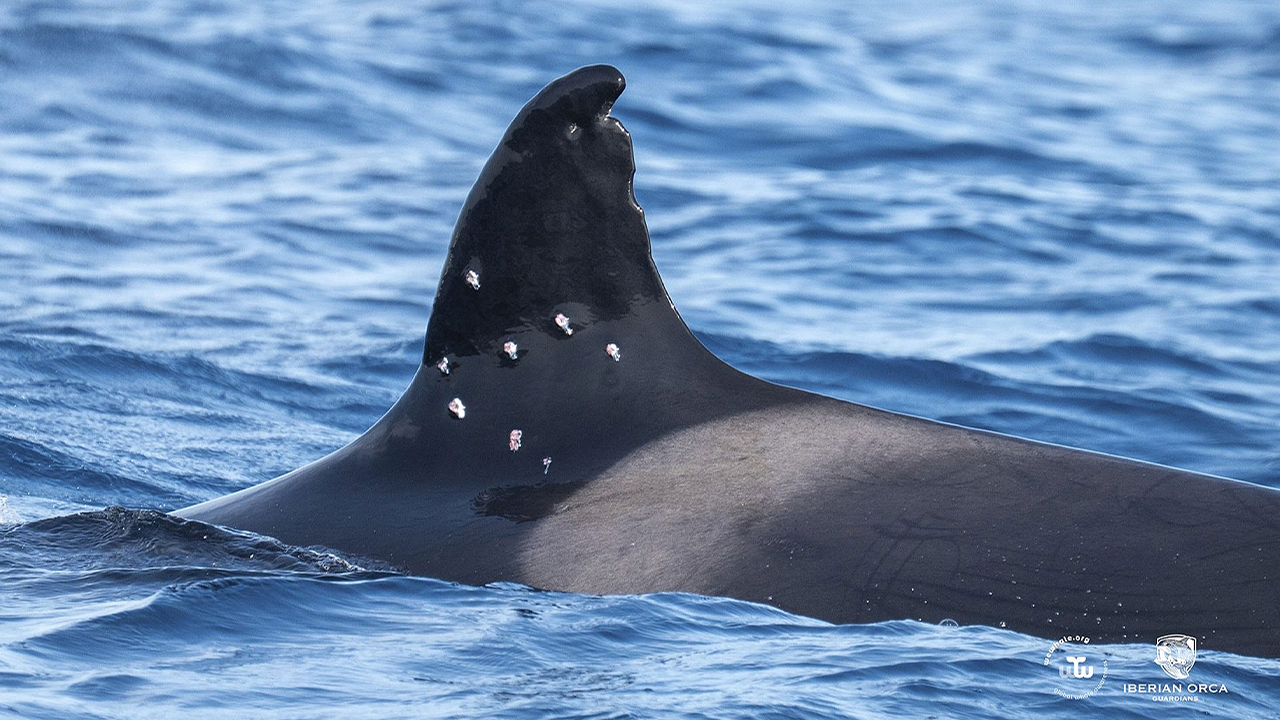
The vast blue waters of the Strait of Gibraltar have always carried stories of mystery, migration, and survival, but this week they delivered a darker tale. Amid the waves, a familiar silhouette appeared—an aging orca, her dorsal fin slicing through the surface with the grace of a grandmother who has seen half a century of ocean life. Her name is Toñi, also known as “La Abuela,” the grandmother. At roughly sixty years old, she is the oldest known member of the critically endangered Iberian orca population, a living piece of maritime heritage. But when conservationists spotted her this week, the joy of recognition turned to horror. Across her dorsal fin and back were multiple fresh wounds—small, round, suspiciously clustered marks that looked less like the scars of natural life and more like the cruel signature of a shotgun blast. Weeks earlier, she had been photographed without a single mark. Now, her body told a story of violence, and the question echoing across Spain’s coastline was as simple as it was chilling: who could shoot an ocean grandmother, and why?
The details of Toñi’s injuries, as documented by marine conservation groups WeWhale and Iberian Orca Guardians, paint a picture that is at once heartbreaking and medically concerning. The team counted roughly ten apparent pellet impacts on the left side of her dorsal fin, with at least two or three of the projectiles passing completely through the fin’s tough tissue. Other pellets, they fear, may still be lodged inside her body, hidden beneath the skin like ticking time bombs. The fin itself is not merely a decorative feature; it is a vital organ of sorts, rich in blood vessels and essential for regulating the animal’s body temperature. Wounds in that area can lead to tissue damage, swelling, infection, and, in the worst-case scenario, a slow and agonizing death if the animal’s immune system fails to fight off opportunistic pathogens. Toñi’s age only amplifies the risk. At sixty, she is old by orca standards, and her body may not recover with the resilience of a young calf. Yet in the midst of this grim assessment, there is a small flicker of hope. Observers report that she is still swimming normally, still hunting with purpose, still carrying herself with the quiet dignity of an alpha matriarch. She is not giving up. But her caretakers on land are watching her closely, their binoculars trained on her every movement, their hearts heavy with the knowledge that even the strongest grandmother can only take so much.
Spanish authorities have responded with the gravity such a crime deserves. The Ministry for the Ecological Transition and the Demographic Challenge, known as MITECO, launched preliminary investigative proceedings on August 12, the day after receiving reports of Toñi’s injuries from WeWhale, an organization that operates in the area under government authorization. The investigation is being led by the General Directorate of Biodiversity, Forests and Desertification, and officials are gathering photographic evidence, observational records, and any other clues that might lead to a suspect. While the ministry has stopped short of officially concluding that Toñi was shot, the conservation groups who know her best have no doubt. They point to the sudden appearance of the wounds, the uniform size and distribution of the marks, and the fact that no prior injuries existed in photographs taken just weeks earlier. To them, the evidence screams shotgun. If the culprit is found, the consequences could be severe. Under Spanish law, killing, capturing, pursuing, or disturbing protected species is strictly prohibited, and violations can carry fines of up to two million euros—roughly 2.3 million dollars—along with potential criminal liability. The law is meant to speak loudly for creatures who cannot speak for themselves. But laws only matter if someone is caught, and for now, no suspect has been named, no arrests announced. The investigation continues, and Toñi’s fate hangs in the balance.
This heartbreaking incident does not exist in a vacuum. It arrives after years of tense, well-documented encounters between Iberian orcas and boats along the Atlantic coast of the Iberian Peninsula. Since 2020, these intelligent, curious, and sometimes mischievous animals have repeatedly approached and interacted with vessels, in some cases bumping rudders, turning boats around, or causing what some sailors have described as terrifying standoffs. The reasons behind this behavior remain a subject of scientific debate—some researchers suggest curiosity, others point to trauma or learned behavior, and a few have speculated that the orcas are simply playing a strange game with the intruders into their world. The encounters have generated enormous public discussion, with some boaters demanding action and others urging patience and sympathy for the animals. Spanish officials have issued guidance aimed at protecting both watercraft and whales, advising sailors to stay calm, avoid aggressive maneuvers, and above all, refrain from using deterrent measures that could kill, injure, or disturb the cetaceans. In this charged atmosphere, the apparent shooting of Toñi feels like a breaking point. Janek Andre, founder and president of WeWhale and the Iberian Orca Guardians Foundation, expressed the frustration and sorrow of many when he said that if someone deliberately fired a shotgun at her, it is not only an act of extreme cruelty against an individual animal, but an attack on one of the last remaining members of a critically endangered population. Whatever one’s opinion about orca-boat interactions, he insisted, shooting at these animals can never be an acceptable response.
Toñi’s personal story is inseparable from the broader fight for her species’ survival. The Iberian orca population, which lives in the waters of the Strait of Gibraltar and the Gulf of Cádiz, is strikingly small—so small that every single individual matters in a way that is difficult for those who have never worked in conservation to fully grasp. They are classified as vulnerable under Spain’s Catalog of Endangered Species, a category that places them perilously close to the edge of oblivion. Each breeding female is more than just an animal; she is a guardian of genetic diversity, a keeper of cultural knowledge, and a symbol of the astonishing intelligence and social complexity that have made orcas one of the most beloved creatures on Earth. Toñi, as the oldest known member of this beleaguered group, is a living repository of memory. She has likely led her family through the Strait’s currents for decades, teaching younger generations the ancient routes to their prey—the bluefin tuna that are their lifeblood. Her loss would be devastating, not only ecologically but emotionally, for the scientists and volunteers who have spent years observing her, photographing her, and admiring her enduring spirit. The conservation groups now say they are preserving their original photographs and observational records, and they have pledged to continue monitoring Toñi’s physical condition and behavior as the government investigation moves forward. For them, this is not just a bureaucratic process. It is a personal mission, a chance to seek justice for a being who has already survived so much and deserves to spend her final years in peace, not in pain.
As the sun sets over the Strait of Gibraltar, the ocean remains as inscrutable as ever, holding its secrets close. Toñi continues to swim, a living question mark etched into the waves. Will anyone ever be held accountable for her suffering? Will the pellets in her body, if any remain, eventually poison her bloodstream, or will she heal and continue her reign as the grandmother of the deep? The authorities have not yet announced a suspect, and the investigation may take weeks or months. But beyond the legal questions, a human one lingers—what kind of society allows a creature of such majesty, such rarity, such cultural heritage to be shot at like a clay pigeon? In the story of Toñi, we see the collision of human impatience and animal innocence, the fragility of life in a rapidly changing sea, and the profound responsibility that comes with sharing the planet. The hope, perhaps, is that this incident will not become a footnote of tragedy, but a catalyst for greater empathy. The orcas of the Iberian Peninsula are not enemies; they are neighbors, strangers, and ultimately, family members of a shared world. Toñi, with her scars and her survival, reminds us that the oldest among us deserve not bullets, but protection. As she swims onward, her dorsal fin carrying the marks of someone’s cruel disregard, she asks a question that needs no translation: will we listen, or will we look away?