




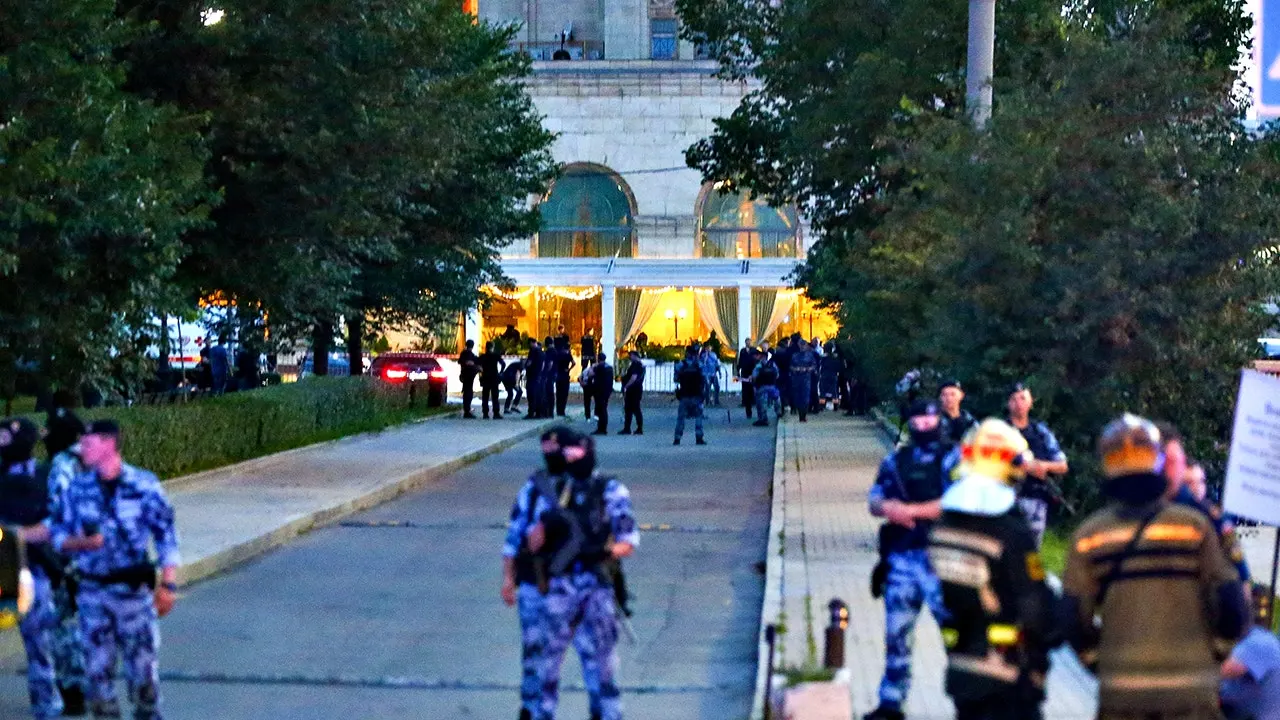
On a crisp, biting Saturday evening in the heart of Moscow, Kudrinskaya Square stood as a beacon of urban elegance, its towering Stalinist-era skyscraper glowing warmly against the dark Russian sky. Beneath the monumental architecture, the Balzi Rossi restaurant was alive with the familiar, glittering hum of city residents and visitors seeking refuge from the autumn cold. Inside the upscale Italian eatery, famed for its opulent high ceilings, dramatic columns, and refined atmosphere, a private gathering was underway. It was a scene defined by the gentle clinking of crystal glasses, the low murmur of laughter, and the rich, comforting aromas of high culinary art—a sanctuary of civilian life seemingly insulated from the heavy geopolitical anxieties that have increasingly draped themselves over the country. Yet, in a single, earth-shattering moment, this vibrant hub of celebration and human connection was violently torn apart. Around 8 p.m. local time, a deafening explosion ripped through the entrance of the restaurant, shattering the massive glass windows and sending a destructive shockwave of fire and debris tearing through the elegant dining space. The sheer violence of the blast instantly silenced the laughter, replacing it with a horrifying chorus of screams, smoke, and panic. This was not merely an assault on a physical building, but a devastating rupture of the unspoken social contract of urban life—the simple, fundamental expectation that one can gather with friends on a weekend evening without becoming the target of a lethal act of violence. As the smoke drifted out into the cold Moscow night, it became clear that the warmth of the evening had been permanently extinguished, replaced by a grim reality that would leave an indelible mark on the city’s consciousness.
The physical and emotional toll of the tragedy began to register in the dark, frantic hours of Sunday morning, as desperate families sought news of their loved ones and city officials rushed to assess the devastation. Moscow Mayor Sergei Sobyanin emerged as the voice of a grieving and angered metropolis, taking to social media to officially condemn the bombing as a “brutal terrorist act” and pledging a relentless pursuit of those who planned and executed the attack. His public address carried a heavy mixture of profound sorrow and unyielding determination, reflecting a city administration trying to maintain a posture of total control even as an act of extreme violence had slipped through its security net. He promised that the perpetrators would certainly be found and would face the severe punishment they deserved, a rhetorical attempt to restore a sense of order to a shaken populace. Meanwhile, across the capital, Moscow’s hospitals became the grim focal points of survival, with at least twenty-one injured victims receiving emergency treatment for severe burns, shrapnel wounds, and deep psychological trauma. In these sterile corridors, far removed from the political rhetoric of retribution, medical teams worked exhausting shifts to stabilize patients whose lives had been fundamentally altered in the span of a single second. For the families waiting anxiously in hospital lobbies, the Mayor’s vow of justice offered little immediate solace against the raw, agonizing reality of their loved ones’ suffering, highlighting the vast chasm between the cold calculations of political response and the deeply personal, messy process of human recovery in the wake of sudden disaster. Every monitor beep and whispered prayer in those recovery rooms served as a stark reminder of the fragile thread upon which human life hangs during times of societal upheaval.
As federal investigators and local forensic teams began painstakingly to sift through the charred ruins of Balzi Rossi, a narrative of extraordinary, tragic heroism began to crystallize from the wreckage. Reports from the National Anti-Terrorism Committee and state news agency RIA Novosti revealed that the scale of the tragedy, as terrible as it was, could have been exponentially worse had it not been for the split-second bravery of a restaurant security guard. A woman carrying a concealed, highly volatile homemade explosive device had approached the establishment, attempting to slip past the lobby and into the main dining hall where the private event was in full swing. Recognizing something amiss, the vigilant guard intercepted her at the threshold, placing his own body between the threat and the unsuspecting crowd inside. In that brief, tense confrontation, the device was detonated, instantly killing the guard, the female bomber, and an innocent patron who was caught in the immediate blast radius. This self-sacrificing act of duty by an ordinary worker transformed him into an unsung hero, a shield that preserved dozens of other families from experiencing the ultimate grief. Yet, the cost of his vigilance was absolute, leaving his own family to mourn a husband, father, or son whose final act on this earth was a profound demonstration of courage in the face of imminent terror. The loss of the patron, who had simply hoped to enjoy an evening of companionship, further underscores the indiscriminate cruelty of such attacks, where the innocent are violently torn from their life journeys. The tragedy of the bomber herself also raises haunting questions about the forces that drive an individual to carry such destruction into a peaceful gathering, leaving behind a wake of ruined lives and unanswered questions.
To fully understand the weight of the Balzi Rossi bombing, one must view it through the prism of a city that has spent more than two years adapting to a heavy, unspoken atmosphere of tension and conflict. Since the Kremlin launched its full-scale invasion of Ukraine in February 2022, the psychological landscape of Moscow has undergone a subtle but undeniable transformation, where the distant theater of war occasionally, violently breaches the boundaries of civilian life. From high-profile drone strikes that have targeted neighborhoods near the city center—such as the massive barrage of over four hundred drones reported recently—to previous targeted assassination attempts on prominent figures, Muscovites have had to cultivate a dual consciousness. They must maintain a surface-level normalcy, commuting to work, enjoying parks, and dining out, while harboring a persistent, low-grade anxiety about their safety. The bombing of an upscale restaurant, a symbol of leisure and security, directly targets this fragile peace, demonstrating that no space is entirely immune to the spillover of geopolitical strife. This ongoing tension forces ordinary citizens to engage in a silent, daily calculus of risk, transforming routine decisions into acts of quiet resilience. As people look at their neighbors on the subway or watch security personnel patrol the streets, there is a heightened awareness that the lines between the front line and the home front have become increasingly porous, rendering the pursuit of simple happiness an act of courage in its own right. The fear is rarely loud or chaotic; instead, it exists as a collective holding of breath, a recognition that the physical distance between the capital and the front lines offers no true shield against the asymmetric threats of a highly unstable era.
In the shadow of the smoking ruins, Russia’s formidable security apparatus has mobilized with intense urgency, with the Federal Security Service (FSB) taking the lead in a complex, high-stakes investigation that carries immense political implications. The absence of any immediate claim of responsibility from organized militant groups or foreign agencies has created a tense informational vacuum, fueling widespread speculation and intensifying the pressure on authorities to deliver clear answers. This incident occurs against a backdrop of heightened security protocols, as the FSB had recently announced plans to significantly tighten protection for senior government and military officials following several sophisticated assassination attempts in various urban centers. Although officials have been cautious not to prematurely link the restaurant bombing to these past operations or directly to the Ukrainian military, the methodology of using a homemade explosive device in a civilian setting points to a sophisticated level of planning and coordination. Forensic teams are painstakingly tracing the chemical composition of the bomb, analyzing security footage from the surrounding streets, and investigating the identity and associates of the deceased female attacker to dismantle the network that enabled her. This climate of suspicion deepens the rifts within society, as neighbors look upon strangers with newfound wariness, and the state relies on increasingly heavy-handed surveillance measures to maintain order, further altering the social fabric of the historic city. Until the perpetrators are identified and brought to justice, the unresolved mystery of the attack remains a potent psychological weapon, keeping both the state apparatus and the general public on a knife-edge of defensive anticipation, wondering where and when the next blow might fall.
As the initial shock of the weekend subsides and the physical debris is cleared from Kudrinskaya Square, the slow, painful process of communal healing and remembrance must begin. The physical wounds of the twenty-one survivors will heal over time under the diligent care of the city’s medical personnel, but the invisible scars left by the trauma will endure, reshaping how these individuals and their families view the world around them. Outside the shuttered, blackened entrance of Balzi Rossi, a spontaneous monument of flowers, candles, and handwritten notes has begun to take shape, created by grieving citizens who wish to honor the lives lost and assert their shared humanity in the face of senseless violence. These small, quiet acts of defiance remind us that even in the deepest moments of crisis, the human capacity for empathy, solidarity, and recovery cannot be extinguished by terror. The tragedy at the restaurant serves as a sobering reminder of the devastating human cost of geopolitical conflict, where innocent civilians pay the ultimate price for decisions made far beyond their control. Yet, as Moscow moves forward, the memory of the heroic guard and the victims will be preserved not just in official reports, but in the collective heart of a city that, despite the encroaching shadows of war, continues to seek light, community, and the hope for a more peaceful future. In the end, the resilience of the human spirit is not found in grand geopolitical victories, but in the quiet determination of ordinary people to rebuild their lives, comfort the grieving, and refuse to let fear dictate their capacity for love and community. It is this quiet endurance that ultimately triumphs over the chaotic noise of bombs and hatred, proving that even when buildings are shattered, the human bond remains unbreakable.