





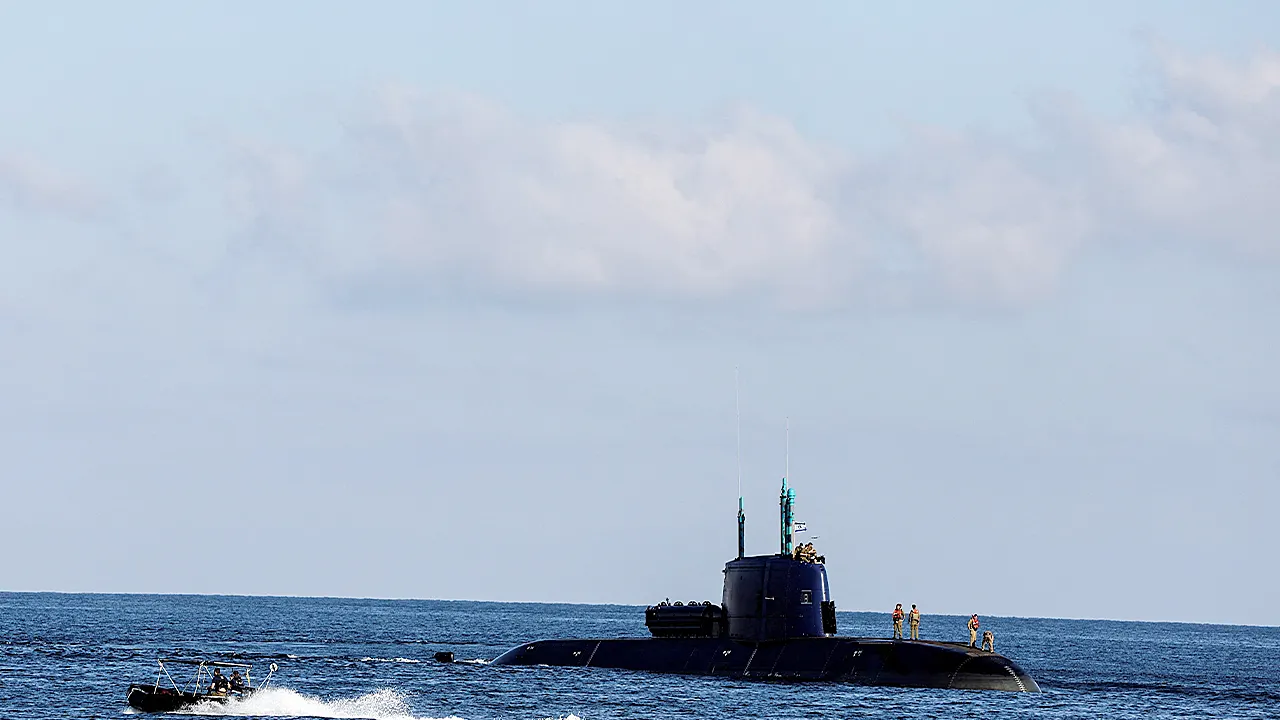
Amid the persistent winds and cold waters of the shipyard in Kiel, Germany, a monument of modern engineering and national survival was quietly handed over to the Israeli Navy, marking a profound milestone in one of the world’s most intense defense partnerships. The delivery of the INS Drakon (Dragon), a state-of-the-art Dolphin II-class submarine built by ThyssenKrupp Marine Systems (TKMS), represents far more than a routine military transaction; it is a $634 million shield designed to secure a nation’s existence. Measuring over 70 meters in length and displacing more than 2,000 tons, the vessel is the largest submarine constructed in Germany since the end of World War II. Yet, beyond the staggering financial investment and the cold, imposing steel of its hull lies a deeply human story. Inside this high-tech labyrinth of pipes, screens, and specialized weaponry, a tightly knit crew of young Israeli submariners will soon live, work, and navigate the claustrophobic depths of the ocean. For these sailors, the vessel will become a temporary home where they must endure weeks of sensory deprivation, artificial light, and absolute isolation from their families, all while bearing the psychological weight of knowing they are Israel’s ultimate line of defense.
The arrival of the INS Drakon comes at a time of unprecedented geopolitical volatility, as Israel grapples with multi-front regional conflicts and a lingering shadow war with Iran. Defense analysts emphasize that the primary value of this incredibly sophisticated machine is its role as a sea-based “second-strike” deterrent. Unlike land-based airfields, radar stations, and missile silos—which are vulnerable to preemptive, catastrophic strikes—a submarine hidden deep within the ocean remains virtually invisible and invulnerable. Dr. Ehud Eilam, a prominent national security expert and former researcher for Israel’s Ministry of Defense, notes that maintaining a continuous undersea presence is a vital insurance policy for national survival. In a doomsday scenario where a surprise attack might temporarily cripple Israel’s domestic military infrastructure, a submarine actively patrolling the silent depths of the sea would remain fully operational, ready to deliver a devastating response. This operational reality places an extraordinary burden on the shoulders of the crew, who must maintain constant, high-alert readiness around the clock, knowing that their silent vigil is what prevents regional adversaries from taking existential risks.
From a technical and tactical standpoint, the INS Drakon represents a massive evolutionary leap, particularly through its integration of Air-Independent Propulsion (AIP) technology. This system allows the submarine to remain submerged for weeks at a time without needing to surface or snorkel for oxygen, dramatically reducing its vulnerability to modern detection systems. Furthermore, the submarine’s increased size compared to its predecessors suggests a strategic shift in Israel’s maritime defense doctrine. Dr. Eilam points out that the larger hull likely accommodates longer-range missile systems, which would allow the Israeli Navy to strike targets deep inside hostile territory, including Iran, directly from the relatively safe waters of the Mediterranean Sea. This capability removes the operational necessity of navigating the treacherous bottleneck of the Suez Canal—a move that could be highly risky or politically impossible during an active conflict—or embarking on an exhausting, weeks-long journey around the entire African continent. By engineering a vessel that can project immense power from vast distances, German shipbuilders and Israeli strategists have created a weapon that maximizes safety for its operators while projecting a credible, undeniable threat to any adversary.
Yet, for all its cutting-edge technology, the INS Drakon is a vessel haunted and inspired by history, carrying a name that resonates deeply within the soul of the Israeli Navy. The name Drakon, meaning “Dragon” in Hebrew, was deliberately chosen because it contains the Hebrew letters Dalet, Kof, and Resh—spelling out Dakar, the name of the ill-fated Israeli submarine that tragically sank in the Mediterranean in January 1968, taking the lives of all 69 crew members. For decades, the mystery of the INS Dakar hung like a heavy shroud over the families of the fallen and the entire naval community until its wreckage was finally discovered in 1999. By embedding the linguistic DNA of the Dakar into this new flagship, the Israeli Ministry of Defense has ensured that the memory of those lost sailors is carried forward into the future. For the young men and women boarding the Drakon today, the ship is not just a tool of war, but a floating sanctuary of remembrance, linking generations of maritime defenders and reminding them of the inherent risks, sacrifices, and honor associated with serving in the “silent service.”
This complex emotional and strategic reality is mirrored in the unique relationship between the nations of Germany and Israel, which has culminated in the delivery of this exceptional vessel. The partnership between TKMS in Kiel and the Israeli Navy is a testament to decades of diplomatic reconciliation, industrial collaboration, and a shared commitment to security. German engineers and Israeli naval officers spend months working side-by-side in the shipyards, meticulously customizing every control panel, sonar system, and living quarter to meet the precise, grueling demands of Israeli naval operations. TKMS CEO Oliver Burkhard expressed pride in the seamless execution of the program, highlighting the deep mutual trust required to bring such a massive project to fruition. This collaboration represents a bridge over a painful historical past, transforming historical responsibility into a tangible, modern defense partnership that actively secures the future of the democratic state of Israel.
Ultimately, as the INS Drakon prepares to make its journey to its homeport in Haifa, the true measure of its success will not be found in the missiles it carries or the speed at which it travels, but in the quiet resolve of the humans who command it. These sailors will slip beneath the waves, leaving behind the warmth of their homes and the comforting familiarity of daylight to patrol the cold, dark underbelly of the Middle East. They are the silent sentinels, operating in a realm where a single mistake can be fatal, and where success is measured by the preservation of a peace that is never guaranteed. In an era defined by rapid technological advancements and unpredictable geopolitical shifts, the INS Drakon stands as a powerful symbol of human ingenuity, historical resilience, and the enduring, silent sacrifice of those who watch over their nation from the depths of the sea.