





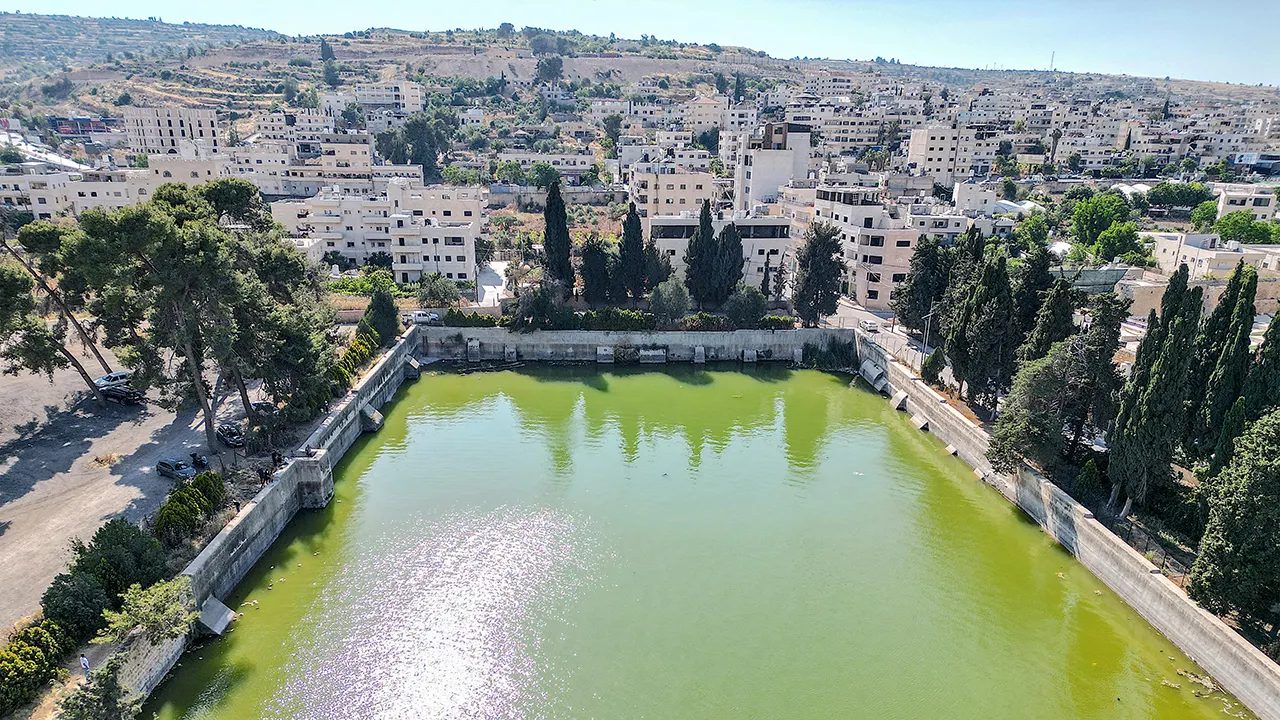
Nestled in the sun-drenched hills between Bethlehem and the Israeli town of Efrat, Solomon’s Pools stand as silent, monumental witnesses to over two millennia of human history. Built during the Hasmonean period in the second century B.C. and later expanded by Herod the Great to supply his magnificent fortress-palace at Herodium, these three massive stone reservoirs were once the beating heart of Jerusalem’s water system. For centuries, they collected winter rains and natural spring waters from the surrounding Judean hills, channeling life into the Holy City during the Second Temple era and beyond. To walk along their ancient stone edges is to step into a shared biblical narrative, where the physical dust of the desert meets the ingenious engineering of antiquity. Holding over ten million cubic feet of water, the pools are not merely archaeological ruins; they are deeply tied to the cultural identity, faith, and daily survival of the countless generations of Jews, Christians, and Muslims who have called this contested region home.
In the modern era, however, these tranquil reservoirs have been swept into the turbulent currents of Middle Eastern geopolitics, transforming a shared cultural landmark into a bitter territorial dispute. Following the landmark 1993 Oslo Accords, the West Bank was divided into a complex mosaic of administrative zones, and Solomon’s Pools were placed inside Area A, under the civil and security jurisdiction of the Palestinian Authority. According to Israeli officials, this placement was a profound historical mistake. They contend that during the delicate mapping processes of the peace negotiations, then-Prime Minister Yitzhak Rabin insisted that major Judeo-Christian heritage sites, including the pools and Rachel’s Tomb, remain under Israeli oversight. However, local leaders claim that due to a cartographical error on zoomed-out maps, the boundaries were misdrawn, leaving the pools under Ramallah’s administration and effectively cutting off easy access for Israelis to a vital piece of their heritage.
For the residents and leadership of the nearby Israeli town of Efrat, the current state of Solomon’s Pools is a source of profound heartbreak and frustration. Local figures, such as Yonatan Marcus and Mayor Dovi Shefler, paint a grim picture of the site today, describing historic stone structures marred by neglect and pools that once held pristine spring water now contaminated with diverted sewage. They argue that the Palestinian Authority has failed in its treaty obligations to protect and preserve shared historical landmarks, pointing to signs in Arabic warning visitors against swimming due to toxic wastewater. To these communities, the pools represent more than just stone and water; they are a vital link to the biblical past and a cornerstone for the region’s tourist future. The decay of the site is viewed not merely as environmental mismanagement, but as an existential threat to the preservation of Jewish history in the Judean hills, prompting urgent calls for Israel to reclaim administrative control over the reservoirs.
Across the political divide, the Palestinian Authority and its supporters offer a starkly different narrative, viewing these allegations as a coordinated attempt to justify land theft and settlement expansion. Ahmad Fattouh, a spokesman for the Fatah faction, vehemently rejects the accusations of neglect, calling it “absolutely audacious” for Israeli settlement leaders to claim custody over a site they have actively compromised. From the Palestinian perspective, it is the nearby Israeli settlements themselves that have diverted the natural springs feeding the historic reservoirs, causing the dramatic decline in water levels. The PA asserts that it has actively worked to restore the area, known locally as Burak Sulaymān, and has endeavored to develop it as a peaceful tourist destination for all. They view the sudden concern from right-wing Israeli politicians as a cynical smoke-screen designed to pave the way for an Israeli takeover of Area A territory, further eroding Palestinian self-determination.
Despite the fierce political rhetoric, the reality on the ground is a delicate, often tense coexistence mediated by military escort and sporadic diplomatic pressure. Because the pools reside within Area A, Israeli citizens can only visit the site under the heavy protection of the Israel Defense Forces, turning what should be a peaceful pilgrimage into a highly coordinated military operation. Interestingly, these visits have occasionally yielded unexpected results; following high-profile tours by prominent Israeli figures like Finance Minister Bezalel Smotrich, Palestinian authorities were seen clearing away years of accumulated garbage from the site. This back-and-forth dynamic highlights a strange paradox: the very tension surrounding the pools has forced both sides to pay closer attention to their preservation. For advocates on both sides of the divide, this proves that international attention and local pressure can stir action, though it remains a far cry from the collaborative, peaceful stewardship that many dream of for such a monumental site.
Ultimately, the battle over Solomon’s Pools is a microcosm of the larger, unresolved conflict over the land itself, where history is weaponized and the past is constantly renegotiated. Voices like Yishai Fleisher, an international spokesman for Hebron, argue that the only way to truly protect this piece of ancient temple history is to assert absolute Israeli sovereignty, dismantle the Palestinian Authority’s control, and redraw the map to place the pools back into Area C. Conversely, Palestinians see the site as an integral part of their heritage and their emerging state, a resource to be protected from colonial encroachment. As the dispute rages on, the ancient stones of Solomon’s Pools remain, quietly holding the rainwater of the Judean hills, waiting for a day when the water that once united Jerusalem can flow without being divided by the deep, human scars of modern politics.