


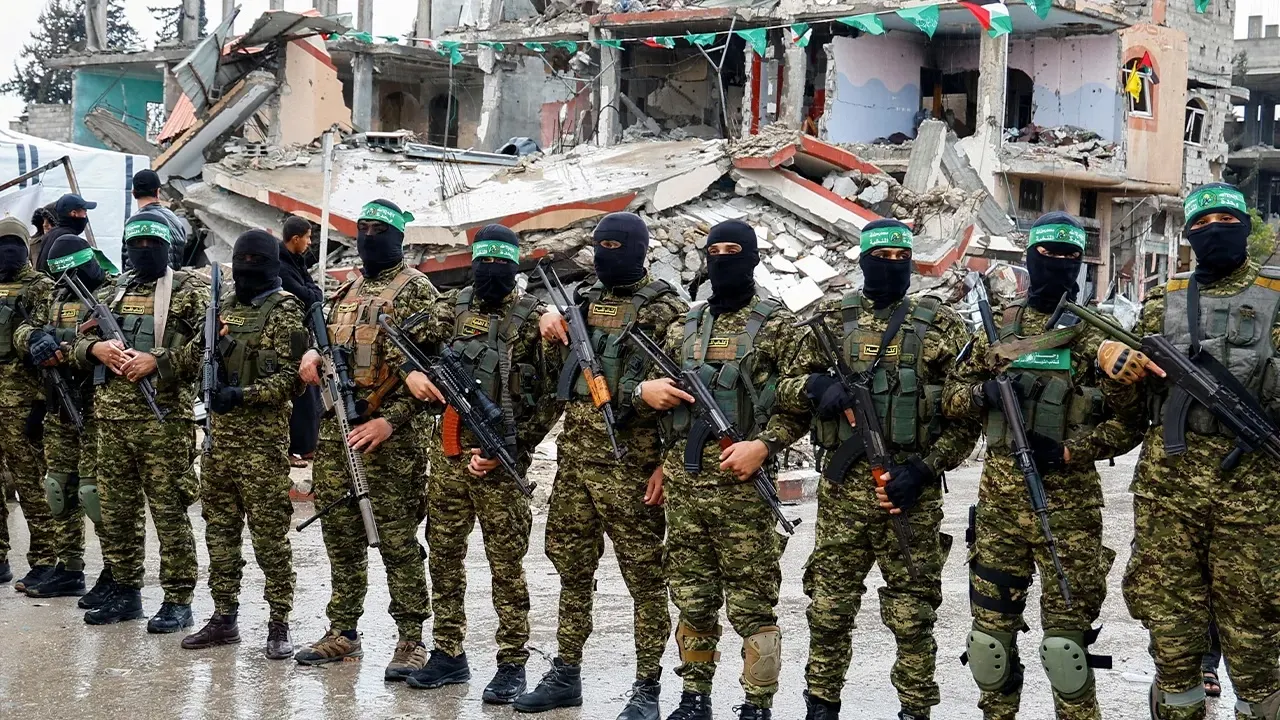
On the direct eve of Eid al-Adha, a major and deeply sacred holiday meant for family gatherings, spiritual reflection, and joy across the Muslim world, a devastating Israeli airstrike targeted and destroyed a prominent building in Gaza City. The precision strike killed Mohammed Odeh, the newly appointed chief of Hamas’s military wing, who had assumed the perilous mantle just days earlier, alongside several of his immediate family members who were gathered with him. Yet, in a striking demonstration of collective resilience, shock, or pure wartime adaptation, Gaza’s bustling open-air markets were completely filled with people only two hours later. Video footage of the packed, vibrant streets showed children buying holiday toys, parents carefully selecting goods, and families walking amidst the backdrop of rubble with an almost total absence of visible grief or concern over the sudden death of a leader whom Israel and its allies labeled a primary architect of the tragic October 7, 2023, attacks. This striking juxtaposition—of high-level military assassinations immediately followed by the standard, determined hum of holiday preparations—vividly highlights the profound and growing psychological chasm between the militant organization’s leadership and the exhausted average citizens of Gaza. For these ordinary people, the immediate, exhausting imperatives of securing a slice of normalcy and surviving another day have entirely eclipsed the ideological priorities of a governing system they increasingly perceive as detached from their daily suffering and survival.
This civilian detachment is the direct byproduct of nearly three years of absolute physical devastation, relentless economic displacement, and a mounting toll of human suffering that has pushed the local population to its absolute limit. According to data continually released by the Hamas-run Gaza Health Ministry—numbers that do not differentiate between armed combatants and innocent non-combatants—more than 70,000 Palestinians have perished in this conflict, alongside the near-total, repeated displacement of Gaza’s entire multi-million population. For the average resident living in desperate conditions, the grand, historic promises of armed resistance have yielded nothing but the wholesale destruction of their historic neighborhoods, the complete collapse of their health systems, and the constant, terrified flight from one temporary plastic shelter to another. This crushing reality has fostered a pervasive, heavy sense of betrayal, as families increasingly come to realize that their safety and security were never factored into the reckless military calculations of their rulers. The initial feelings of natural national solidarity that once characterized Gaza’s complex political dynamic have largely eroded under the weight of severe hunger, disease, and constant mourning, leaving behind a collective exhaustion. Today, many Gazans openly express that the war is being waged not for their liberation, but as a high-stakes gamble with their lives by leaders who remain safe from the physical consequences of the violence they initiated.
Indeed, the raw, unfiltered voices emerging from the ground reflect a deep-seated anger that is sweeping through the civilian population, as residents increasingly risk their personal safety to voice their internal opposition to the regime. In candid, blurred-face video interviews conducted for local news, anonymous activists, former political prisoners, and local journalists expressed an unprecedented level of indifference to the targeted killings of key figures like Yahya Sinwar, Izz al-Din al-Haddad, and now Mohammed Odeh. These citizens point out that when a commander is assassinated, the leadership feels no real pain, while the civilian population is left to exist in an environment akin to the Stone Age—lacking access to electricity, clean water, healthcare, or stable homes. Adding fuel to this burning resentment is the stark economic and lifestyle inequality between the rulers and the ruled; while everyday Gazans are forced to survive in makeshift tents amidst mountains of garbage, the children and immediate relatives of high-ranking Hamas officials are notoriously known to live luxurious, safe lives abroad in Turkey and Qatar, driving exotic sports cars and attending elite international universities. This stark disparity has led many local human rights advocates to state clearly that Hamas did not merely cause immense damage to Israelis on October 7, but dealt an equally devastating, permanent blow to the very Palestinian population they claimed to govern and represent.
From a structural perspective, the systematic, constant elimination of Hamas’s leadership has had a profoundly disintegrating effect on the organization itself, transforming it from a cohesive governing body into a deeply fragmented entity. Hadeel Oueis, the editor-in-chief of Jusoor News, explains that these constant, targeted assassinations have created a severe, irreparable leadership vacuum, successfully dismantling the centralized chain of command that once successfully coordinated efforts between leadership figures inside Gaza and political bureaus operating abroad. Without this vital centralized structure, Hamas is rapidly devolving into a loose collection of localized, desperate militias that are forced to compete with other armed factions inside the strip simply to survive. This operational fragmentation has severely hampered the group’s capacity to maintain civil order, run local administrative offices, or enact any cohesive military strategy, turning their ongoing activities into a disorganized fight for self-preservation. This rapid dissolution of authority proves that while the group may still possess weapons, its capacity to function as an organized governing authority or a unified national movement has been fundamentally broken by the relentless pressure of tactical military operations, leaving them vulnerable and structurally crippled.
Despite these massive organizational fractures, political and military experts caution that the physical destruction of Hamas’s command structure does not automatically guarantee the absolute collapse of the movement. Michael Milshtein, a leading expert on Palestinian political affairs, highlights that while Israel’s decapitation strategy has removed almost all of the strategic minds behind the October 7 attacks, the organization is built to operate under extreme attrition. Newly promoted leaders like the late Mohammed Odeh are often less experienced, less strategic, and significantly less charismatic than their predecessors, yet there remains a structural chain of command that quickly fills these leadership gaps. The deeply institutionalized culture of martyrdom within the group ensures that despite the near-certainty of being targeted next by Israeli intelligence, there is no shortage of younger, highly radicalized operatives who actively compete for these newly vacant command roles. Consequently, while the tactical capabilities of Hamas have been heavily degraded to the point of localized guerrilla warfare, the underlying, resilient ideology remains deeply embedded, indicating that military actions alone are insufficient to completely resolve the conflict without an alternative political structure to fill the governance void and provide a peaceful future.
This strategic bottleneck has intensified international efforts to formulate a viable postwar political framework that can offer a pathway toward permanent stability and the demilitarization of the region. A critical component of this effort is the 15-point roadmap proposed under the Board of Peace initiative by High Representative Nickolay Mladenov, designed to seamlessly align with the peace proposals outlined by the Trump administration. The cornerstone of this proposed framework rests on the strict implementation of “one authority, one law, one weapon,” a principle that demands the phased, internationally supervised disarmament of Hamas and all other active militant organizations in Gaza. Experts agree that no meaningful physical reconstruction or economic recovery can occur as long as parallel armed groups are allowed to operate as governing authorities, keeping the population hostage to their militant agendas. For the millions of ordinary Palestinians who have spent years navigating the horrors of war and displacement, the abstract debates over geopolitics boil down to a simple, visceral longing: the desire to end the cycle of permanent conflict, reclaim their basic human dignity, and build a quiet, safe life where their families are no longer used as disposable pawns in an endless ideological struggle that has brought them nothing but devastation.