





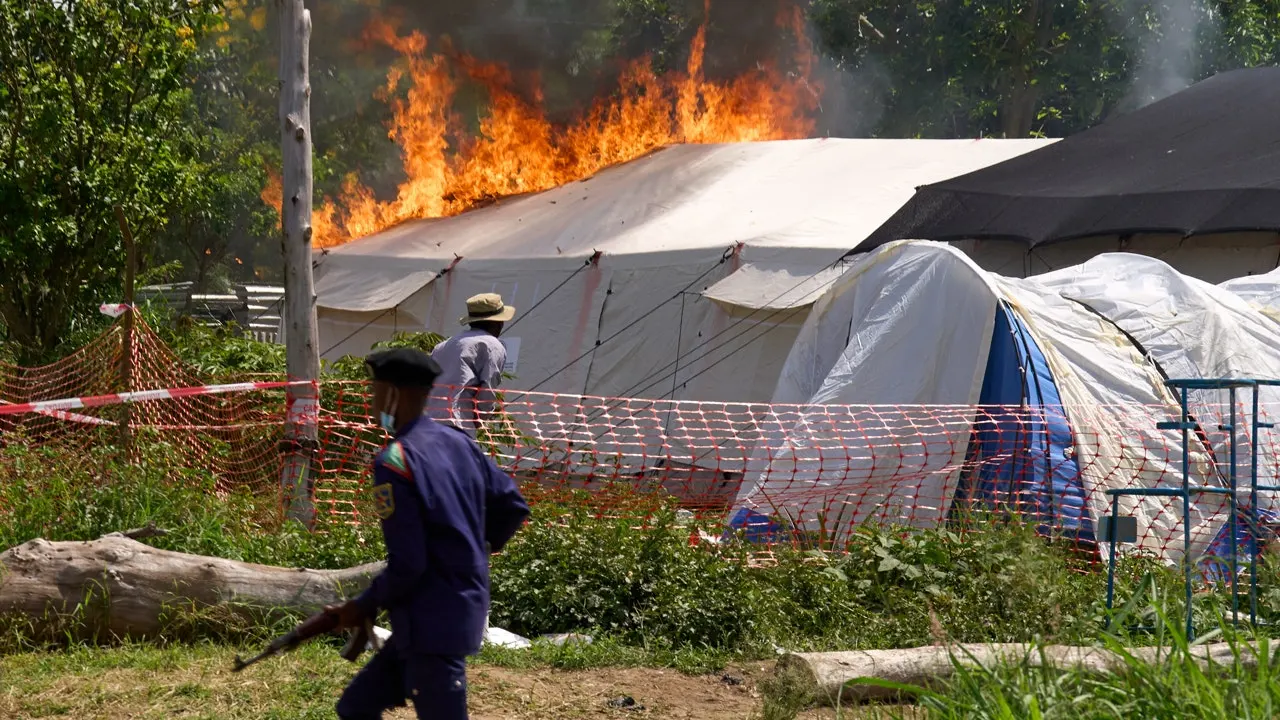
The air in the eastern Democratic Republic of the Congo, already heavy with the anxiety of a mounting health crisis, turned thick with the scent of smoke and tear gas on a devastating Thursday afternoon. Rwampara Hospital, situated in the very heart of a deadly new Ebola outbreak, became the latest tragic battleground where scientific intervention collided head-on with raw human grief. A crowd of angry local youth, devastated by the sudden death of a close friend suspected of harboring the virus, descended upon the medical center with a singular, desperate mission: to reclaim his body. In the collective mind of the grieving community, the cold, sterile protocols of isolation felt less like medical safety and more like a cruel theft of their right to mourn. Alexis Burata, a local student who witnessed the escalation, watched as police tried and failed to pacify the swelling crowd. The grief quickly curdled into fury, culminating in a chaotic breach of the facility where protesters began destroying equipment and ultimately set fire to two treatment tents operated by the Alliance for International Medical Action (ALIMA). As flames consumed the structures, onlookers gasped at the horrific sight of what appeared to be the body of at least one suspected victim being burned in the wreckage of the clinic. It was a harrowing manifestation of what happens when a community’s trust in authority completely disintegrates under the weight of fear and loss, leaving six active Ebola patients who were receiving treatment inside the facility to navigate a terrifying afternoon of survival amidst fire and smoke, though thankfully all were eventually accounted for by government officials. This incident reflects a deeper, systemic wound in a region that has long suffered from war, poverty, and epidemiological neglect, where the sudden influx of heavily armed security forces and foreign medical staff can sometimes feel more like an occupying army than a healing presence.
At the core of this tragedy lies a profound and painful misunderstanding regarding death, dignity, and ritual. Deputy Senior Commissioner Jean Claude Mukendi, head of the public security department in Ituri Province, pointed out that the young people who set fire to the hospital simply did not comprehend the rigid, highly sterile burial protocols required to stop the spread of Ebola. In many traditional Congolese societies, a funeral is not merely a brief ceremony; it is a sacred, communal transition requiring close physical touch, washing of the deceased’s body, and collective weeping over the open casket. When authorities sweep in with body bags, chlorine sprays, and plastic hazmat suits, they effectively outlaw these age-old rites of passage in the name of bio-safety. Mukendi explained that while the instructions from health authorities are mathematically logical—stating clearly that all infected bodies must be buried by specialized teams to prevent post-mortem viral transmission—they completely fail to translate into the language of love, ancestry, and respect. To a grieving mother or a loyal friend, being barred from touching their loved one’s face one last time feels like a monstrous violation of their humanity. This severe cultural disconnect transforms medical professionals, who risk their lives to treat the sick, into perceived kidnappers of the dead. Consequently, the burning of the Rwampara Hospital was not an attack on medicine itself, but a desperate, albeit misguided, rebellion against a system that forces families to choose between protecting their community’s physical health and preserving their spiritual obligations. Without a bridge of empathy to connect these two worlds, the bio-secure body bag becomes a symbol of oppression rather than protection. This tension highlights an ongoing failure in global health crises: the tendency to prioritize clinical logistics while neglecting the deep-seated psychological and anthropological needs of the people suffering on the ground.
To understand the terror fueling both the communities and the authorities, one must examine the terrifying medical reality of the pathogen currently silently sweeping through the Democratic Republic of the Congo. The World Health Organization (WHO) recently declared this outbreak a public health emergency of international concern, a rare and sobering designation reserved only for the world’s most severe biological threats. This particular epidemic is driven by the Bundibugyo strain of the Ebola virus, a highly lethal variant that poses a unique nightmare scenario for epidemiologists. Unlike more common strains of Ebola, such as the Zaire strain for which highly effective vaccines and therapeutic treatments have been developed, the Bundibugyo strain is far more elusive. Existing vaccines offer little to no proven efficacy against it, stripping healthcare workers of one of their most powerful defensive weapons and leaving them to rely almost entirely on basic supportive care, strict isolation, and early intervention. The scale and speed of this epidemic have sent alarm waves through the global community, with WHO Director-General Tedros Adhanom Ghebreyesus expressing deep concern over its rapid expansion. The virus has already swept across two major provinces in the DRC, leaving a trail of 671 suspected cases and claiming at least 160 lives in a matter of weeks. The sheer lethality of the virus creates a pressure-cooker environment where every fever is treated with suspicion, every death is a potential biohazard, and the terrifying realization that there is no magic-bullet cure breeds a paralyzing atmosphere of dread that infects both the healthy and the sick alike. This void of clinical certainty exacerbates the anxiety of the population, who see their neighbors entering treatment centers only to emerge in body bags, reinforcing the false but pervasive belief that these facilities are slaughterhouses rather than places of healing.
Amplifying this volatile atmosphere is the modern scourge of digital misinformation, which acts as a super-spreader of fear long before the physical virus even reaches a household. In the wake of the Rwampara Hospital attack, ALIMA issued a stern and urgent warning condemning the rapid dissemination of incorrect, unverified, and sensationalized information across social media networks and various internet platforms. In an era where almost everyone has access to a smartphone, a single false rumor about the origins of the outbreak, the intentions of international health organizations, or the safety of treatment procedures can spread across a village within minutes, completely undermining months of painstaking community trust-building. Some online narratives falsely claim that the virus is a hoax designed to attract foreign aid money, while others spread conspiracy theories that Western doctors are harvesting organs or importing the disease. When communities are fed a constant diet of digital hysteria, their natural suspicion of authority hardens into violent resistance. The tragedy is that social media algorithms are built to promote outrage over nuance, meaning that calm, scientifically accurate advice from local clinics is routinely drowned out by sensationalized half-truths and fearmongering. This digital wilderness turns the clinic into a fortress and the medical staff into potential targets, making it infinitely harder for health workers to engage in the gentle, face-to-face dialogue that is genuinely required to dismantle rumors and reassure a terrified public that they are safe in medical care. The digital echo chamber effectively strips the human element out of crisis communication, leaving behind a sterile landscape dominated by suspicion. Ultimately, clinical experts are forced to realize that fighting an epidemic in the twenty-first century requires combatting not only microscopic pathogens in a laboratory, but also viral falsehoods spreading across fiber-optic cables and mobile screens in the palm of every villager’s hand.
Amidst the smoke, ashes, and digital warfare, the raw human cost borne by those on the frontlines of this crisis is staggering. The dedicated doctors, nurses, and support staff of local organizations like ALIMA, alongside government medical personnel, find themselves working under conditions of unimaginable stress, where they must constantly calculate the risk of viral infection against the risk of physical assault. Following the attack on Rwampara Hospital, government spokesperson Patrick Muyaya worked tirelessly to reassure the public that medical care for the afflicted was continuing normally, confirming that all six patients who were undergoing active treatment at the time of the fire had been safely accounted for and relocated. However, the psychological trauma inflicted upon both those treating the sick and the patients themselves remains unquantifiable. Imagine being a patient, already fighting a terrifying, painful, and often fatal disease, only to hear the screams of an angry crowd outside and see the very roof over your head set on fire. The medical staff, too, are left to cope with the reality that their selfless dedication to saving lives is met with hostility and vandalism. Muyaya’s condemnation of the violence was accompanied by a desperate plea for calm, reminding the population that attacking the clinics only guarantees that the virus will win. If health workers are forced to flee the region due to safety concerns, the thin line protecting eastern Congo from a full-scale catastrophic humanitarian collapse will vanish, leaving the most vulnerable populations utterly defenseless against an unchecked epidemiological nightmare. These healthcare practitioners are local heroes, many of whom are Congolese nationals working in their own communities, enduring sleepless nights, physical exhaustion, and social isolation from their own families who fear they might bring the virus home. To see their efforts go up in flames is a heartbreaking testament to the psychological toll of this crisis.
The consequences of this localized rebellion are already reverberating far beyond the borders of eastern Congo, illustrating how a regional health crisis can rapidly expand into a global security concern. The United Nations recently confirmed that neighboring Uganda has already recorded its first cases of the outbreak, including one tragic death, proving that the virus does not respect geopolitical boundaries or customs checkpoints. In response to the escalating danger, the United States issued its own urgent travel warnings for the region, while the World Health Organization quickly approved nearly $4 million in emergency funding to bolster national health authorities on the ground. Yet, as the international community mobilizes financial capital and logistics, the burning of the Rwampara Hospital proves that money and medicine alone cannot solve a crisis of faith. The true path toward conquering this outbreak lies in rebuilding the broken contract of trust between the scientific community and the people they serve. It requires global health agencies to listen as much as they lecture, to integrate cultural burial practices into safe medical protocols, and to treat the local population as partners in survival rather than subjects of containment. Only when the grieving young men of Ituri Province are empowered to mourn their lost friends with both safety and dignity will the fires of suspicion finally be extinguished, allowing the healing work of medicine to proceed in peace, and ensuring that a tragedy like the one at Rwampara is never repeated. This delicate balance of human-centric medicine and strict clinical science is the only true vaccine against both the physical virus and the social division it generates. The road ahead remains incredibly perilous, but it is a journey that the global community must walk hand-in-hand with the local people, respecting their heritage while protecting their lives.