






Title: The Left Turns Realist: How Mette Frederiksen Shook Europe’s Progressive Core
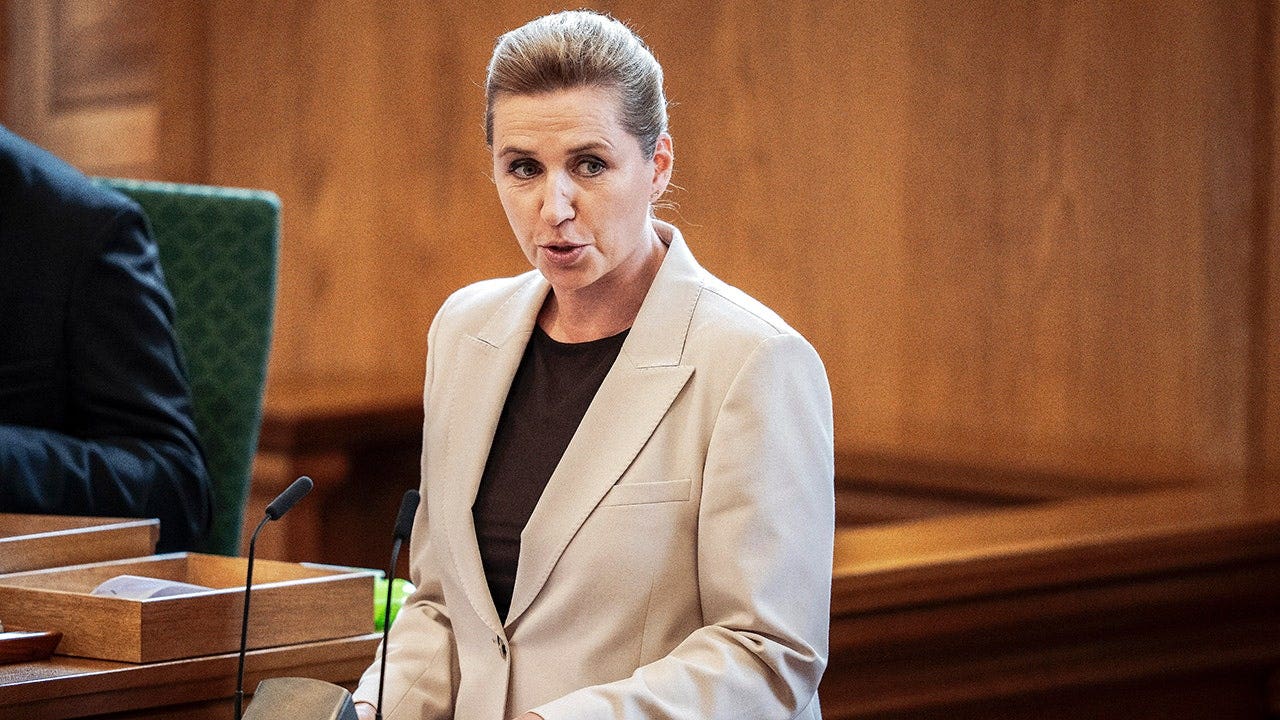
In the genteel, consensus-driven halls of Northern European politics, Mette Frederiksen has always been a study in controlled intensity—a Social Democratic premier who wears her pragmatism like a shield. But when she stood before the Danish Parliament this autumn, her words landed like a thunderclap, sending a shockwave through the very foundation of European leftism. The context was raw and immediate: the chaos of mass migration had just erupted in the Spanish exclave of Ceuta, where thousands of migrants stormed the border, and Frederiksen, typically focused on domestic welfare, took an unprecedented jab at Spain’s socialist Prime Minister, Pedro Sánchez. She accused Sánchez of recklessness, of fostering a permissive environment that pushed the crisis northward. Yet it wasn’t merely a diplomatic spat between two left-wing leaders; it was the opening salvo in a philosophical war. For decades, the European left has wrapped itself in the twin dogmas of open borders and absolute multicultural tolerance, treating any criticism of migration as a concession to the far right. Frederiksen, however, chose to shatter that taboo, signaling to the continent that the center-left could no longer afford to be an ostrich with its head buried in the sands of idealogy. She was, in essence, telling her progressive peers that the world had changed, and so must they—even if that meant sounding more like a conservative security hawk than a bleeding-heart social democrat.
The precise words Frederiksen used in that parliamentary exchange were not ambiguous, nor were they cloaked in diplomatic nuance. When a far-left legislator accused her government of lacking “solidarity” with Spain against right-wing “anti-democratic forces,” she pivoted with surgical precision. “If we talk about undemocratic forces, then Russia is our biggest enemy,” she stated, acknowledging the external threat. Then came the gut punch. “The problem is that a big enemy has started to grow from within, and it is foreigners who have come to Europe.” She did not stop there. She laid out a checklist of indefensible behavior, naming “Hamas supporters,” “people who commit terror against European societies,” and those who “do not recognize our fundamental European values.” She spoke of individuals who “sympathize with some of the darkest forces in this world,” warning that Europe is now threatened “both from outside and now from within.” Crucially, she clarified that this was not about the Spanish government’s policies, but about a specific demographic issue: people with an Islamic background who, in her view, do not want the open, liberal society that Europe offers. To hear these words from a center-left prime minister was a seismic event. She wasn’t speaking in code about “values” or “integration” in vague terms; she was naming the elephant in the room—religious extremism and the rejection of democratic norms by a minority—and demanding that her fellow leftists stop pretending it didn’t exist. For millions of ordinary Europeans who have felt their concerns dismissed as racism for years, her speech felt like a vindication, a permission slip to voice their anxieties without being branded a fascist.
The reaction from political analysts was immediate, and perhaps the most striking observation came from Daniel Schatz, a Sweden-based foreign policy expert and author, who spoke to Fox News Digital. Schatz captured the essence of the moment by pointing out the sheer irony of the speaker. “What is striking is not that a conservative politician is talking about illegal immigration, failed integration and Islamist extremism,” he said. “It is that one of Europe’s leading center-left prime ministers is saying it in such blunt terms. That tells you how far the European immigration debate has shifted.” Schatz’s insight highlights a profound political realignment. The center of gravity on immigration policy has moved so decisively that the old left-right spectrum is nearly obsolete. Voters no longer trust conservative parties alone to secure their borders; they want pragmatic leadership from wherever it comes. Frederiksen’s gamble is that by tackling these issues head-on, she can reclaim the working-class voters who fled to the populist right, while simultaneously forcing the liberal elite to face harsh realities. Her critics see it as a betrayal of socialist principles, a surrender to xenophobia. But her defenders argue that it is the ultimate act of left-wing compassion: protecting the welfare state—that great achievement of social democracy—from being diluted by uncontrolled demographic pressures and cultural conflicts that erode social trust. She is effectively saying that if the left refuses to manage migration sensibly, it will lose the political power to protect the vulnerable citizens it claims to champion.
This ideological stance is not a recent whim for Frederiksen; it is the culmination of a trajectory that began long before she stood in parliament criticizing Spain. Since taking office in 2019 on a platform that unconventional for a socialist—one that prioritized strict migration control alongside generous climate policies—she has systematically dismantled the old asylum architecture. In 2018, even before she was prime minister, Denmark passed a controversial law targeting “parallel societies,” which allowed the government to intervene in neighborhoods where more than half the residents came from “non-Western” backgrounds, including seizing or demolishing properties and restricting family reunification rights. Then, in 2021, she went a step further, introducing a deportation law that permitted Danish authorities to send refugees back to their country of origin if the region was deemed “safe,” even if Denmark had no diplomatic relationship with that country. This law was so draconian that it drew sharp rebukes from the European Commission, which deemed it incompatible with EU law. Yet Frederiksen did not blink. She framed these measures not as cruelty, but as pragmatism, arguing that a small, homogeneous welfare state cannot absorb endless waves of migration without sacrificing its core social contract. Her humanized perspective, often expressed privately, is that of a leader who sees the exhaustion on the faces of Danish social workers, the friction in overcrowded schools, and the anxiety of working-class neighborhoods where cultures clash—and she decided that the state must put its own citizens’ sense of security first, even if it looks cold on paper.
The most surprising chapter of this saga is how Frederiksen has found unlikely allies, transcending the traditional left-right chasm. In August, she joined forces with none other than Italian Prime Minister Giorgia Meloni—the leader of a post-fascist party in Italy—along with 20 other EU leaders, in a strongly-worded letter demanding that the European Union take a hard line on migration. The letter declared that the EU “cannot allow mass crossings, the instrumentalization of migration or other hybrid threats to create the perception that illegal entry into the European Union is possible.” Meloni and Frederiksen, the only two female heads of government in the EU, then issued a joint statement further solidifying this unlikely alliance. They proudly invoked Europe’s “Christian cultural heritage,” stating that those who arrive must respect the fundamental values of their host nations and not attempt to “impose ways of life” that clash with the liberal, democratic ethos. Daniel Schatz pointed out that this alliance is less about ideology and more about governance; Frederiksen has realized that to save the European project, it must become pragmatic and tough-minded. For Meloni, this partnership legitimizes her demote to the mainstream. For Frederiksen, it proves that being a social democrat doesn’t mean being naive about identity or security. It is a coalition of “maternal realists”—women leaders unafraid to make tough decisions, unburdened by the macho posturing of male politicians who historically used immigration as a wedge issue. They are effectively telling Brussels: stop lecturing us on utopian dreams, and help us manage a mess that threatens to tear the continent apart.
Ultimately, Frederiksen’s declarations mark a watershed moment in European history, a definitive end to the era of naive multiculturalism. The question now is whether the rest of the left will follow her lead or resist it. Political analyst Daniel Schatz astutely noted that Frederiksen is “right to name the enemy within,” and that Europe has spent years pretending that uncontrolled migration and failed integration come without consequences. “Parallel societies have taken root, Islamist extremism has been allowed to fester, and support for groups such as Hamas is no longer confined to the margins,” he said. “Denmark understands the cost.” The human side of this story is not black and white—it is filled with the desperate faces of migrants seeking a better life, but also the weary faces of native Europeans who feel their identity is being erased. Frederiksen is attempting to navigate this moral minefield with a simple principle: you can be generous, but you must also be protected. Her “political formula,” as Schatz puts it, is straightforward: protect the generous Danish welfare model, control the border, and deny the populist right a monopoly on legitimate concerns. For an American audience, this translates into a familiar dilemma—how to balance security and compassion. But for Europe, it is a revolution. By speaking plainly about the failures of integration and the threat of religious extremism, Frederiksen has given the European left a new playbook. She has shown that true courage in politics is not about adopting the most radical idealistic stance, but about looking reality in the eye, admitting mistakes, and crafting a future where both newcomers and long-settled citizens can coexist with dignity. Her legacy is still being written, but she has already changed the conversation forever—and for a center-left politician, that might be the most dangerous and necessary act of all.