


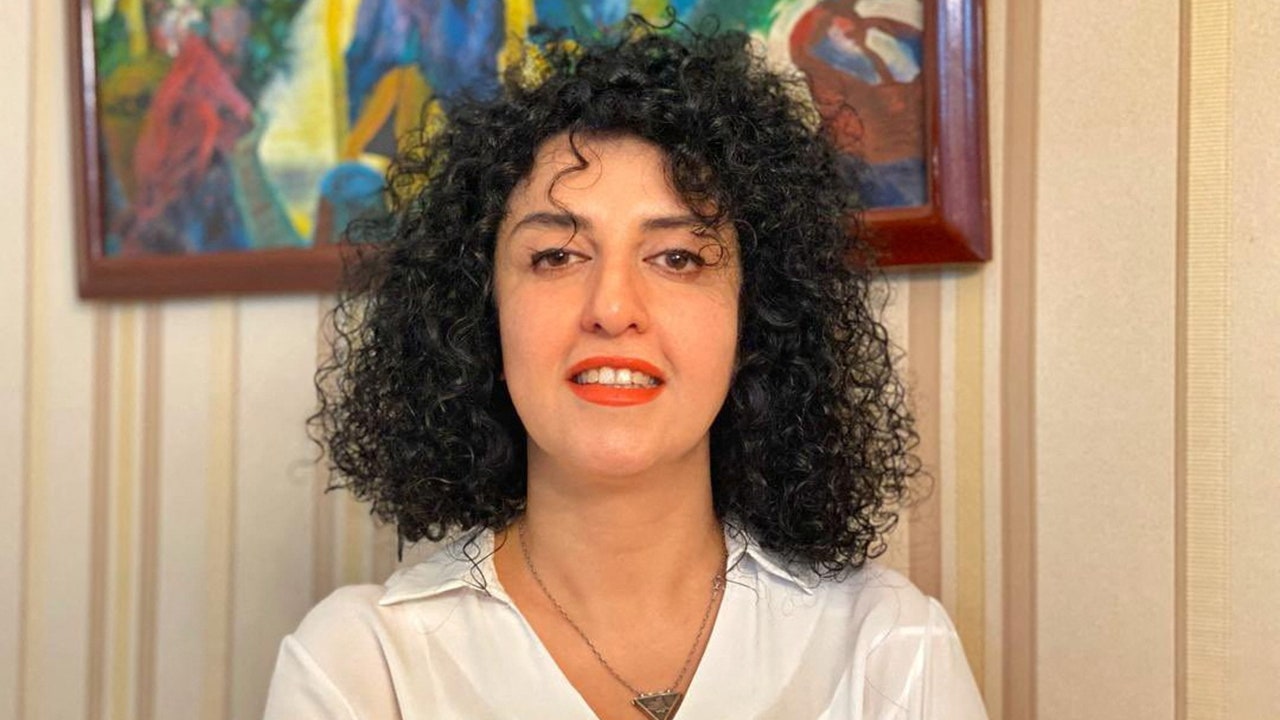
In the heart of a nation gripped by turmoil, where war’s shadows loom large over the lives of ordinary Iranians, Narges Mohammadi emerges as a beacon of unyielding courage. Jailed in a bleak prison in Zanjan, she’s not just a prisoner—she’s a symbol of defiance against a regime that seems to crush its own people in waves of repression and blackout-induced silence. Her husband, Taghi Rahmani, shares her story from the safety of exile in Europe, his voice trembling with a mix of pride and sorrow as he recounts how she was savagely beaten during her arrest in Mashhad back in January. “Narges is a human rights activist and an advocate for civil society,” he tells me, his words echoing like a plea from afar. In this exclusive conversation, he paints a picture of a woman who, despite the physical toll, remains spiritually intact, mobilizing for a freer Iran with every breath. As the Islamic Republic reels from U.S. and Israeli strikes, a fragile ceasefire does little to shield its people from economic ruin and intensified crackdowns. Narges, cradling the 2023 Nobel Peace Prize she won while behind bars, stands apart—not exiled like many leaders, but rooted in the suffering of those inside the system. She embodies a rare authenticity, born from decades of fighting for women’s rights, against the death penalty, and the barbarity of solitary confinement. Trained as an engineer and a journalist, she rose through the ranks of Shirin Ebadi’s Defenders of Human Rights Center, championing hijab reforms and exposing abuses that most dare not speak of. Yet, in this moment of chaos, as drone footage from Gaza to Tehran fills the world with dread, her plight feels even more urgent. Rahmani describes her injuries—blows to her chest, head, lungs—the kind that turn a proud woman into a figure of quiet endurance. It’s impossible not to humanize her pain: imagine the isolation of a prison cell after such violence, denied even basic medical care under the excuse of bureaucracy from a ministry that’s more weapon than guardian. And yet, he insists, she’s unbroken, her spirit a flame against the regime’s darkness. This isn’t just a political story; it’s a deeply personal one, of a couple torn apart by tyranny, where love and resistance intertwine in the face of adversity. As global eyes turn to Iran, wondering if its fractured opposition can unite, Narges offers a glimpse of what true leadership might look like—born from the soil of suffering, not the comforts of exile.
Delving deeper into Narges’s world, I find myself reflecting on the humanity behind her activism, a life woven from threads of intellect, empathy, and sheer fortitude. Born into a society where women’s voices are often muffled by law and tradition, she defied norms early on, arming herself with engineering knowledge and a journalist’s keen eye for truth. Her work with the Defenders of Human Rights Center wasn’t mere professionalism; it was a passion that cost her freedom time and again. She campaigned tirelessly against compulsory hijabs, exposing how these mandates stripped women of autonomy, turning streets into battlegrounds of identity. Solitary confinement, she argued, wasn’t isolation—it was psychological torture designed to break the human spirit. And the death penalty? A barbaric tool wielded against the most vulnerable, from political dissidents to those deemed morally astray. Rahmani, in his heartfelt narrative, brings her to life: a courageous mobilizer shaping civil institutions amid repression. It’s stories like hers that remind us of the Iranian people’s resilience, even as war rages and internet blackouts erase their cries from the digital world. Inside Tehran, checkpoints surge, people used as human shields in a fog of fear and uncertainty. Yet Narges persists, her engineer’s precision meeting her advocate’s fire, proving that one woman’s determination can echo through a nation’s soul. As the regime’s grip tightens, her presence in prison becomes a rallying point, a testament to the human capacity for change even in the bleakest dungeons. This isn’t abstract history; it’s the lived reality of families sundered, dreams deferred, and hopes clung to like lifelines in the storm. Her husband’s last words to her, that fateful night before arrest, hang in the air—a poignant goodbye laced with unspoken promises. In humanizing Narges, we see not just a Nobel laureate, but a sister, a mother, an engineer-turned-warrior for justice, whose story urges us to question: how many more like her must suffer before the world truly listens?
The physical scars Narges carries today, as Rahmani agonizingly describes, paint a grim portrait of a regime that’s as cruel as it is paranoid. Arrested in Mashhad, she endured brutal beatings—blows raining down on her chest, head, body, and lungs, leaving her with severe traumas that demand urgent attention. Prison doctors recommended transfer to her own physician, a simple mercy, yet the Ministry of Intelligence denies it, insisting she rot in Zanjan’s unforgiving walls. “Spiritually and mentally, Narges remains steadfast,” her husband says, his voice cracking under the weight of months without touch, without shared silence in the night. She clings to her vision: an Iran liberated from the Islamic Republic, embracing freedom, human rights, and open ties with the world—a dream that’s as human as it is profound, fueled by years of witnessing oppression firsthand. Rahmani, exiled and powerless, offers this rare window into her life, a man with no choice but to shout from afar, his love a bridge across continents. In this context, where military strikes and economic collapse breed despair, Narges’s condition worsens, yet her resolve doesn’t wane. It’s heartbreakingly clear: this isn’t just detention; it’s systematic assault on the body to quelch the mind. Families like the Rahmanis are ravaged, their lives a testament to untold Iranian grief. As he reminisces about their final conversation, the humanity overflows—the worry in his tone, the hope he wishes to convey. This arrest, in the heart of wartime, underscores the regime’s desperation, using war as a veil for domestic atrocities. Narges’s battered form is a mirror of a nation’s pain, where physical injuries symbolize deeper wounds inflicted by a system that fears change. Rahmani warns of escalation, war amplifying repression, militarizing streets and decimating civil society. Yet, in his words, I hear defiance: Narges believes in a better Iran, one where people, not dictators, hold power. Her story humanizes the abstract numbers of prisoners, turning statistics into sobs, urging empathy in a world quick to forget.
As we broaden the lens to Iran’s opposition, a fractured tapestry unfolds, where unity feels elusive amid exile and intrigue. Iranian activist Maryam Shariatmadari, a face of the defiant “Girls of Revolution Street,” sheds light on this divide, her own imprisonment in 2018 a scar of her hijab defiance. She outlines two camps: those who curse the 1979 Revolution as a calamity, yearning for a pre-Shah path, and others—ex-revolutionaries, reformists, communists, and groups like the MEK—who once bought into the system before rebelling against its betrayals. “The first group considers the 1979 revolution a disaster and seeks a return to Iran’s previous path,” she explains, her voice a mix of passion and pragmatism. This bifurcation explains Reza Pahlavi’s enduring pull, the exiled crown prince symbolizing dynasty and remembrance, recognized even inside Iran despite his decades abroad. Analyst Lisa Daftari echoes this, noting his resonance during January’s protests, where sheer name recognition galvanized masses. But amid this fragmentation, Mohammadi stands apart—her legitimacy forged in prisons, not palaces, appealing to those seeking genuine endurance over factional strife. Shariatmadari’s insights reveal the opposition’s human core: real people with histories, hopes, and heartbreaks, divided yet driven by a shared dream of freedom. The Girls of Revolution Street movement, born from bold acts of unmanning veils, underscores youthful fire clashing with regime rigidity. In humanizing these struggles, we glimpse the personal toll—arrests, exiles, divided families—yet also the unbreakable spirit that unites them. As strikes pummel military targets, the opposition grapples with survival under blackout and bombardment, each voice a thread in a unraveling rope. Pahlavi’s European tour, critiquing Western indifference, highlights a diaspora yearning for recognition. This isn’t just politics; it’s the soul of a nation sobbing for identity, where leaders emerge not from thrones but from trenches of suffering.
Enter Reza Pahlavi, a figure shrouded in royal legacy yet fueled by populist fervor, whose recent travels across Europe unveiled layers of frustration and fortitude. Addressing parliaments, governments, and press in Stockholm and Berlin, he lambasted what he calls Europe’s “silencing”—a censorship as insidious as Iran’s own, ignoring massacres of protesters and executions of dissidents. “I spent the past several weeks traveling across Europe, speaking to members of parliaments, governments, and the press,” he declared in a fiery video on X. “My visit had one objective: to give a voice to the millions of Iranians held hostage by the Islamic Republic.” His six-step plan for pressuring Tehran resonates with exiles, a blueprint for coordinated action. Yet, Daftari cautions against overt Western endorsement, warning it could paint him as a puppet, undermining domestic legitimacy—lessons hard-learned from Iraq and Afghanistan’s misadventures. Pahlavi’s message, sharpened by January’s bloodied streets, carries weight: “We will fight until Iran is free,” he vows, his determination humanizing a man once abstract. Compared to Mohammadi’s imprisoned poise, Pahlavi embodies exile’s fire, rallying the diaspora with stories of silenced kin. His critique of European media—over 150 journalists present, yet none probing executions—stings with raw emotion, echoing Iranians’ isolation. We feel his weariness, the toll of perpetual advocacy, the love for a homeland lost to tyranny. His lineage ties him to pre-revolution memories, a nostalgia for stability amid current chaos. Amid airstrikes and IRGC setbacks, Pahlavi’s defiance pulsates, a prince turned warrior for the people’s crown. Humanizing him reveals vulnerability: a father of revolutionary ideals, battling indifference on global stages. His story intertwines with Iran’s broader narrative, where exile births leaders as dynastic as they are divisive. As opposition fractures, Pahlavi’s star rises, yet war complicates everything, making unity a distant dream. Still, his “fight” inspires, reminding us of humanity’s quest for belonging.
Finally, gazing at the horizon, Iran’s opposition faces its gravest test: survival amidst war’s cloak and repression’s chokehold. Rahmani weighs in sagely, arguing that conflict becomes the regime’s alibi for crushing dissent, consolidating IRGC power while civil society withers. “The Islamic Republic has practically taken control of the streets during wartime and has severely weakened Iran’s civil society, which is the guarantor of democracy,” he asserts, his words heavy with foreboding. In this crucible, uniting factions—dynasts like Pahlavi, activists like Mohammadi, reformers and radicals—seems insurmountable, yet imperative. Daftari’s analysis underscores strategic hesitancy: Washington tempers overt support to avoid alienating allies, focusing on degrading regime threats rather than naming successors. Mohammadi, from her cell, offers an alternative path—legitimacy through lived pain, not external anointing—a figure whose endurance might bridge divides if unleashed. But can she emerge as that leader? Rahmani hints at doubt, war’s distractions proving too potent. The UN silence from Iran’s mission speaks volumes, a regime unrepentant. As airstrikes rain and ceasefires fray, the Iranian people endure, their spirit flickering despite human shields and checkpoints. This narrative humanizes a nation’s agony: mothers grieving sons, children orphaned by executions, activists like Narges forging ahead. Rahmani clings to hope, her unwavering belief in a freer Iran a north star. In closing, the challenge looms—not just leadership, but grinding out existence under blackout and barrage. Opposition thrives on endurance, yet each day erodes it. Pahlavi fights from afar, Mohammadi from within—polar visions converging toward liberation. As war rages, their stories remind us: Iran’s future hinges on humanity’s triumph over terror. In this tapestry of resistance, people like Narges and her husband embody the undying hope that one day, freedom will dawn unassailed. The path ahead is arduous, but the human heart, bruised yet beating, whispers of possibility. With apologies to her captors, the world watches, waiting for the unseen chains to break.