





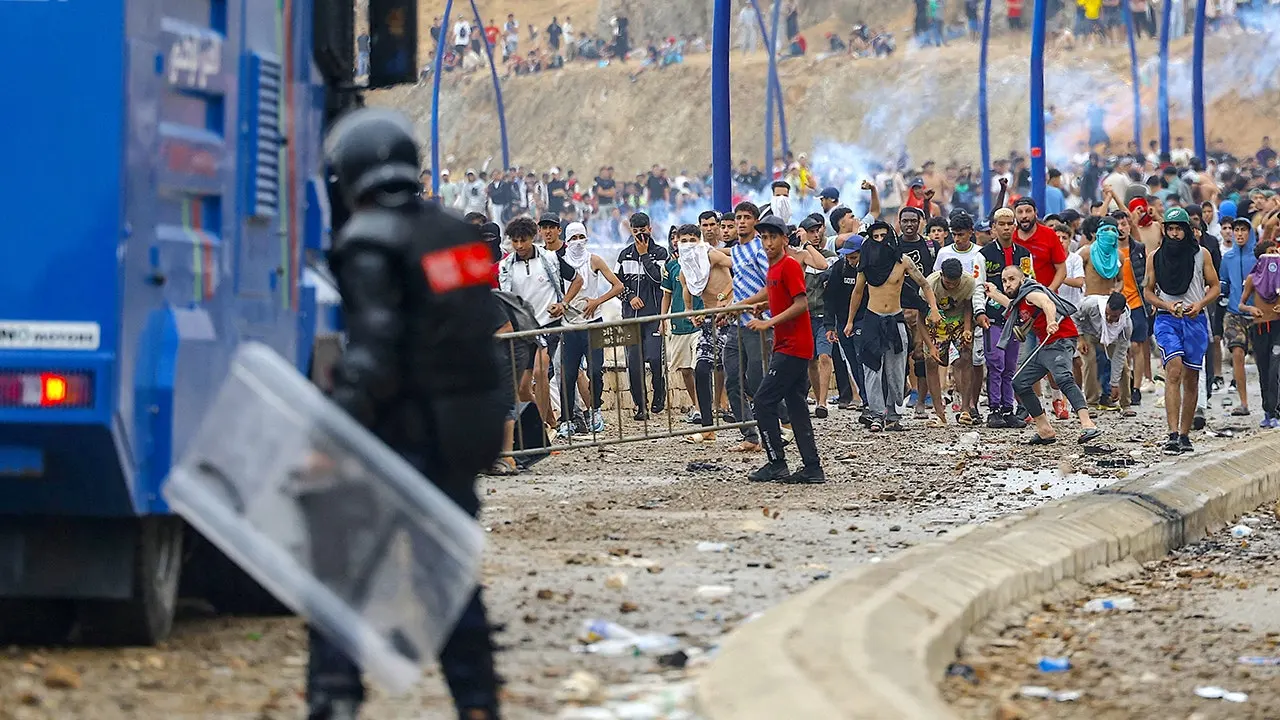
The small, sun-drenched Spanish enclave of Ceuta, a tiny fragment of Europe clinging to the North African coast, became the epicenter of a profound humanitarian and geopolitical crisis as a sudden, overwhelming wave of humanity crashed against its borders. Within a matter of days, an estimated 72,000 migrants made the desperate crossing from neighboring Morocco, transforming the quiet, fortified territory into a scene of chaotic desperation. While Spanish authorities managed to process and facilitate the return of approximately 70,000 people back across the border, a residue of roughly 2,000 exhausted souls remained stranded in the enclave, caught in a agonizing state of administrative and physical limbo. Among those left behind in the dust and heat were 862 unaccompanied minors, protected under Spanish law from immediate, summary deportation, but left with nowhere to go as local youth shelters collapsed under the sheer volume of arrivals. The heartbreaking reality of the crisis quickly materialized on the streets of Ceuta, where local residents witnessed children, some barely into their teens, begging for scraps of bread and sleeping on cold concrete pavements under the open sky, their dreams of a secure European future reduced to a struggle for daily survival.
This massive human tide did not emerge from a vacuum; rather, it was engineered and accelerated by a highly sophisticated, invisible digital storm that exploited the deep-seated desperation of North African youth. An open-source intelligence investigation conducted by Golden Owl Intelligence revealed that the mass migration was preceded by weeks of intense, coordinated mobilization across digital platforms like TikTok, Instagram, WhatsApp, and Facebook, generating more than 11 million potential online impressions. This campaign weaponized a July 8 Spanish Supreme Court ruling regarding the immediate return of migrants intercepted at sea, twisting a complex legal decision into a viral, misleading rumor that Spain was offering open borders and automatic legal status to anyone who could reach its soil. Administered in part by messaging networks linked to Algerian international phone codes, these platforms flooded the internet with practical advice, including highly detailed maps, optimized swimming routes, and coordinated departure times. For thousands of hopeful teenagers scrolling through social media in search of a future free from poverty, these idealized, algorithmically boosted videos of European prosperity became an irresistible siren song, convincing them to risk their lives on the false promise of an open door.
As the chaotic nature of the mass crossing unfolded, the humanitarian tragedy quickly collided with acute national security anxieties, forcing Spanish security forces to confront the dark potential of opportunistic infiltration. Spain’s National Police and Guardia Civil launched exhaustive investigations, meticulously reviewing border surveillance footage and cross-referencing biometric data against international counterterrorism databases. The primary concern for Spanish interior ministry officials was the genuine risk that seasoned criminals or suspected jihadist operatives might have used the overwhelming, chaotic surge as a tactical smokescreen to slip undetected into European territory. This anxiety was deeply compounded by Ceuta’s immediate geographical proximity to the Moroccan border town of Fnideq, also known as Castillejos, a locality that has historically loomed large in counterterrorism investigations as a fertile recruiting ground for extremist groups. Having previously dismantled active terror cells operating across this very border, and knowing that hundreds of individuals from the region had migrated to join ISIS in Syria and Iraq during the mid-2010s, security forces found themselves walking a razor-thin line between managing a heartbreaking humanitarian emergency and protecting the external frontier of the European Union from asymmetric security threats.
Beyond the immediate security and humanitarian implications, the crisis in Ceuta has emerged as a powerful ideological weapon for domestic political movements seeking to undermine the stability of the Moroccan government. According to Zineb Riboua, a research fellow at the Hudson Institute, local Islamist factions have seized upon the visible desperation of the youth to launch a coordinated political offensive against Morocco’s secular, pro-Western monarchy. By portraying the government’s close diplomatic relationships with the United States and Israel as a betrayal of traditional values, and by arguing that the state has failed to provide a viable economic future for its own people, these opposition movements have successfully tapped into widespread domestic frustrations over high youth unemployment and stagnant economic conditions. Islamist voices have systematically promoted an idealized, almost mythic image of Europe as a sanctuary of wealth and easy legal regularisation, transforming the physical act of migration into a form of political protest. With national elections on the horizon, the tragic images of thousands of Moroccans fleeing toward a Spanish enclave have been weaponized to weaken public confidence in the state, turning a border control crisis into a pivotal domestic struggle for political legitimacy.
This multifaceted crisis has also pushed the diplomatic relationship between Spain and Morocco to a point of intense friction, exposing deep divisions within Spain’s political leadership and testing the European Union’s external border strategy. In the immediate aftermath, European Commissioner for Internal Affairs and Migration Magnus Brunner convened an emergency meeting in Brussels, offering Spain emergency financial and logistical assistance to reinforce Ceuta’s heavily fortified perimeter. Within Spain, a sharp contrast emerged between national diplomatic caution and local outrage; while Spanish Foreign Minister José Manuel Albares defended Rabat’s cooperative response in facilitating the return of the vast majority of the migrants, and Interior Minister Fernando Grande-Marlaska admitted his intelligence services had received no advanced warning of the surge, local officials were far less forgiving. Juan Jesus Vivas Lara, the president of the autonomous city of Ceuta, gave voice to the deep resentment felt by many local residents, publicly declaring that Morocco had shown itself to be an unreliable neighbor that had, at the very least, permitted the chaotic breach to unfold as a form of geopolitical leverage. This diplomatic standoff highlights the delicate, often volatile nature of Europe’s strategy of outsourcing its border enforcement to North African partners, where human lives can easily become pawns in larger geopolitical disputes.
Ultimately, the dramatic events in Ceuta serve as a stark, modern parable about the fragility of borders in a hyper-connected, volatile global landscape, where the physical world is increasingly governed by digital currents. As the crisis sent shockwaves across the continent, prompting neighboring Italy to restore border controls with Spain, the systemic vulnerabilities of Europe’s open-border Schengen system were once again laid bare. The situation highlights an unprecedented challenge for the modern nation-state: how to secure physical frontiers against surges that are coordinated entirely in the borderless, digital realm of social media algorithms, while still upholding the fundamental human rights of those who arrive. Meanwhile, far removed from the high-stakes political debates in Brussels and Madrid, the human cost of this crisis remains visible on the dusty streets of Ceuta, where hundreds of stranded children wait in administrative limbo, caught between a homeland that offered them little hope and a European dream that has locked its gates.