


On a quiet Monday evening in North Belfast, the fragile peace of a working-class neighborhood was shattered in a matter of seconds by an act of devastating, life-altering violence that has left a community in deep mourning and anger. Stephen Ogilvie, a local man in his 40s, was walking through his community when he was suddenly and brutally set upon in a vicious knife attack. The assault, which occurred shortly after 10:30 p.m., left Ogilvie with horrific, deep wounds to his neck, back, chest, and face, culminating in the permanent and agonizing loss of his left eye. As the terrifying scene unfolded, it was only the extraordinary, split-second bravery of ordinary bystanders—including one individual who defended Ogilvie with a traditional Irish hurling stick—that prevented a dark night from becoming a fatal tragedy. These local heroes put their own lives at risk to pull the attacker away, an act of sheer courage that emergency responders and police officials later credited with saving Ogilvie’s life. The man accused of this senseless brutality is Hadi Alodid, a 30-year-old Sudanese asylum seeker who had entered Northern Ireland through the Republic of Ireland in 2023 and had recently been granted a five-year permit to remain. When Alodid appeared via video link in Belfast Magistrates’ Court, his refusal of legal representation and quiet reliance on an Arabic interpreter stood in stark, chilling contrast to the immense geographic and social chaos his alleged actions had unleashed. He now faces heavy charges of attempted murder, possession of a weapon, and threatening to kill a hospital radiographer, leaving a traumatized victim to face a lifetime of physical disability and a community grappling with the profound psychological scars of an unprovoked assault.
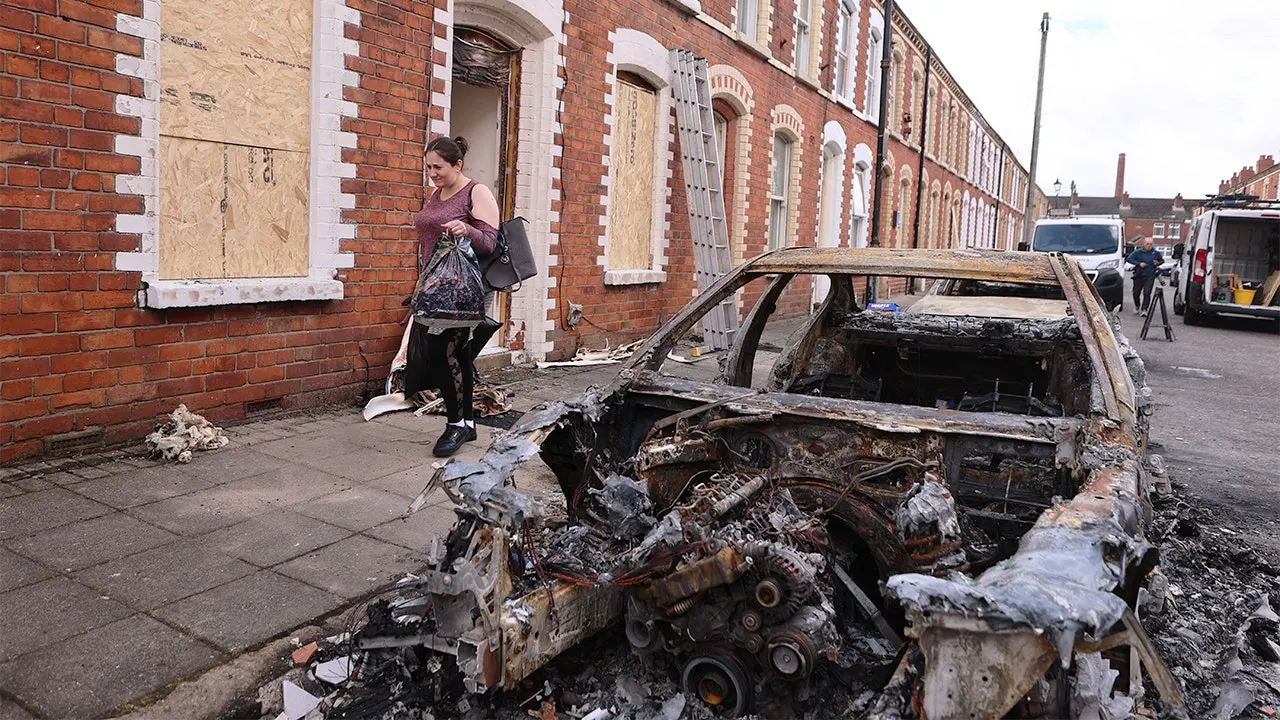
The graphic footage of the attack quickly went viral online, acting as a highly combustible accelerant in an already tense and fragile social landscape. Within hours, the shock of the stabbing turned to raw, unfocused fury as mobs of masked men took to the streets of Belfast, weaponizing their anger against the city’s immigrant population. What followed was a night of absolute terror for immigrant families who had come to Northern Ireland seeking sanctuary from violence in their own war-torn homelands. Rioters set fire to residential homes they believed housed immigrants, threw petrol bombs, torched a public bus, and targeted emergency services trying to quell the flames. For residents like Anselme Shima, a native of the Democratic Republic of the Congo who has lived peacefully in Belfast for nearly a decade, the night was a waking nightmare. Shima, who had long built warm, neighborly relationships on his street, described the paralyzing fear of watching his neighborhood descend into tribal violence, wondering if his home would be the next one targeted by the arsonists. The desperate sight of firefighters pulling traumatized families from burning living rooms captured the tragic irony of the unrest: in the name of protesting a violent crime, rioters were perpetrating acts of life-threatening violence against innocent people who had absolutely no connection to the stabbing.
This explosion of street level violence forced a swift and severe response from Northern Ireland’s political leadership, who stood united in their condemnation of the rioters while acknowledging the gravity of the initial attack. First Minister Michelle O’Neill of Sinn Féin denounced the masked mobs as cowards engaged in nothing short of “disgusting thuggery,” while Deputy First Minister Emma Little-Pengelly of the Democratic Unionist Party pointed out the moral bankruptcy of punishing innocent people for the wicked acts of a single suspect. British Prime Minister Keir Starmer also weighed in, branding the stabbing “sickening” and promising that those using the tragedy to justify racial and sectarian violence would face the full force of the law. However, beneath the political condemnation lies a complex and deeply sensitive geopolitical debate regarding national security. The fact that Alodid crossed into Northern Ireland from the Republic of Ireland has reignited intense political scrutiny over the porous nature of the Irish border. For decades, the open border has been a sacred pillar of the 1998 Good Friday Agreement, which brought a delicate end to “The Troubles”—a bloody conflict that claimed nearly 3,600 lives. Today, politicians and citizens alike are left asking how to balance the necessity of border control and national immigration security with the preservation of a hard-won peace that relies on free movement and mutual trust.
The speed with which the Belfast riots escalated cannot be decoupled from the modern digital ecosystem, where real-time outrage is carefully curated, packaged, and weaponized by political agitators. Prominent anti-immigration figures, most notably Stephen Yaxley-Lennon, widely known as Tommy Robinson, used their massive online platforms to broadcast details of the stabbing, framing the incident not as an isolated criminal act but as a systemic failure of national immigration policy. This digital instigation found fertile ground in Belfast’s working-class neighborhoods, areas where the legacy of historic paramilitary organizations still looms large over daily life. In these communities, young men, some masked and organized, took to the streets to engage in running battles with the Police Service of Northern Ireland (PSNI), who were eventually forced to deploy water cannons and riot gear to regain control. The intersection of online disinformation, real-world anxiety over immigration, and the lingering threat of localized paramilitary influence created a perfect storm, transforming a horrific knife attack into a broader, highly volatile ideological battlefield that threatens to destabilize local communities for months to come.
The unrest in Belfast does not exist in a vacuum; rather, it reflects a growing, palpable frustration across the United Kingdom regarding public safety, migration, and the perception of the justice system. Many communities draw direct and painful parallels to other high-profile tragedies, such as the heartbreaking death of Henry Nowak in Southampton, England. Nowak, a white man, was brutally murdered by Vickrum Digwa, a Sikh man who maliciously lied to responding police officers, claiming he had been the victim of a racist attack by Nowak. Believing the killer’s false narrative, officers initially treated the dying Nowak as a hostile suspect rather than a victim, delaying critical life-saving care in his final moments. While Digwa was recently sentenced to life in prison with a minimum of 21 years, the case left behind a legacy of deep-seated public anger and fueled widespread allegations of a “two-tier justice system” where victimhood and criminality are perceived to be viewed through the lens of identity politics. The violent protests that followed Nowak’s killing, much like the riots currently seen in Belfast, demonstrate how quickly a sense of systemic unfairness and administrative failure can boil over into public disorder when citizens feel that the state is failing to protect them or administer justice impartially.
At its core, the unfolding crisis in Belfast is a deeply human tragedy that leaves two distinct communities mourning and fearful. On one side is Stephen Ogilvie and his loved ones, whose lives have been forever altered by an act of unprovoked violence, facing a long road of physical rehabilitation and psychological recovery. On the other side are innocent asylum seekers and ethnic minority families, many of whom fled torture, war, and persecution in countries like Sudan and the Congo, only to find themselves cowering in their own homes as mobs of angry men try to burn them alive. The path forward for Northern Ireland requires more than just police crackdowns and political platitudes; it demands an honest, empathetic reckoning with the anxieties of working-class communities alongside a fierce defense of the basic human rights of vulnerable residents. As the smoke clears from the streets of Belfast, the true challenge lies in rebuilding a society where justice is swift and fair, where borders are managed with integrity, and where the safety of a citizen is never compromised by the color of their skin, their country of origin, or the desperate circumstances that brought them to these shores.