




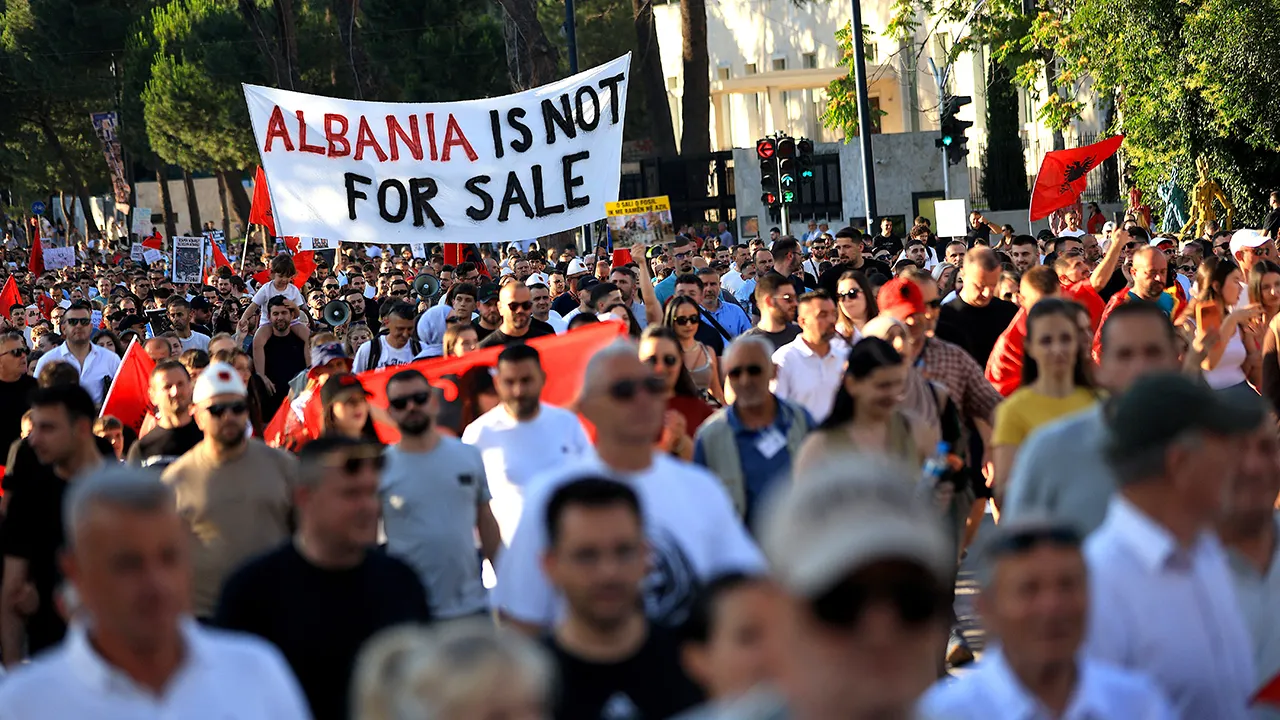
The coastal breezes of the Balkan Peninsula, once carrying only the gentle scents of the Adriatic and Ionian seas, are now thick with the electric tension of a nation awake and demanding change. Across Albania, the streets of major cities have become a canvas of human frustration as thousands of citizens gather in tireless waves to demand the immediate resignation of Socialist Prime Minister Edi Rama. This is not a sudden flare of passion but a deep, collective sigh from a populace that has weathered three decades of systemic disappointment. Since the collapse of one of Europe’s most repressive communist regimes in 1991, ordinary Albanians have watched power cycle between Prime Minister Rama and opposition figures like Sali Berisha, both of whom are increasingly viewed as custodians of a stagnant political class. For more than thirty years, the promise of true democracy and transparent governance has retreated further into the horizon, replaced by allegations of entrenched public corruption, economic inequality, and contested elections. Now, the boiling point has been reached, driven by a profound fatigue with a system where political elites are seen as enriching themselves at the expense of the nation’s youth, its natural heritage, and its democratic spirit.
The immediate catalyst for this groundswell of public outrage lies in a multi-billion-dollar luxury coastal development plan spearheaded by Jared Kushner’s investment firm, Affinity Partners. The ambitious proposal aims to breathe ultra-luxury tourism into two highly distinct coastal properties, promising to construct approximately 10,000 high-end hotel rooms and exclusive private villas. The first of these locations, Sazan Island, is a rugged, mysterious landmass that once served as a heavily fortified Soviet military base during the height of the Cold War, a place long shrouded in secrecy and closed to the public. The second proposed development site in Zvërnec is even more controversial, as it sits within the ecologically delicate Vjosa-Narta protected landscape. This pristine delta serves as an irreplaceable sanctuary for rare Mediterranean monk seals, flocks of vibrant pink flamingos, and nesting sea turtles. For many Albanians, the transformation of these ecological gems into playgrounds for the global ultra-wealthy is a symbolic final straw, representing the commodification of their national identity and the destruction of irreplaceable ecosystems under the guise of progress.
Yet, those who understand the complex inner workings of Albanian socio-politics emphasize that the anger of the people is far more nuanced than simple anti-foreign sentiment. Agim Nesho, a highly respected diplomat who has served as Albania’s ambassador to both the United States and the United Nations, points out that the protests are not targeting foreign investors or the family of former U.S. President Donald Trump. Instead, Nesho explains that many Alabanians view foreign investment—potentially injecting up to $4 billion into the local economy—as a desperate need for a nation trying to retain its disappearing youth. The tragedy, in the eyes of many locals, is not the foreign capital itself, but the corrupt framework through which it is being facilitated. Critics accuse Prime Minister Rama and his network of aligned oligarchs of systematically stripping away long-standing environmental protections on private lands to lay the groundwork for these mega-projects. For a population that has endured twelve years of Rama’s rule, marred by allegations of rigged parliamentary elections that granted him an unchecked supermajority capable of rewriting the constitution at will, the luxury resorts have become a physical manifestation of a government that answers only to itself.
In the face of mounting domestic and international pressure, Prime Minister Edi Rama’s administration has constructed a fierce defense, characterizing the outcry as a campaign of disinformation orchestrated by political adversaries. When the protests first erupted in May, the government initially attempted to downplay the movement, dismissing the crowds as a negligible gathering of disgruntled individuals. However, as the protests ballooned in size and gained traction in global media outlets, the administration’s narrative shifted dramatically, with officials claiming the unrest was part of a “hybrid war” fueled by geopolitical adversaries like Iran and Russia seeking to destabilize the region. In official statements, Rama’s administration insisted that Sazan Island remains public state property that will never be sold, and that the Zvërnec project is taking place on legitimate private land subject to rigorous, “In-Depth Environmental Impact Assessments.” Despite these assurances, the international community has signaled deep concern; the European Parliament recently urged the Albanian government to halt construction on protected lands and issued a call for a moratorium on permits, highlighting the growing divide between the government’s rhetoric and the ecological realities validated by international observers.
This political battle is not fought in abstract legislative halls alone; it is lived daily by the weary citizens who occupy the streets of Tirana. Eric Czuleger, an editor who has lived in Albania for five years documenting the evolving societal landscapes, notes that the current protests represent an unprecedented level of direct pressure on the executive branch, leaving the public caught in a tense psychological dilemma. On one hand, there is a pervasive fear that if this movement fails, systemic corruption will become permanent, prompting even more young Albanians to flee the country in search of a future. On the other hand, there is a haunting anxiety that a sudden collapse of the government could trigger a chaotic power vacuum, potentially ushering in a leadership that is even more volatile. This exhaustion is palpable among the protesters, yet the flame of resistance is kept alive by cultural figures like actor and artist Florjan Binaj, who describes the current wave of demonstrations as the most powerful and significant collective awakening the country has witnessed since the fall of communism in 1991.
As the standoff continues to unfold under the watchful eye of the global community, the ultimate destiny of Albania remains balanced on a razor’s edge. Asher Abehsera, representing the real estate development interests on Sazan Island, has publicly stated that the project’s future will ultimately be decided by the Albanian people themselves, promising a commitment to environmental stewardship and economic opportunity. However, for the thousands of citizens waving flags and chanting in the public squares, corporate promises of future ecological care are insufficient guarantees when the domestic political system is perceived as thoroughly compromised. For seasoned diplomats like Agim Nesho and the passionate crowds who refuse to go home, there is no longer any room for compromise or backroom negotiations with the current administration. They believe that the only viable path toward healing national wounds and restoring faith in the democratic process is the immediate resignation of the government, followed by early elections conducted under the strict, transparent supervision of international monitors, finally allowing the Albanian people to reclaim their voice and secure their homeland.