


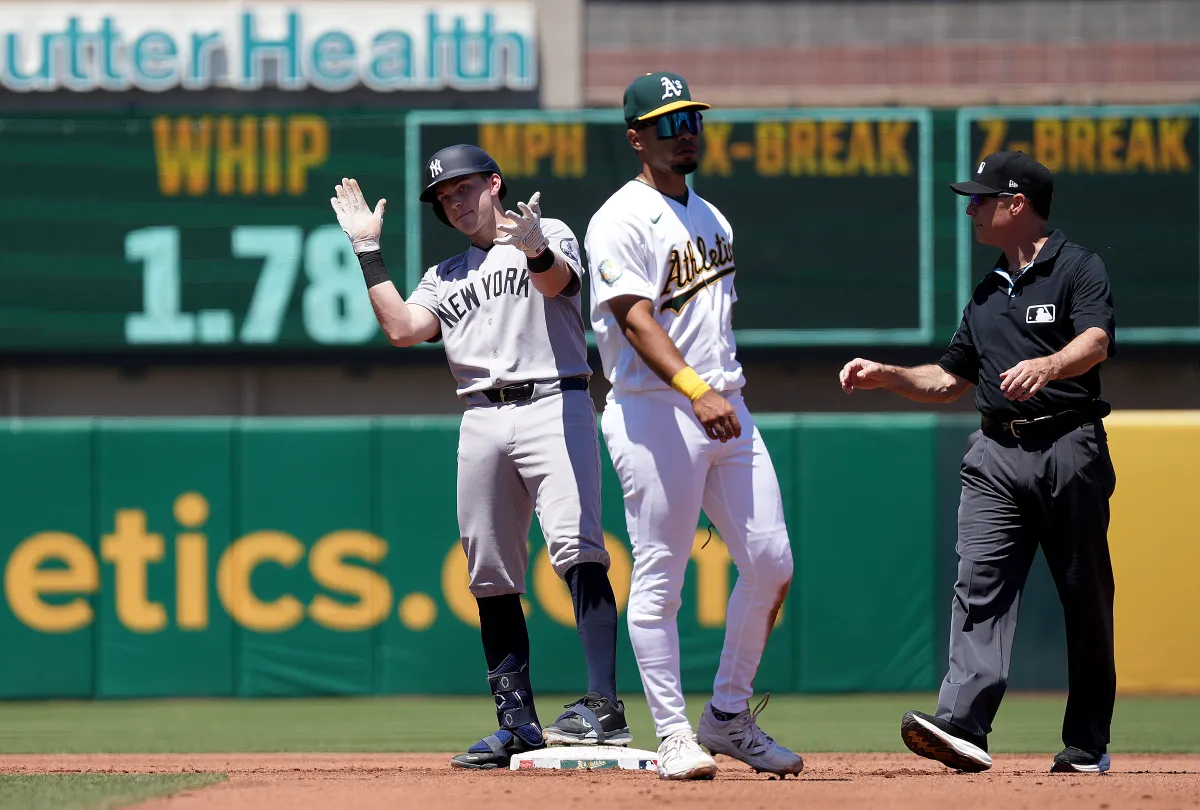
There is a beautiful, almost poetic absurdity to the game of baseball, a sport completely unbound by the constraints of a game clock, where momentum can shift like the wind and history can be written in the span of a single, chaotic hour. On May 31, under the warm spring evening skies of West Sacramento, the New York Yankees and the Oakland Athletics treated fans to a performance that defied not only traditional sporting logic but the very laws of probability. In a game that will be studied by researchers and sports historians for generations, the Yankees secured a victory over the Athletics by launching a historic, offensive onslaught that was as concentrated as it was devastating. For eight of the nine innings played, the Bronx Bombers resembled a dormant volcano, completely silent, utterly hitless, and seemingly unable to find any rhythm against the Athletics’ pitching staff. Yet, in one miraculous, exhausting, and utterly breathtaking frame—the bottom or top of the third inning—the Yankees erupted for a staggering 13 runs, packing an entire game’s worth of offensive fireworks into a single explosive window before vanishing back into the shadows of offensive dormancy for the rest of the night. It was a sports phenomenon that perfectly illustrates the capricious nature of baseball, landing somewhere between a masterclass in offensive dominance and a bizarre statistical anomaly.
To truly understand the human experience of this historic evening, one must look at the game through the eyes of the players who lived through the whirlwind on the field, particularly young shortstop Anthony Volpe. For a batter, a normal game involves hitting, running, and then resting on the bench for a significant period to recover, but the third inning became an endless merry-go-round that pushed the physical endurance of the Yankees’ lineup to its limits. Volpe described the sheer dizziness of the moment to reporters afterward, laughing about the surreal feeling of constantly running the bases, barely having time to catch his breath in the dugout, and immediately having to strap his heavy batting armor and helmet back on to hit all over again. The young infielder actually came to the plate twice in that single inning and was left standing in the on-deck circle, batting helmet on and bat in hand, when the marathon frame finally concluded on a Trent Grisham flyout. In total, the Yankees sent an astonishing 18 batters to the plate during that single inning, successfully chasing three different Athletics pitchers from the mound in a relentless parade of baserunners. In an incredible display of focused execution, the first 12 consecutive Yankees batters reached base safely before the Athletics could record a single out, tying a momentous expansion-era record and leaving the opposing defense looking utterly helpless under the onslaught.
What makes this particular game a historic masterpiece, and a source of endless debate for baseball purists, is the absolute void of offensive production that bookended this single explosive inning. According to the Elias Sports Bureau, the official historians of Major League Baseball, the Yankees became the first team since the major league expansion of 1961 to score as many as 13 runs in a game while compiling literally all of their hits in a single, solitary inning. In the other seven innings they came to the plate, the Yankees were held entirely hitless and scoreless, a feat that typically guarantees a devastating loss rather than a blowout victory. This staggering contrast places the Yankees in an elite club of historical anomalies, as only two other franchises in the long, storied annals of American and National League history have ever managed to score that many runs in a single frame to account for their entire scoring output. The Philadelphia Phillies achieved this rare feat on April 13, 2003, during a road game in Cincinnati, and the Atlanta Braves did the same on September 20, 1972, but neither of those historic squads paired their offensive explosion with the absolute silence of going completely hitless through the rest of the contest.
On the opposite side of the diamond, the game offered a poignant, highly human story of professional resilience, redemption, and the cruel, unsung reality of being a major league relief pitcher. For the Athletics, the third inning was a defensive nightmare of epic proportions, a runaway train that simply could not be stopped no matter who was thrown onto the mound. Yet, once the dust finally settled and the Yankees’ historic rally was capped at 13 runs, a quiet and deeply impressive pitching performance began to unfold for Oakland. A quartet of resilient relievers—Jack Perkins, Mark Leiter, Jr., Luis Medina, and José Suarez—stepped onto the mound in a game that was already mathematically out of reach and proceeded to throw an absolute gem of a ballgame. Perkins inherited a chaotic, bases-loaded situation with two outs in the third and finally extinguished the fire, and from that moment on, these four pitchers completely neutralized one of the most dangerous and expensive lineups in professional sports. For the remainder of the evening, they allowed no runs and remarkably surrendered zero hits, performing at an elite level that would normally dominate sports headlines. Instead, because of the insurmountable 13-run mountain established in the third, their stellar and heroic efforts were relegated to a historical footnote, highlighting the occasional unfairness of a sport where a single bad half-hour can completely erase hours of subsequent excellence.
To put the sheer scale of the Yankees’ third-inning explosion into its proper historical perspective, one has to travel back through time and summon the legendary ghosts of the franchise’s past. Not even the vaunted, near-mythical “Murderers’ Row” of the 1927 New York Yankees, an offensive powerhouse anchored by the immortal duo of Babe Ruth and Lou Gehrig, ever managed to put together a 13-run inning. The absolute franchise record for runs scored in a single inning stands at 14, a milestone set nearly a century ago on July 6, 1920, during an era when the sport looked entirely different. On that hot summer afternoon, Babe Ruth himself drew an intentional walk and later hammered a two-run single during a legendary fifth-inning onslaught against the Washington Senators. To think that nearly 126 years of franchise history, filled with dozens of Hall of Fame legends, championship rings, and legendary dynasties, separated that afternoon in 1920 from this modern-day game in West Sacramento provides a profound sense of scale. The modern Yankees managed to carve their names alongside the greatest teams to ever play the game, not by dominating a full nine-inning contest, but by capturing lightning in a bottle for a single, unforgettable stretch where every bounce went their way and every swing found open grass.
Ultimately, this unforgettable game serves as a beautiful, head-scratching metaphor for the sport of baseball itself, reminding us why fans continue to flock to ballparks and keep their eyes glued to television screens night after night. It is a sport where spreadsheets, predictive algorithms, and advanced analytics can be completely undone by the glorious, unpredictable chaos of human performance. On May 31, the Yankees proved that a team does not need a sustained, game-long offensive attack to make history; sometimes, all it takes is a single, magical window of perfect alignment where everything falls into place. As the players packed their bags and the stadium lights in West Sacramento struggled to fade, they left behind a box score that read like sports fiction—an extraordinary document of a game won comfortably by a team that was completely silenced for almost the entire night. For Anthony Volpe, his teammates, and the fans who witnessed it, it was a joyous, exhausting, and wonderfully bizarre reminder that no matter how much we think we understand the game of baseball, the diamond still reserves the right to shock us with something we have never seen before.