


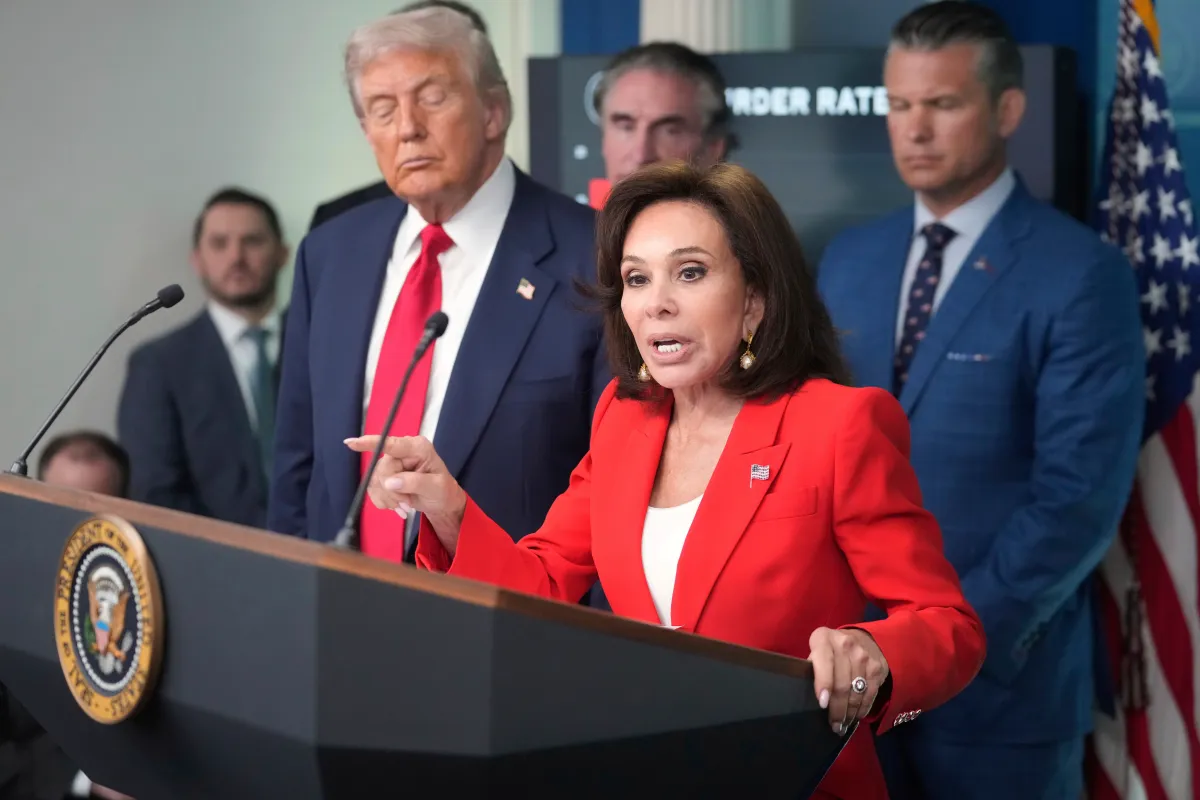
In the heart of the nation’s capital, where marble monuments stand as silent witnesses to centuries of political theater, a highly public and remarkably personal civil war has erupted within the upper echelons of federal law enforcement. The dispute centers on the iconic Lincoln Memorial Reflecting Pool, a place usually reserved for quiet national reflection, which has suddenly become the focal point of a fierce rhetorical battle between President Donald Trump and one of his most prominent appointees, interim U.S. Attorney for the District of Columbia Jeanine Pirro. Taking to his social media platform, Truth Social, on a turbulent Saturday, Trump unleashed a blistering public rebuke of Pirro, declaring that he disagreed “100%” with her office’s decision to dismiss felony charges against a high-profile protester. The public splintering of a president and his hand-picked prosecutor is a rare and jarring spectacle in modern American politics, instantly transforming a localized dispute over property damage into a high-stakes drama about political loyalty, justice, and the definition of truth in a deeply divided country. Trump’s blunt online broadside—asking his millions of followers what Pirro was “thinking?”—laid bare a fundamental disconnect between the political demands of the executive branch and the quiet, evidence-based realities of federal prosecution. This sudden fracture has sent shockwaves through the Department of Justice, illustrating how even the most technical legal decisions can be instantly politicized and transformed into litmus tests of political fealty, leaving career prosecutors and political observers alike scrambling to understand the long-term fallout of this unprecedented public confrontation.
The core of this ideological and legal conflict lies in a fundamentally different interpretation of physical reality: was the damage to the historic Reflecting Pool a deliberate act of political warfare, or was it merely the unfortunate result of administrative and technical incompetence? Interim U.S. Attorney Jeanine Pirro’s office concluded the latter, filing motions to dismiss the criminal case after an exhaustive investigation revealed that the structural and aesthetic degradation of the pool was primarily caused by “flawed installation” by private contractors rather than malicious intent by demonstrators. This pragmatic, evidence-based assessment, however, ran directly into the buzzsaw of the president’s narrative-driven worldview, which favors clear-cut battles between good and evil. To Donald Trump, the scientific and contractual explanations offered by his own appointee were nothing more than a bureaucratic cop-out that ignored the blatant visual evidence of a targeted assault on a cherished national landmark. Trump passionately argued that the site had been subjected to a “pure case of VANDALISM,” pointing to the scarred grass and the surrounding landscape as undeniable proof of a malicious attack that could not be explained away by technicalities. By framing the incident as an act of destruction rather than a construction mishap, Trump sought to validate the outrage of his political base, who viewed the physical disruption of the National Mall as a direct insult to the administration. This clash highlights a recurring theme of the modern era: the tension between a complex, data-driven investigation that uncovers mundane technical failures and a powerful, emotionally charged political narrative that demands a visible villain and immediate retribution.
At the eye of this political hurricane stands David Hearn, an Olympian whose life was abruptly upended when he was thrust into the national spotlight as the primary target of a high-stakes federal felony prosecution. Hearn had participated in a highly charged demonstration near the Reflecting Pool in May, a protest that sought to draw attention to pressing national issues through bold visual statements and public assembly. However, the transition from peaceful demonstrator to accused federal felon is a terrifying journey, one that carries the potential to destroy an athlete’s career, reputation, and life’s work in an instant. For months, Hearn lived under the crushing weight of these allegations, only for the prosecution’s case to quietly unravel behind closed doors as investigators dug beneath the surface of the initial accusations. When federal prosecutors finally reviewed the newly obtained evidence, they realized a hard truth: while Hearn was undoubtedly present at the protest, there was simply no way to prove beyond a reasonable doubt that he was personally responsible for the physical destruction of the site. The decision to dismiss the charges was a moment of profound relief for Hearn and his legal team, representing a triumph of the legal system’s requirement for concrete proof over mere association. Yet, this victory was short-lived in the court of public opinion, as the president’s subsequent intervention dragged Hearn’s name back into the arena, proving that in the digital age, a legal exoneration does not always guarantee a return to peace.
Perhaps the most culturally explosive element of this entire saga is the message that was left emblazoned upon the manicured lawns surrounding the Reflecting Pool: the giant, scorched letters and numbers “86 47.” This simple sequence of characters quickly became a modern-day Rorschach test for a polarized nation, with its meaning shifting dramatically depending on the political lens through which it was viewed. To the president’s most ardent allies and security officials, the phrase was interpreted as a chilling, thinly veiled threat against the safety and legitimacy of the president himself, utilizing the restaurant industry slang “86”—meaning to eject, discard, or eliminate—alongside “47,” a direct reference to the forty-seventh presidency. They argued that carving such a message into the earth near a national monument was an act of intimidation that transcended peaceful protest and crossed the line into domestic extremism. On the other side of the debate, civil liberties advocates and Hearn’s supporters vigorously defended the display as a classic, albeit provocative, form of protected political expression, arguing that the phrase was merely a creative demand for political change and electoral rejection. This linguistic battleground underscores the profound difficulty of policing speech in a highly charged political atmosphere, where a single phrase can be simultaneously defended as a fundamental constitutional right and condemned as an act of treasonous vandalism, leaving the justice system caught in the impossible position of refereeing the boundaries of political metaphor.
The public rift between Trump and Pirro also shines a harsh spotlight on the delicate and often perilous position of interim political appointees who find themselves caught between their oath to the law and their loyalty to the executive who appointed them. Jeanine Pirro, a figure long known for her fierce media presence and alignment with conservative ideals, suddenly found herself in a role that demanded absolute adherence to the sober, non-partisan rules of federal law enforcement. In choosing to dismiss the charges based on the objective findings of contractor error, Pirro demonstrated a commitment to the ethical standards of her office, prioritizing the integrity of the judicial process over the political desires of the White House. This act of professional independence, however, met with swift and public condemnation from the very president who placed her in power, illustrating the immense pressure faced by justice officials who dare to contradict the preferred political narrative. The situation serves as a stark reminder of the fragile boundaries that separate the administration of justice from the theater of political campaign trail, raising deep questions about the sustainability of independent institutions in an era where public officials are increasingly expected to prioritize personal loyalty over factual accuracy.
As this breaking news story continues to send shockwaves across the country, it serves as a powerful microcosm of the broader challenges facing modern American society, where facts are continuously contested and public institutions are subjected to relentless pressure. The immediate rush of social media commentary, political punditry, and official statements has created a dizzying echo chamber where the nuances of contract law and evidentiary standards are easily drowned out by partisan anger and sensational headlines. The ultimate resolution of the Reflecting Pool incident remains uncertain, with citizens and legal experts alike waiting to see if the Department of Justice will bend to presidential pressure or stand firm behind the independent findings of its prosecutors. What is clear, however, is that the human cost of this conflict—borne by the accused, the prosecutors, and the public trust—will be felt long after the physical damage to the monument is repaired and the grass grows back over the controversial slogan. In an age defined by rapid-fire digital communication and deep-seated institutional distrust, this high-profile clash stands as a sobering reminder of how easily the search for truth can be overtaken by the pursuit of political dominance, leaving a nation to ponder the true state of its justice system.