





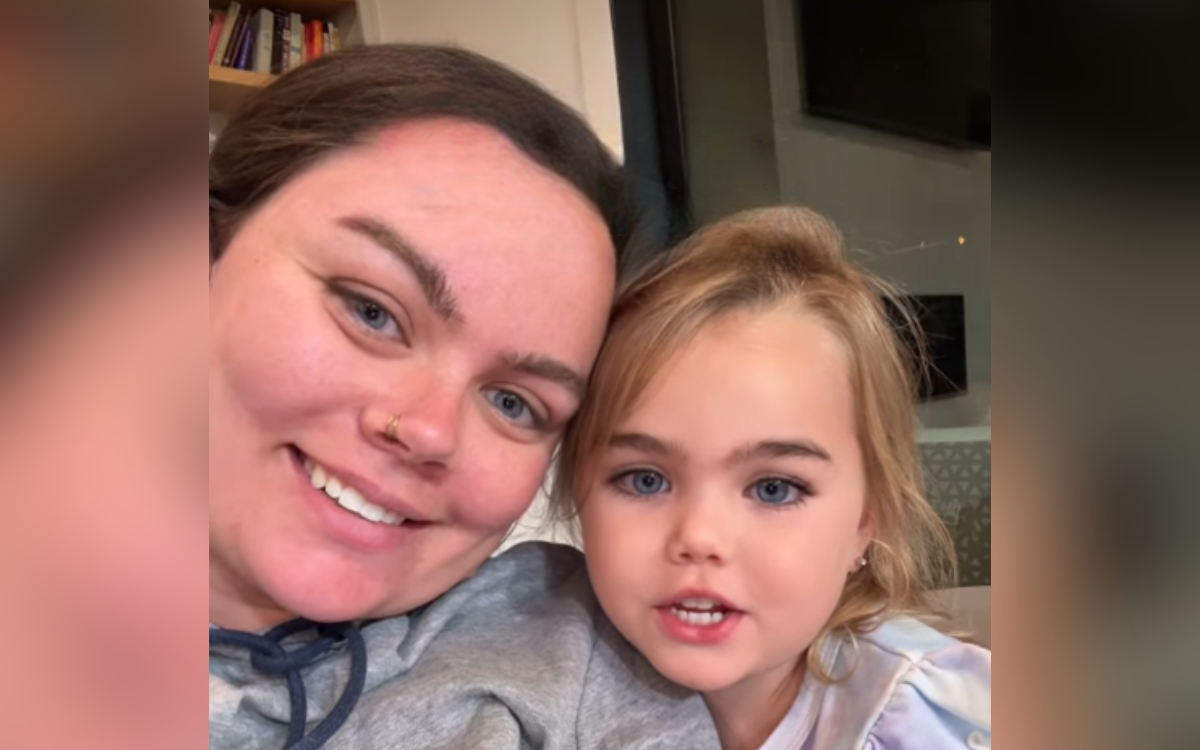
Kiely Branch, a mother in Texas, is used to a full house and a full schedule: four children under the age of five, with a fifth on the way. Every day brings a swirl of small toys, bedtime battles, snack negotiations, overflowing laundry baskets, and the kind of sweet, chaotic moments that she has learned to treasure. Like many parents of young kids, Branch has found comfort and community in sharing pieces of her family’s entire life on social media. The good moments. The funny ones. The ones that make other parents feel like they aren’t alone. “Life in our house is definitely never boring,” she says, laughing. That steady documentation of family life has made her no stranger to the strange and sometimes unexpected ways the internet can respond to ordinary moments. But nothing prepared her for the moment she posted an ordinary photo of her four-year-old daughter and woke up the next morning to a completely different internet reality.
It looked like just another small post at first, not the kind of thing that would lead to thousands of replies. Branch noticed that the views were worryingly low and even considered taking the photo down entirely. She shrugged it off as one of those posts that simply flew away. But overnight, something shifted. She woke up and the post had not only taken on a life of its own. It had filled the video comments with new faces, long messages, and a strikingly sincere tone. She tried to understand why so many strangers had suddenly gathered around a picture of her and her daughter. The answer, when she found it, was not a simple compliment, not a kind word about the girl’s smile, and not even the usual internet nonsense. Instead, two features on her daughter’s face had caught the attention of the crowd: her dark, thick eyebrows. The strangers weren’t just replying with some silly use. They were telling Branch something alarming. They said she needed to take her daughter to the doctor, and quickly, because those eyebrows shared a suspected symptom of a rare genetic condition. “A surprising number of people were telling me I needed to have her checked for a particular genetic condition because of her eyebrows,” she remembers. At first she didn’t take it too seriously, because she had been online long enough to know that the internet always has opinions. But the comments became more, and more persistent, and her mood turned from calm to frustration in the same way that any mother’s reaction might, when strangers start suggesting she was placing her child at risk.
The condition that people were mentioning was the one called Sanfilippo syndrome, also known as mucopolysaccharidosis type III, or MPS III. It is a rare inherited disorder that affects the body’s ability to break down certain sugar molecules, which causes progressive damage, especially to the brain and nervous system. Many affected children show signs of slowed development, speech difficulties, behavioral problems, and sometimes certain physical changes, including broad facial features, border forehead, or unusually shaped eyebrows. It is a devastating condition, and most people who heard the name before probably stumbled on it through a medical emergency, not through a comment pile. But here, the whole thing was based solely on the presence of thick eyebrows in a little girl. “What made it especially strange to me was her eyebrows aren’t unusual in our family,” Branch says. In fact, they are completely normal. She and her husband have both with naturally full, thick, even bushy eyebrows if they let them around. They actually joke that their kids were genetically guaranteed to inherit that same feature. “She’s not available, and we have no more unibrows. These eyebrows mean a full family feature, not a symptom of some disease,” Branch says. But this particular encounter offered an unexpected lesson on how easily a social media video can set an uncertain alarm campaign in motion, and how comfortable strangers can feel about jumping from a single photo to a medical diagnosis, without even considering all the blind spots in their own knowledge.
Branch decided to take the issue seriously, not because she believed it, but because she trusted that she should at least learn more. As a mother, she didn’t want to be careless about any suggestion that could affect her child’s health. So she began reading about Sanfilippo syndrome, and one after another, nothing in her daughter’s life seemed to fit. Her daughter had no developmental delays, no behavioral red flags, no speech or motor concerns. She had never had the ear infections that people and other commenters raised in the tower room. She didn’t have any gastrointestinal problems. She slept well. Her head circumference was green. Every pediatrician and medical professional who had cared for her in four years had said what she had seen in the development. “My daughter doesn’t have the issues people were assuming she had,” Branch says. “She’s never had an ear infection, doesn’t have the GI issues people were mentioning, sleeps extremely well, and we’ve never had concerns raised about her head circumference or development by her pediatrician or any of the other medical professionals who have cared for myself.” Still, the commenters kept coming, and their concern turned into a direct accusation. They called her neglectful, and said that she was failing her daughter if she didn’t rush to a doctor, she said. There are children joke; Maybe we have to imagine walking into a pediatrician’s office and saying, “Hi, TikTok told me my daughter has a genetic disorder because of her eyebrows. She isn’t showing any other symptoms, but can you check her out?” To Branch, that sentence alone explains how strange the moment had become. She wasn’t angry at everyone. Some were genuinely concerned. But countless users had gone from one specific feature to a rare syndrome, and then somehow to a story about a mother who was refusing to get care. It was “pretty wild” to him that people could a child they’d never even met from two photographs. “This is getting frustrating,” she says. The world refuses to think that this is how we make medical parenting decisions.
Branch’s story is one of the many realities that come from what researchers call “sharenting.” According to a 2021 survey from Security.org, 77 percent of parents in the United States have shared photos, videos, or stories of their children somewhere online. Posting family photos has become as normal as sending a text, but that level of visibility also turns ordinary footballing into a place where strangers believe they have access to a child’s story. A child can be about be examined, speculated about, and styled in front of thousands or event depending on who visits. For many parents, the internet is just a lifeline, a place to seek support, to laugh about the familiar disasters of family life, and to move out of the way they are rarely alone. The positive side of that connection is real. But the downside is darker. The same platforms that allow a mother to find a community also allow random users to share misinformation, stress, and unsolicited expertise. Sometimes a video from one parent and a group of strangers can spot a rare condition. That happens, and occasionally an increase from a good observer can be a life-changing thing. But the danger of pattern-recognition online is that almost any physical trait, a single gesture, a tone of voice, a sticky bedtime, can be turned into a red flag by someone who has no training and complete context. Branch’s two photos of a child’s understand are a living reminder of how little context social media encourages. It is a change to an entire family in miniature. It is only a close-up or an angle, a knock from the rest of the person’s the child.
In the end, Branch has chosen to stay in and often them for the strange community she found herself in. She loves her daughter, she knows her child’s history, and she trusts the pediatricians who have been part of her life, not by people on a social app that has never called her name. She was outside and frustrated at times, especially when concerned commenters left the suggestion of medical negligence. But once the frustration passed, she began to watch the whole experience with a sense of humor and disbelief. “It has been really interesting, and sometimes hilarious, watching the internet try to figure out a child they’ve never met from two photographs,” she says. It is a model that many can relate to, especially in a time when social media has become such an important part of parenthood. The posts that take off are not always the ones we expect to matter. The conversations that erupt are sometimes about the things we least expected. And you can never predict what a stranger’s apparent sees in a child’s tiny face: a family resemblance, the mother’s own eyebrows, a niche, or a genetic condition that has no actual connection to the person. For Branch, the story could also be one small piece of the wider reason why we still need to be careful. Parents should value their pediatricians, trust their instincts, and appreciate that they can’t build a medical picture of a child from two of them. She plans to keep sharing moments from her busy home and looking forward to the newest baby. But she’ll remember the time a TikTok file from a Monday morning told her that her child had a serious disease, because her eyebrows weren’t for everyone. It was a strange chapter, but it was also part of motherhood in the digital age. And as her own family growing, she laughs, includes, she knows one thing: Life will never be boring, and neither is the internet.