







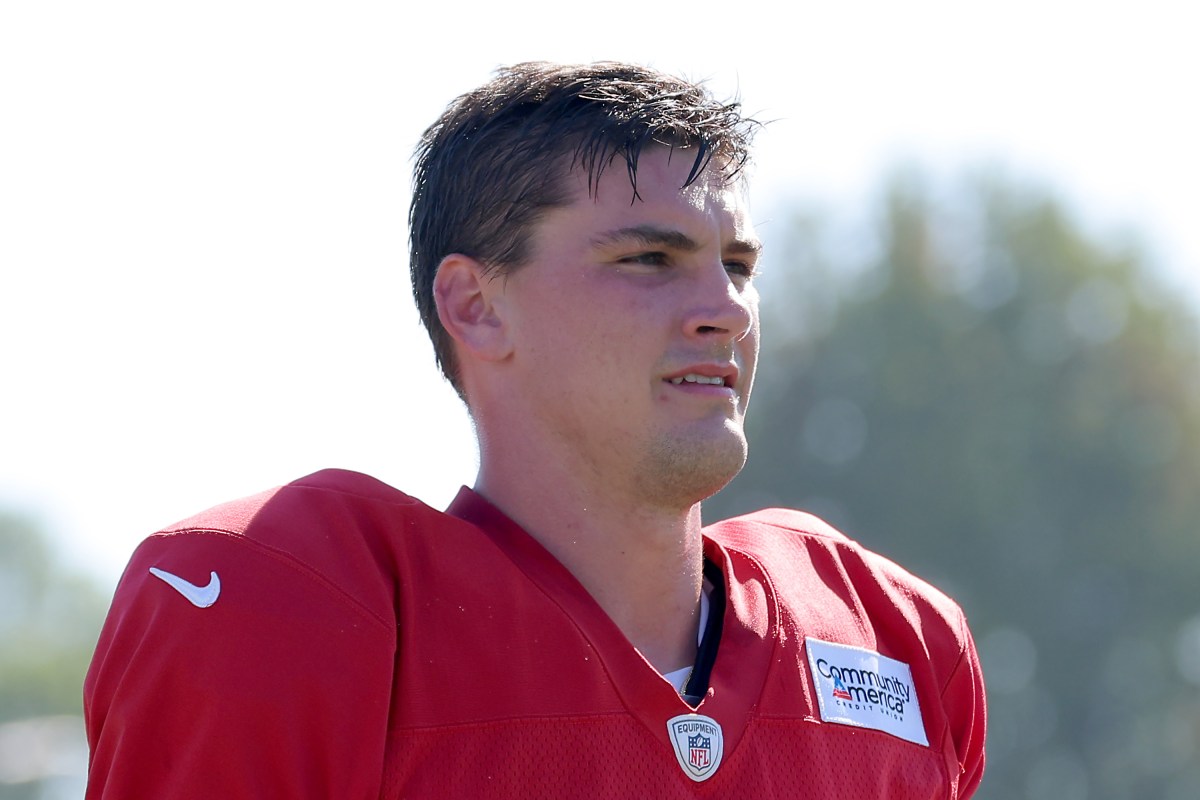
The transition from a celebrated collegiate athlete to an NFL rookie is often described as a sudden, jarring shock to the system, where comfort zones are completely demolished and the margins for error shrink to the width of a razor blade. For Ty Simpson, the young quarterback currently navigating his first training camp with the Los Angeles Rams, this summer has been a masterclass in adaptation, resilience, and quiet determination. Under the intense, unrelenting glare of the Southern California sun, Simpson has had to shed the skin of his collegiate identity and embrace the grinding, unglamorous reality of proving himself all over again at the highest level of professional sports. He has not been perfect, nor would anyone in the Rams’ organization expect him to be, but perfection is rarely the goal during these grueling summer weeks. Instead, the focus is on progress, and by all accounts, Simpson is delivering exactly the kind of encouraging growth that makes coaches and front-office executives smile behind closed doors. The energy around the Rams’ practice facility shifted noticeably when the team finally strapped on the heavy shoulder pads, transitioning from non-contact drills to the violent, chaotic reality of full-contact football. It was during these highly physical padded sessions that Simpson truly began to find his footing, turning heads with a pair of practices that observers widely regarded as his finest and most composed performances of the summer so far. In the face of a collapsing pocket and the thunderous collision of linemen, the rookie did not panic; instead, he showed a remarkable capacity to slow down the game in his mind, delivering the football with a poise that belied his lack of professional experience.
To truly appreciate the significance of Simpson’s early success, one must understand the immense psychological and intellectual burden placed upon a rookie quarterback entering the NFL. The jump from the college game to the pros is not merely a physical step up; it is a complete cognitive overhaul, requiring players to process complex defensive schemes, pre-snap disguises, and lightning-fast blitzes, all while operating an entirely new and highly intricate playbook. For a young signal-caller, the sheer volume of information can easily lead to a state of mental paralysis, where overthinking translates into slow physical reactions on the field. In this high-stakes environment, mistakes are not just inevitable—they are an essential, calculated part of the learning curve, designed to expose a player’s weaknesses so they can be systematically corrected. The Rams’ coaching staff fully anticipated that Simpson would endure his share of rough practices, throwing interceptions into tight coverage, holding onto the ball too long, and experiencing those uncomfortable moments of self-doubt that plague every rookie. What has set Simpson apart, however, is not a lack of mistakes, but the mature, constructive manner in which he responds to them. Rather than letting a bad throw or a misread coverage snowball into a disastrous afternoon, he has demonstrated an impressive emotional resilience, immediately absorbing the constructive criticism from his coaching staff and actively applying those corrections to his very next rep. This ability to self-correct under pressure is the hallmark of a true professional, signaling to everyone in the organization that Simpson possesses the mental fortitude necessary to withstand the brutal ups and downs of an NFL career.
This remarkable capacity for rapid adjustment has not escaped the notice of Sean McVay, the Rams’ brilliant and notoriously demanding head coach. McVay, whose offensive systems are celebrated for their complexity and surgical execution, holds his quarterbacks to an exceptionally high standard, constantly pushing them to refine the smallest details of their craft. When McVay speaks to the media about a young player’s development, he rarely relies on empty, generic praise; instead, he speaks in specifics, and his recent assessment of Simpson was a testament to the rookie’s hard work and receptiveness to coaching. McVay specifically lauded Simpson for significantly speeding up his release, a mechanical adjustment that can mean the difference between a spectacular touchdown completion and a catastrophic turnover in the NFL. At the collegiate level, a quarterback can often rely on raw arm strength to bail them out of late decisions, but in the professional ranks, defensive backs close distances with terrifying speed, and pass rushers are in your face in a fraction of a second. By consciously shortening his throwing motion and training his mind to make quicker, more decisive reads, Simpson is showing that he can adapt to the blistering tempo of the professional game, transforming his physical tools into highly functional on-field assets. This kind of mechanical refinement requires hours of tedious, repetitive work away from the spotlight, and the fact that Simpson is already translating these adjustments into padded practices is a massive feather in his cap.
In addition to accelerating his release, Simpson has made substantial strides in another critical, albeit less glamorous, area of quarterback play: marrying his lower body with the timing of his pass routes. To the casual fan, a quarterback’s talent is often measured by the distance of his deep balls or his ability to escape a collapsing pocket and make an off-platform throw. However, football purists and coaches know that elite quarterback play is built from the ground up, starting with a player’s footwork. A quarterback can have a rocket for an arm, but if his feet are out of sync with the route concepts developing downfield, the entire offensive structure falls apart, resulting in late throws, poor accuracy, and disrupted rhythm. Marrying the lower body with the route timing means that a quarterback’s dropback, hitch steps, and throwing stance must perfectly mirror the steps and breaks of his receivers downfield. It is a delicate, highly synchronized dance that requires a deep understanding of timing, spacing, and defensive positioning. Simpson’s dedication to mastering this intricate connection is a clear indication of his commitment to the mental and technical aspects of the position. When his feet are perfectly aligned with the timing of the play, he is balanced, confident, and ready to deliver the ball the exact millisecond his receiver cuts open, minimizing the defenders’ opportunity to make a play on the ball and maximizing his team’s offensive efficiency.
While these encouraging developments are certainly cause for optimism, the Rams are maintaining a highly realistic, long-term perspective on Simpson’s career trajectory. Two standout practices in August, no matter how impressive they might look in the heat of training camp, do not make a franchise quarterback, and everyone involved understands that Simpson is still very much at the beginning of a long, unpredictable journey. There will undoubtedly be more challenging days ahead, afternoons where the defense completely baffles him with an exotic coverage, or moments where the physical toll of his first professional season begins to weigh heavily on his shoulders. The true beauty of Simpson’s current situation in Los Angeles is that he is not being asked to step into the spotlight and carry the weight of a franchise on his back from day one. Instead of being thrust into the fire of a starting role before he is truly ready—a premature move that has derailed the careers of countless talented young quarterbacks in the past—Simpson is being allowed the luxury of time. He is in a developmental environment where he can observe, listen, and learn, enjoying the rare privilege of patience while refining his skills behind the scenes under the guidance of one of the finest coaching minds in the sport.
Ultimately, Ty Simpson’s journey through his first NFL training camp is a human story of growth, humility, and the relentless pursuit of self-improvement. It is about a young man who has entered a high-pressure, multi-billion-dollar industry and had the maturity to realize that his college accolades mean nothing if he is not willing to put in the work to reinvent himself as a professional. By embracing the grind, listening intently to Sean McVay’s coaching, and treating every mistake as an opportunity to learn, Simpson is building a incredibly strong foundation for his future. Whether he eventually develops into a highly dependable backup who can steady the ship in times of crisis, or eventually grows into a starting caliber quarterback down the road, his current trajectory is a testament to his character and work ethic. For the Los Angeles Rams, Simpson represents a highly valuable, long-term project—a talented, deeply coachable athlete who is quietly putting in the work necessary to turn his immense potential into professional reality, one padded practice at a time.