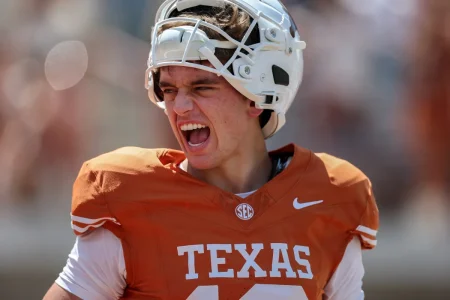







College football has always been a game of enormous expectations, where a single afternoon can reshape a season, a reputation, and a legacy. That was exactly the weight hanging over Saturday’s showdown between Ohio State and Texas. For weeks, this game had been circled as one of the defining matchups of the year, a collision between two blue-blood programs that both believed they had everything it took to win a national championship. Everyone knew the stakes. The loser, most experts agreed, would see their title hopes take a devastating blow, a wound from which recovery might be nearly impossible. For three quarters, it looked like that hard truth was about to land squarely on Texas. Ohio State was the sharper, more confident team. They moved the ball with authority, they made plays on defense, and they seemed to have taken all the air out of the Longhorns’ sideline. The Buckeyes built a 20-point lead, and as the fourth quarter began, the Texas dream appeared to be fading into the familiar pain of another near-miss. There was a heaviness in the air, that sense of another season slipping away. But football, as they say, is never over until the final whistle. And this particular Texas team, led by a young quarterback named Arch Manning, was not ready to surrender. Manning had been carrying his own emotional burden into this game, still haunted by last year’s 14-7 loss to Ohio State in the season opener. That loss had stayed with him, a recurring nightmare, a benchmark of unfinished business. Now, facing the same opponent on the same kind of national stage, he had a chance to erase the memory. What unfolded over the next fifteen minutes was nothing short of miraculous. The Longhorns found their rhythm. They scored once, then again, then once more. Three touchdowns in the fourth quarter, a sudden explosion of belief and execution, completely flipping the game on its head. The Ohio State defense, which had been in control, suddenly had no answer. Texas was flying, the sideline was alive, and the momentum was unstoppable. When the final whistle sounded, the Longhorns had come back from 20 points down to win, and Arch Manning had finally exorcised the ghost of that last-season loss. It was the kind of win that makes a season, and it sent a message not just to Ohio State, but to the entire country: Texas was not just a contender anymore. Texas was a problem.
The raw emotion of that fourth-quarter rally was impossible to miss. After the game, Manning stood in front of cameras, his voice thick with relief and joy. He didn’t boast about his own performance or the numbers. Instead, he praised his team in a way that felt genuinely humble and grounded. “I’m just so proud of our guys in all three phases,” he said. “It wasn’t very pretty, but we found a way to win. That’s what good teams do. We’ve got a bunch of good players. Lot of leaders. It’s going to be a fun night. I had nightmares about that game last year. So, we finally got a good win tonight. Gonna have a good night in Austin.” Those words carried a lot of weight. For Manning, this wasn’t just another victory in a long season. It was personal. It was about redemption, about silence in the doubters, about proving to himself and everyone else that he could rise to the occasion when the stage was biggest. His reaction felt human, not scripted. You could hear the months of frustration melting away in his voice, the relief that comes after finally slaying a dragon that had been chasing him for an entire year. And he wasn’t alone in feeling that way. Head coach Steve Sarkisian, too, had been searching for a signature win, the kind of victory that validates an entire program’s trajectory. He had built Texas into a winner, but critics always pointed to the big-game failures, the moments when the Longhorns seemed to fall just short. After this comeback, Sarkisian finally had his defining moment. It wasn’t pretty, as Manning said, but it was beautiful in its own way. It was a win built on grit, resilience, and an unshakable belief in the person standing next to you. It was the kind of win that doesn’t just show up in the record books. It changes the DNA of a team. It gives a program a new identity, one that says even when everything is going wrong, we can still find a way.
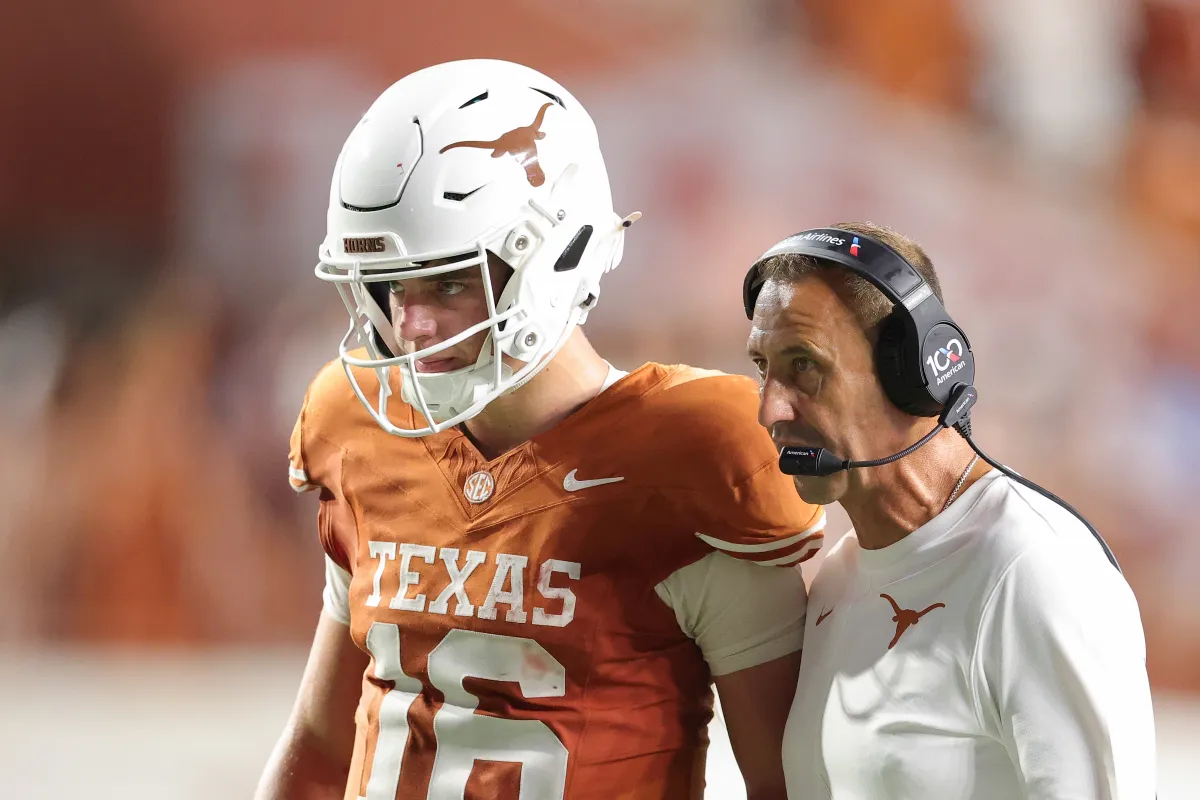
The victory did more than just give Texas a memorable night in Austin. It legitimated the Longhorns as a bona-fide national championship contender, and perhaps more importantly, it gave both Manning and Sarkisian the exact kind of validation their résumés had been missing. Manning arrived at Texas with one of the most famous names in football history, and with that name comes a level of scrutiny that most players never experience. Every pass he threw, every decision he made, was analyzed and debated. He was being measured not just against other quarterbacks, but against the legacy of his own family, a weight that would crush most people. But in that fourth quarter against Ohio State, Manning showed something that cannot be taught in practice or measured in stats. He showed composure. He showed leadership. He showed that when his team needed him most, he could carry them to victory. That is what separates good quarterbacks from great ones, and it is why this win meant so much more than just a “W” in the standings. For Sarkisian, the victory was equally significant. He had already proven he could recruit, he could develop talent, and he could build a program. But until Saturday, there was still a lingering question about whether he could win the biggest games, whether his teams could deliver when the pressure was at its absolute highest. That question had followed him through previous stops and into his tenure at Texas, even as the Longhorns improved year after year. By engineering a 20-point fourth-quarter comeback against a team like Ohio State, Sarkisian answered that question in the most emphatic way possible. He showed that his team not only had talent, but also had heart. He showed that he could make adjustments, inspire his players, and trust his quarterback in the most critical moments. The win was a statement that Texas was no longer a program that was almost there. They were there. And the rest of the college football world had no choice but to take notice.
The impact of that victory was felt immediately in the world of oddsmakers and analytics, where numbers shifted as quickly as emotions after the final whistle. According to Polymarket, Texas saw its national championship odds jump from 11 percent before the game to 17 percent after the game. That is a massive leap, and it reflected a changing perception of the Longhorns as not just a good team, but a legitimate favorite to win it all. It also showed that the public, and the market, believed in what they had just witnessed. There was something about the way Texas won that felt different. It wasn’t a fluke. It wasn’t a lucky bounce. It was a team deciding that they were not going to lose, and then going out and making that decision a reality. Interestingly, Ohio State’s odds also improved, jumping from 12 percent to 14 percent and tying with Notre Dame for the second-best odds in the country. That might seem odd at first. How can a team that just blew a 20-point lead see its championship odds improve? But in the strange logic of college football, this loss may have actually proven something about the Buckeyes. They were good enough to dominate a top-tier opponent for three quarters. They were talented enough, physical enough, and well-coached enough to be ahead by 20 points against one of the best teams in the country. The collapse was real, but so was the talent that established the lead in the first place. The oddsmakers were essentially saying that Ohio State was still a serious threat, despite the heartbreaking nature of the loss. For Texas, though, the surge in odds was tangible proof that their comeback had altered the national landscape. They were no longer a team with potential. They were a team with momentum, belief, and a very real path to the national championship. And in a sport where confidence can be just as important as talent, that distinction matters enormously.
The rankings reflected the same dramatic shift. Texas jumped to No. 1 in the Associated Press Top 25 Poll and the USA Today Coaches Poll, a stunning ascent for a team that had spent much of the season being regarded as a contender but not the favorite. They also moved to No. 2 in ESPN’s FPI Top 25 Rankings, a metric that uses advanced analytics to evaluate team strength. For a team that had been doubted, questioned, and constantly compared to the more historically decorated programs, earning the No. 1 ranking was a moment of validation. It wasn’t just about the polls, though. It was about respect. For years, Texas had been talked about as a sleeping giant, a program that was always on the verge of returning to the top but never quite able to get there. Saturday’s win changed that narrative. The Longhorns were no longer the team that could potentially be great. They were the team that just beat Ohio State in a way that will be remembered for decades. They were the team that found a way to win when everything seemed lost. They were the team that turned doubt into belief in a single quarter. The No. 1 ranking was a symbol of that transformation, and it meant something not just to the players and coaches, but to an entire fan base that had been waiting a long time to see their team back on top. It also served as a reminder that rankings are not just arbitrary numbers. They are a reflection of what a team has earned on the field. Texas earned this. They went out against a powerhouse, fell behind by 20 points, and refused to quit. They found a way to win, and they did it on the biggest stage. That is why the polls changed. That is why the odds changed. And that is why the conversation about Texas changed.
In the end, this game was about more than just one Saturday in October. It was about the kind of moments that define a season and a program. Arch Manning will likely never forget the feeling of running off the field at Ohio State, the weight of last year’s loss finally lifted from his shoulders. Steve Sarkisian will never forget the sight of his team refusing to give up, even when the scoreboard suggested there was no hope. The Texas players will never forget the joy of that comeback, the bond they formed in those fifteen miraculous minutes, and the knowledge that they are capable of achieving something truly special. And for the Longhorns’ fans, this was one of those games they will tell their children about, one of those memories that becomes part of the fabric of a program. But the season is not over. The win was huge, but it was also just one game. There are still tough opponents remaining, still challenges to overcome, still moments that will test Texas’s character and resolve. What this game proved, though, is that this team has the heart to handle those moments. They have a quarterback who has stared into the face of his own nightmares and come out stronger. They have a coach who knows how to lead his players through adversity. And they have a belief, born in that fourth quarter, that no matter how bleak things look, they can find a way to win. As Manning said, “It’s going to be a fun night in Austin.” And it should be. But even more importantly, whether Texas wins the national championship or falls short somewhere along the way, they will always have this game. They will always have this comeback. They will always have this moment when they refused to lose, and in doing so, reminded everyone why college football is the most beautiful, chaotic, and emotional sport in the world.