


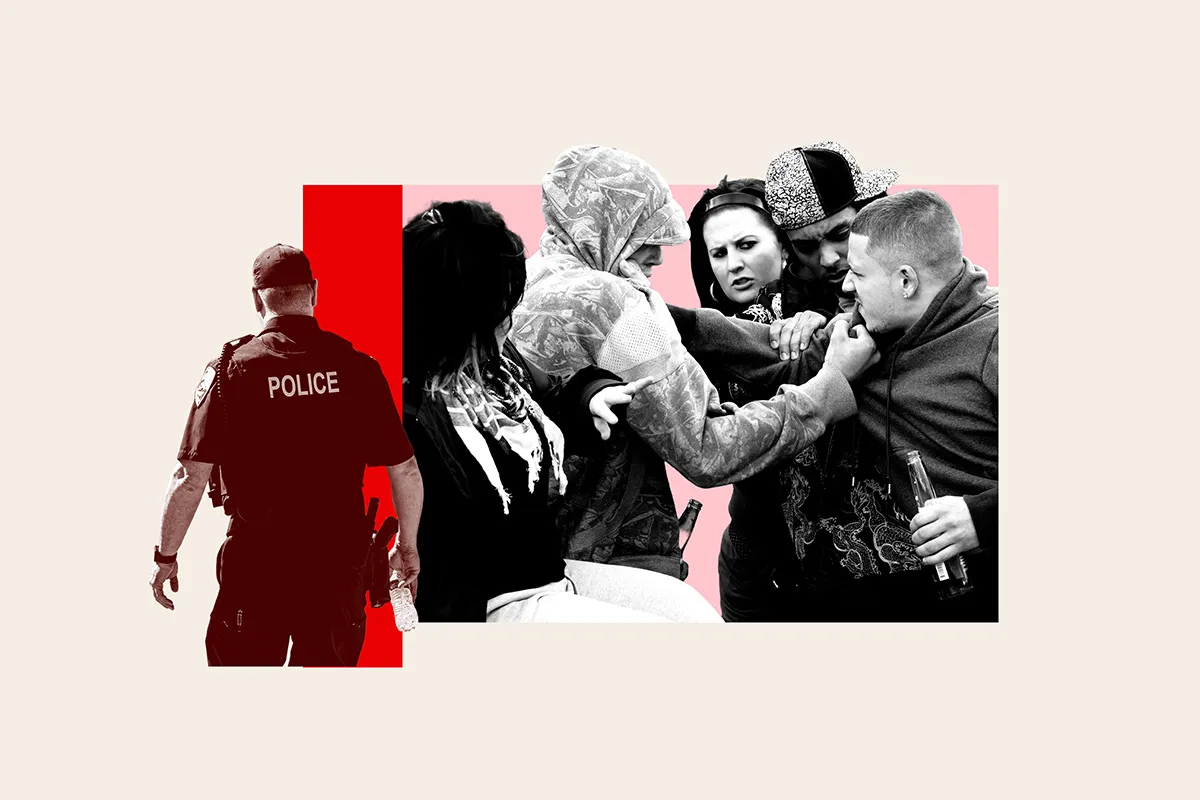
For years, the prevailing cultural narrative painted today’s teenagers as a generation lost entirely to the digital void, content to spend their formative years nestled in the comforting but isolating glow of smartphones, scrolling endlessly through algorithmic feeds from the safety of their bedrooms. However, a dramatic and highly unsettling behavioral shift has occurred in recent months, dragging these young people out of their quiet digital sanctuaries and thrusting them back into the physical world with a chaotic, unchanneled energy that has caught local communities, business owners, and police departments entirely off guard. Across the United States, historical downtown districts, suburban shopping malls, public parks, and scenic coastal beaches are witnessing a sudden and massive influx of adolescents who descend upon these locations in highly coordinated groups. Dubbed “teen takeovers” by alarmed residents and digital onlookers alike, these rapid, flash-mob-style gatherings are far from innocent assemblies of adolescents looking to enjoy a sunny afternoon; instead, they are rapidly deteriorating into dangerous flashpoints of property destruction, intense disorderly conduct, and public violence. As the academic school year winds down and the sweltering heat of summer looms on the horizon, parents and urban administrators find themselves standing at a critical crossroads. Law enforcement agencies are watching the rapid replication of these events across popular digital platforms like Reddit with growing anxiety, bracing themselves for a potential wave of copycat chaos as teenagers look to replicate the viral, high-stakes behavior they see playing out on their screens. This sudden reclaiming of physical spaces challenges the assumption that teenagers prefer isolating online socialization, revealing instead a raw, volatile desire for real-world connection that communities are struggling to manage safely.
The shocking volatility of these “teen takeovers” is painted vividly in the trail of terror and disruption left behind in major metropolitan areas, where ordinary public spaces are transformed into hotbeds of panic in the blink of an eye. In mid-May, a popular restaurant in the nation’s capital became a frantic battleground when a swarm of teenagers suddenly breached the establishment, hurling heavy metal chairs, overturning tables, smashing glassware, and completely shattering the peace of unsuspecting families and diners. Terrified customers fled into the streets while restaurant employees scrambled to find cover from the flying debris, prompting an intense response that eventually drew in federal investigators, with U.S. Attorney Jeanine Pirro confirming that the FBI had stepped in to assist local police. But Washington, D.C. is merely one link in a rapidly expanding chain of incidents across the United States. Only days later, the tranquil shoreline of Narragansett Town Beach in Rhode Island was shattered by chaotic, multi-group brawls involving hundreds of adolescents, culminating in a horrific scene where three young people were stabbed during the violence. The nationwide magnitude of this crisis has even captured the attention of political leaders at the highest level, with former President Donald Trump taking to Truth Social to aggressively criticize a massive Chicago takeover that left five police officers badly hurt. Chicago’s newly elected Mayor, Brandon Johnson, had already recognized the impending danger, taking to social media to issue an urgent, direct alert warning parents that dangerous teen trends were forming in neighborhoods like Hyde Park and pleading with them to monitor their children’s locations to keep them from getting caught in events that so easily spiral into violence.
The hard data and arrest records compiled by police departments nationwide reveal a rapidly escalating emergency that is claiming lives and stretching municipal resources to their absolute limits. In Tampa, Florida, a massive response from local law enforcement resulted in the arrests of twenty-two individuals aged between twelve and twenty-one following a highly disruptive takeover event, with officers filing serious charges of physical affray, illegal drug possession, and the unlawful carriage of lethal weapons. Tragically, this trend has already proven lethal; in Edmond, Oklahoma, an unsanctioned and unregulated gathering of youths ended in absolute tragedy when gunfire broke out, leaving an eighteen-year-old dead and twenty-two other young people wounded, marking a devastating escalation in real-world consequences. Meanwhile, in Orlando, Florida, a gathering of over one thousand teenagers overwhelmed a public park, forcing sheriff’s deputies to intervene under highly hostile conditions that resulted in two deputies suffering physical injuries and nine teenagers being arrested. Facing this complex crisis, law enforcement agencies are trying to find a delicate balance between robust crime prevention and empathetic community policing. In places like Providence, Rhode Island, police departments are actively monitoring online platforms for early warning signs of pop-up parties, while simultaneously redeploying visible patrols to recreational areas and beaches. They are trying to reassure a nervous public that they can maintain order and safety without unnecessarily criminalizing large groups of young people who are simply looking for a place to gather as school closes for the summer.
To truly understand the driving forces behind this behavioral epidemic, we must look beyond simple criminality and explore the complex psychological and developmental landscape of the adolescent mind. Dr. Kenya Brumfield-Young, an assistant professor of criminology at Saint Louis University, urges the public and policy makers to resist the urge to view every teenager present at these takeovers as a malicious bad actor or delinquent. She emphasizes that the vast majority of young people who show up to these large, loosely organized events do not do so with the intention of destroying property, hurting others, or engaging in knife assemblies. Instead, adolescence represents a unique developmental window where biological drives for novelty, social status, peer validation, and collective excitement carry an immense, almost overwhelming psychological weight. Neuroscientific research into adolescent risk-taking has long illustrated that sensation-seeking behaviors and sensitivity to social rewards spike dramatically during these teenage years, while the executive functioning parts of the brain responsible for long-term consequence planning are still maturing. When a teenager is placed into a high-energy crowd of hundreds of peers, the normal social filters that inhibit bad behavior are quickly swept away by a desire to impress their friends, project a tough image, or simply experience the intoxicating rush of collective rebellion, turning what began as a simple hangout spot into a volatile crowd dynamic where a single physical altercation can spark widespread panic.
The historical context of this current crisis is also deeply intertwined with the lingering social and emotional scars of the global COVID-19 pandemic, which systematically dismantled the normal avenues of adolescent socialization. When schools shuttered, sports leagues were suspended, and community after-school programs lost their funding, society effectively erased the structured, adult-supervised spaces that traditionally provided teenagers with a daily routine, constructive outlets for physical energy, and healthy frameworks for conflict resolution. Dr. Brumfield-Young points out that as the country transitioned out of lockdowns, many communities failed to piece back together these vital, affordable youth spaces, instead designing public architecture to actively discourage loitering, implementing strict curfews, and pricing teens out of commercial venues. This phenomenon, often referred to as the “de-teenification” of public spaces, means that when adult communities ask with frustration why young people are congregating in shopping malls, public beaches, downtown plazas, and dark parking lots, the uncomfortable answer is that teenagers simply have nowhere else to go that is both welcoming and financially accessible. After being starved of physical, face-to-face interaction during their most critical formative years and forced to socialize primarily through cold digital interfaces, teenagers are now actively reclaiming physical spaces through these massive gatherings, driven by an instinctual, raw hunger for community, even if that community manifests in highly unregulated and volatile environments.
Perhaps the most modern and dangerous element of these “teen takeovers” is their symbiotic relationship with social media, which functions as both the primary logistic tool and the ultimate psychological reward cycle for this chaotic behavior. Rather than being spontaneous events, these enormous block parties and beach takeovers are carefully planned, promoted, and hyped across platforms like TikTok, Instagram, and Reddit, allowing hundreds or even thousands of youth to mobilize in a single location hours before local police can coordinate an effective response. Once the crowd gathers, the ubiquitous presence of smartphone cameras fundamentally alters the social dynamic, transforming real-world interactions into a hyper-visual performance where teenagers are highly incentivized to engage in risky, destructive, or violent behavior for the sake of digital clout. The chaotic footage of fights, fleeing crowds, and tense standoffs with police officers is instantly uploaded to the internet, where it accumulates thousands of views and likes, establishing a self-reinforcing loop where the virtual reward of online fame validates the real-world danger. As summer settles in with its long, unstructured days and empty schedules, the ultimate challenge for families and city leaders lies not merely in deploying more police officers to patrol the streets, but in actively rebuilding the damaged trust between generations. True resolution of this crisis will require parents staying deeply involved in their children’s digital and physical lives, municipal governments investing in revitalized and constructive recreational spaces, and communities working to provide young people with safe, empowering avenues to find the connection they so desperately crave.