





Commencement ceremonies are traditionally designed to be safe harbors of collective nostalgia and unblemished hope, serving as a formal bridge between the protected world of adolescence and the vast responsibilities of adulthood. Yet, at Hoggard High School’s graduation ceremony in Wilmington, North Carolina, on June 6, this carefully curated milestone took a sharp and deeply polarizing turn that shattered the celebratory atmosphere. The afternoon began predictably enough, with families packed into the arena, capturing photos of their children clad in caps and gowns, and listening to the standard progression of speeches. When Valedictorian Kyler Hosek stood before his peers, his address focused largely on the rapidly evolving landscape of artificial intelligence and the unique challenges and opportunities awaiting his generation. However, the tone of his speech shifted dramatically when he reached his concluding remarks and chose to share a quote from someone he described as his “biggest inspiration,” while conspicuously omitting the individual’s name. Hosek declared to the crowd, “As my biggest inspiration once said, ‘Every human being has something of value that they bring to the table.’” To the casual listener or the proud parents in the audience, the sentiment sounded like a harmless, inspiring cliché of universal human dignity. Yet, beneath the surface of the polite applause, a digital firestorm was already igniting among the graduating seniors, as many internet-literate students immediately recognized the dark, unmentioned origin of those exact words.
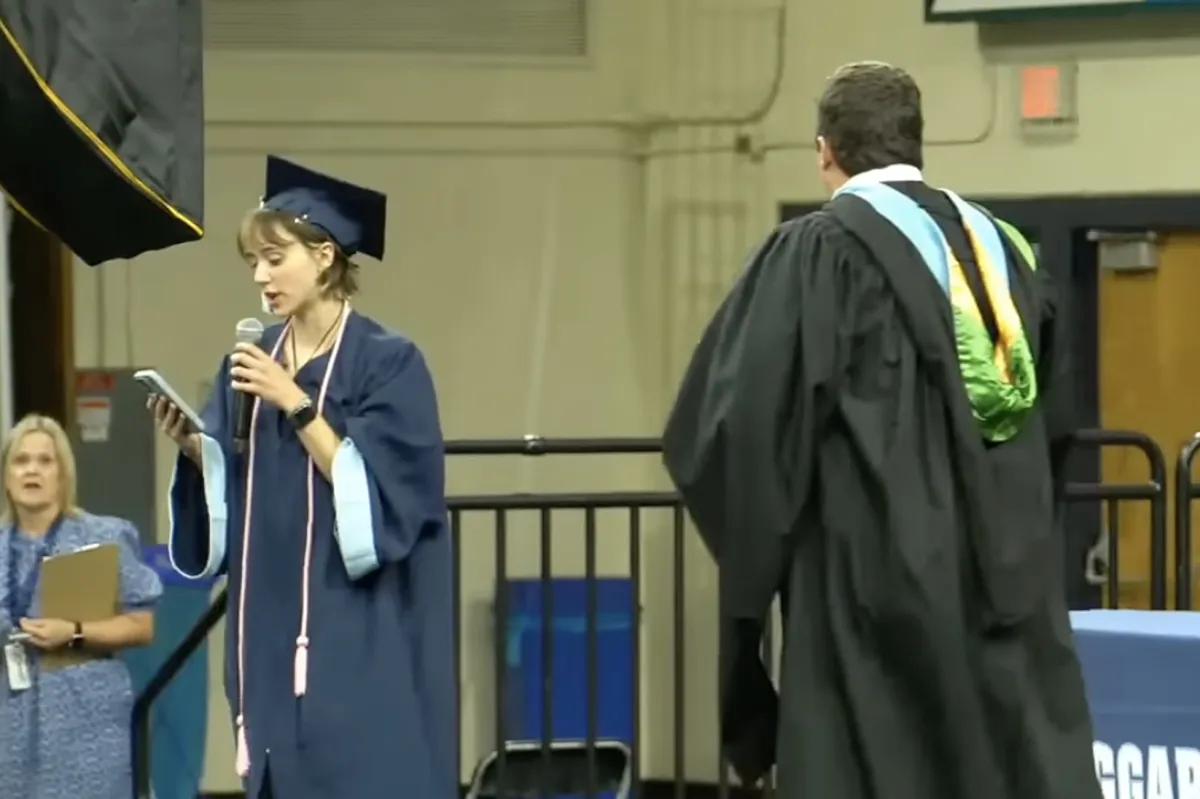
Standing in the queue to receive her diploma about an hour later, senior Sara Rudeseal watched her phone light up with anxious notifications as a tense conversation erupted in a group chat among her classmates. A close friend who is Jewish sent a screenshot of the quote’s source, confirming a deeply troubling reality: the inspiring quote the valedictorian had highlighted was taken directly from a notorious 2022 raw interview on the far-right conspiracy outlet Infowars, delivered by the controversial musician and designer Kanye West, now known as Ye. In that infamous broadcast, West had spoken those exact words, only to immediately qualify them with the shocking statement, “especially Hitler.” For Rudeseal, the realization that an antisemitic dog whistle had just been broadcast seamlessly under the guise of an inspirational valedictory address felt like an intolerable breach of decency that could not be allowed to stand unchallenged. Recognizing that if someone did not speak up, the moment would be swept under the rug and normalized in the school’s history, Rudeseal made a split-second decision to act as she approached the stage. When her name was called, she walked up to the podium, grabbed the microphone, and bared the truth to the audience: “Valedictorian Kyler William Hosek quoted a 2022 interview with Kanye West from Infowars. What Kyler forgot to do was finish the quote. Every human being has brought value that they…” Before she could finish delivering the painful truth of the quote’s conclusion, school administration officials cut her audio, ending her high school experience in a sudden wall of silence as she was directed to leave the stage.
The painful shockwaves of this graduation incident highlight the complex, often treacherous landscape of modern youth culture, where internet memes, extremist rhetoric, and shock value frequently collide with real-world events. When Kanye West appeared on Alex Jones’s Infowars show in December of 2022 wearing a black mesh mask over his face, it marked one of the most widely condemned moments in recent pop culture history, culminating a series of antisemitic outbursts that cost him major corporate partnerships and alienated millions of fans. Though West later issued a full-page apology written in Hebrew in early 2024 via The Wall Street Journal, claiming he was “not a Nazi” and that he “loves Jewish people,” the harm from his previous highly visible praises of Adolf Hitler remained deeply felt. For younger generations who spend significant time navigating online ecosystems, obscure quotes and controversial soundbites from such interviews are frequently recycled, sometimes treated as ironic jokes and other times used to subtly signal harmful ideologies. When these digital undercurrents seeped onto the graduation stage at Hoggard High School, it exposed the profound vulnerability of public school ceremonies to the broader political and cultural wars of our time, leaving Jewish students and other minorities feeling deeply unsettled by the implicit presence of hate speech at what should have been a safe and unifying celebration.
In the emotional fallout of that Thursday afternoon, Rudeseal found herself facing the immediate consequences of her act of protest, navigating a mixture of quiet praise from peers and swift administrative discipline. Immediately after her microphone was silenced, the school’s principal, Christopher Madden, directed her to leave the stage without receiving her physical diploma, denying her the traditional walk across the platform in front of her gathered family and friends. Determined to address the situation constructively and defend her actions, Rudeseal returned to the school campus the following Monday with her family to speak directly with Principal Madden about why she felt compelled to break protocol. However, she was informed that Madden was unavailable to meet with her, and she ultimately received her high school diploma in a quiet, unceremonious encounter with an assistant principal. As she prepares to move on to Western Carolina University, Rudeseal remains steadfast in her belief that staying silent would have made her complicit in the normalization of hate speech, arguing that the valedictorian’s quote was a deliberate choice meant to test boundaries. She expressed a sincere hope that Hosek would eventually take personal responsibility for the pain his choice of words caused, rather than letting the institution shield him from the consequences of his actions.
Conversely, Kyler Hosek’s family sought to frame the controversy through an entirely different lens, issuing a public statement through local news station WWAY that defended the valedictorian’s character, academic merit, and original intentions. According to the family, Hosek’s speech was designed as a forward-thinking, optimistic exploration of the future of artificial intelligence, meant to encourage his fellow graduates as they stepped into an increasingly automated and uncertain job market. They asserted that the core message of his address was the preservation of human worth, emphasizing that despite the rapid rise of advanced technologies, every single person possesses a unique, intrinsic value and creative capability that cannot be replicated by machines. Notably, the family’s statement avoided any direct mention of Kanye West, the Infowars broadcast, or the specific antisemitic context that had deeply disturbed Rudeseal and her peers, choosing instead to focus solely on the literal, positive phrasing of the quote itself. As Hosek prepares to transition to his college years at Purdue University in Indiana, his family’s defense presents him not as an instigator of division, but as a high-achieving student whose philosophical musings on technology and human dignity were pulled out of context and unfairly reinterpreted.
The clash between these two graduating seniors has forced the New Hanover County Schools district into a difficult, highly public reckoning over its handling of student speech, safety, and the protocols surrounding major district milestones. In a formal statement to the media, School Superintendent Christopher R. Barnes sought to reassure the community by issuing an unequivocal condemnation of any messages of hate, discrimination, or antisemitism, affirming that the district rejects any connection to harmful ideologies or divisive public figures. Barnes acknowledged that while Hosek’s speech had undergone the district’s standard administrative review process prior to the ceremony, officials had failed to recognize the subtle, coded connection to the Infowars interview, highlighting a systemic gap in their ability to monitor nuanced contemporary references. In response to the incident, the school district is actively reviewing its graduation speech protocols to implement stricter guidelines and safeguards that can prevent similar controversies from disrupting future ceremonies. This high school graduation drama stands as a sobering reminder of a larger societal challenge: the urgent need to foster empathy, discernment, and ethical accountability in a digital age where words carry immense power, and where the courage to stand up against hatred can reshape a community’s path forward.