


The relentless passage of time in the National Basketball Association has a cruel way of turning youthful exuberance into a heavy, lingering burden. Once a dynamic, Mohawk-sporting young sparkplug who captured the league’s collective imagination as the Sixth Man of the Year for the Oklahoma City Thunder back in 2012, James Harden now finds himself navigating the twilight of an illustrious yet deeply complicated career. It has been over a decade since a youthful Harden first tasted the rarefied air of the NBA Finals—a stage he likely assumed he would return to year after year, given his generational offensive talents. Instead, that singular, early-career trip has transformed into an agonizingly elusive mirage, shimmering just out of reach through various high-profile and dramatic tenures in Houston, Brooklyn, Philadelphia, and Los Angeles. Now, in the year 2026, wearing the wine and gold of the Cleveland Cavaliers, the veteran guard’s desperate quest to return to the sport’s ultimate stage has met another devastating, perhaps final, roadblock. The Eastern Conference Finals were supposed to be the grand stage where Harden finally exorcised his postseason demons, rallied his young teammates, and silenced the legions of critics who have long questioned his championship pedigree and late-game fortitude. Instead, the series has devolved into an absolute nightmare, with the relentless, physical, and highly disciplined New York Knicks orchestrating a systematic dismantling of Cleveland’s aspirations, leaving Harden and his squad on the precipice of a humiliating four-game sweep. The atmosphere inside the arena has shifted from eager anticipation to a somber, suffocating realization that the dream is dying. The weight of this imminent defeat hangs heavily over the entire franchise, serving as a stark, unforgiving reminder of how quickly championship windows can slam shut when an elite opponent exposes your deepest vulnerabilities on the grandest stage of postseason basketball, leaving an aging superstar to contemplate the agonizing reality of another year lost to the passage of time.
The grim reality of this basketball tragedy crystallized during the third quarter of a pivotal Game 4 at Cleveland’s Rocket Mortgage FieldHouse, where the home crowd watched in stunned silence as the game—and the season—slipped completely out of reach. Facing an absolute must-win situation to avoid an embarrassing sweep, the Cavaliers instead looked listless, disorganized, and thoroughly outmatched by a hungry Knicks squad that executed their game plan with surgical precision. By the time the buzzer sounded to end the third period, the scoreboard displayed a brutal, unvarnished truth: the visiting Knicks had built a staggering, near-30-point lead, effectively turning what should have been a high-stakes, competitive classic into a slow-motion blowout. At the center of this collapse was Harden himself, whose sluggish body language and hesitant play mirrored the structural decay of the team’s entire offensive system. Through the first three quarters of play, the former league MVP had managed to scrape together a meager 12 points, a statistical output that looked even worse when examining the mechanical inefficiencies behind it. Harden had connected on just two of his seven attempts from the field, missing all five of his shots from beyond the three-point arc—a signature weapon that had once made him the most feared offensive engine in the entire world. To complicate matters, his decision-making was uncharacteristically sloppy, resulting in a team-high four turnovers that repeatedly ignited New York’s transition offense. Each giveaway and missed shot seemed to drain the remaining oxygen from the arena, as Harden repeatedly drove into congested lanes only to lose possession or settle for heavily contested, low-percentage step-backs that clanked loudly off the rim, embodying the very definition of an aging superstar struggling to find his rhythm while the sand in his championship hourglass rapidly runs out.
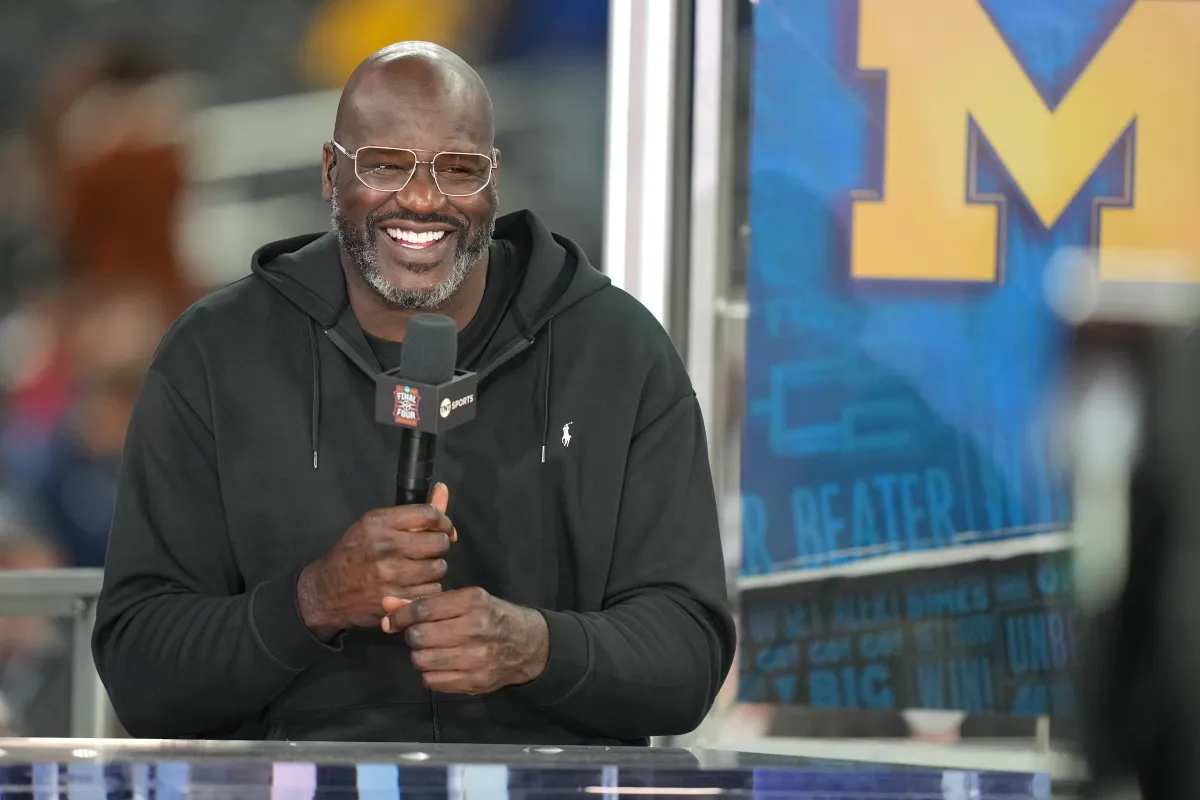
This alarming lack of production did not escape the sharp, unforgiving eyes of the national media, resulting in a devastatingly candid assessment during the halftime broadcast of “Inside the NBA” that felt more like an indictment than simple analysis. Inside the studio, legendary big man Shaquille O’Neal did not mince words when analyzing the veteran guard’s lackluster effort, delivering a verbal blow that quickly reverberated across social media and sports networks nationwide. Speaking directly to his long-time co-hosts Ernie Johnson, Kenny Smith, and Charles Barkley, O’Neal offered a brutal, microscopic evaluation of Harden’s play, stating flatly that James was simply doing what James usually does in high-stakes postseason moments: “disappear.” This searing critique cut straight to the core of Harden’s complex basketball legacy, touching on a painful, decade-long narrative that has continuously overshadowed his regular-season brilliance and historic scoring milestones. Rather than offering excuses or defending the former MVP, his fellow panelists could only offer somber concurrence, with Barkley having already made his own blunt, pessimistic predictions about the Cavaliers’ grim prospects before the opening tip-off of Game 4 had even occurred. The entire segment felt less like standard halftime analysis and more like a televised, live-access autopsy of a legendary superstar’s postseason viability, highlighting how both the general public and the basketball elite have grown weary of the same recurring, tragic storyline. For a player who has spent his entire life striving to be recognized alongside the absolute greatest to ever lace up a pair of sneakers, having a dominant, legendary figure like O’Neal broadcast his competitive shortcomings to millions of viewers served as a humiliating reminder of how quickly historical standing can be eroded by a series of quiet, uninspired, and passive playoff performances when the spotlight burns brightest.
What made Harden’s passive performance all the more glaring was the contrasting, heroic effort put forth by his dynamic backcourt partner, Donovan Mitchell, who did absolutely everything within his physical power to breathe life into Cleveland’s gasping postseason campaign. While Harden looked slow, hesitant, and visually burdened by the pressure, Mitchell played with a desperate, fiery urgency, attacking the tenacious New York defense with a relentless barrage of acrobatic drives, pull-up jumpers, and high-energy transition plays. Heading into the final quarter of play at the Rocket Mortgage FieldHouse, Mitchell had already amassed a game-high 28 points, valiantly carrying the offensive burden of an entire franchise squarely on his shoulders despite receiving precious little help from his primary veteran counterpart. It was a masterclass in individual determination, a spectacular showcase of a young superstar refusing to go quietly into the offseason, even as the structural integrity of his team’s defense and offense collapsed all around him. The stark contrast between the two guards was impossible to ignore: on one side, you had Mitchell, pouring his absolute soul into every single possession, chest-heaving and sweat-drenched as he fought through physical double teams; on the other side, you had Harden, navigating the perimeter with an almost detached demeanor, seemingly unable or unwilling to match the high-octane tempo demanded by this win-or-go-home scenario. This stark dichotomy humanized the silent tragedy of the Cavaliers’ season, showcasing the profound, unspoken frustration of a young star in the absolute peak of his athletic prime watching his hard-earned championship dreams evaporate, not due to a lack of personal grit, but because the legendary veteran superstar brought in to provide championship poise had effectively checked out when the competitive pressure reached its boiling point.
To fully understand the sheer magnitude of this playoff failure, one must look closely at the trajectory of the series leading up to this point, which clearly paints a picture of a consistent, agonizing decline in Harden’s overall on-court impact. Over the course of the first three games against New York’s suffocating defense, the 36-year-old veteran guard had posted remarkably pedestrian averages of 17.3 points, five rebounds, and 3.3 assists per game—numbers that would be highly respectable for an average role player, but are utterly inadequate for an iconic player of Harden’s historical stature and pedigree. Cleveland desperately needed their veteran leader to find another gear, to tap into that legendary Houston Rockets scoring reserve and deliver a vintage, legacy-defining performance to shift the entire momentum of the series. Instead, when faced with the ultimate win-or-go-home scenario, Harden was completely neutralized by the masterfully engineered defensive schemes of Knicks head coach Mike Brown. Brown, who has drawn widespread league-wide praise for his defensive adjustments, designed a game plan specifically tailored to exploit Harden’s declining lateral quickness and athletic burst, utilizing physical, aggressive traps to consistently force the ball out of his hands. Under Brown’s guidance, the Knicks have re-established themselves as an Eastern Conference powerhouse, orchestrated on the floor by the meteoric rise of Jalen Brunson, whom Brown has proudly placed among the absolute elite guard company in the NBA today. Brunson’s relentless competitive motor, clutch shot-making, and vocal leadership stood in direct, almost mocking contrast to Harden’s quiet regression, highlighting a dramatic changing of the guard in the Eastern Conference where hungry, disciplined units are aggressively pushing aside the aging icons of the previous decade who can no longer summon the necessary magic to survive the playoff crucible.
As the final buzzer sounded and the reality of the Eastern Conference Finals sweep became a permanent part of NBA history, James Harden was left to sit quietly on the bench, draped in a warm-up towel, staring blankly onto the court as the joyous New York Knicks celebrated their well-earned ticket to the grandest stage of them all. At 36 years of age, the profound emotional realization of what this specific failure represents must be incredibly heavy to bear, serving as a sobering milestone in a historic sporting journey that has featured nearly every individual accolade imaginable, yet still lacks the singular, most coveted team achievement of all: an NBA championship ring. This latest postseason exit ensures that his historic Finals drought, which stretches all the way back to his formative days as a budding twenty-two-year-old in Oklahoma City, will continue to cast a long, dark shadow over his basketball legacy, perhaps forever. It is a deeply human tragedy of professional athletics: a player who completely redefined how the sport of basketball is played through his isolation brilliance and playmaking genius, who won an MVP award and multiple scoring titles, yet is destined to be remembered by sports history primarily for his postseason disappearances and his inability to cross the ultimate finish line. The grand dream of hoisting the Larry O’Brien trophy in the city of Cleveland has officially evaporated into the Ohio night, replaced by the cold, harsh reality of an impending, highly scrutinized offseason where uncomfortable questions about his declining athletic longevity, his role moving forward, and his overall future in the league will dominate the national sports cycle. For Harden, the ticking clock is no longer a distant metaphor; it is a loud, unrelenting alarm warning him that the window to alter his career narrative has almost entirely slammed shut, leaving him to wonder if he will ever get one more genuine chance to write the triumphant final chapter he has chased for over half his life, or if he is destined to join the ranks of the legendary, ring-less superstars who walked away from the game forever defined by what they couldn’t capture.