

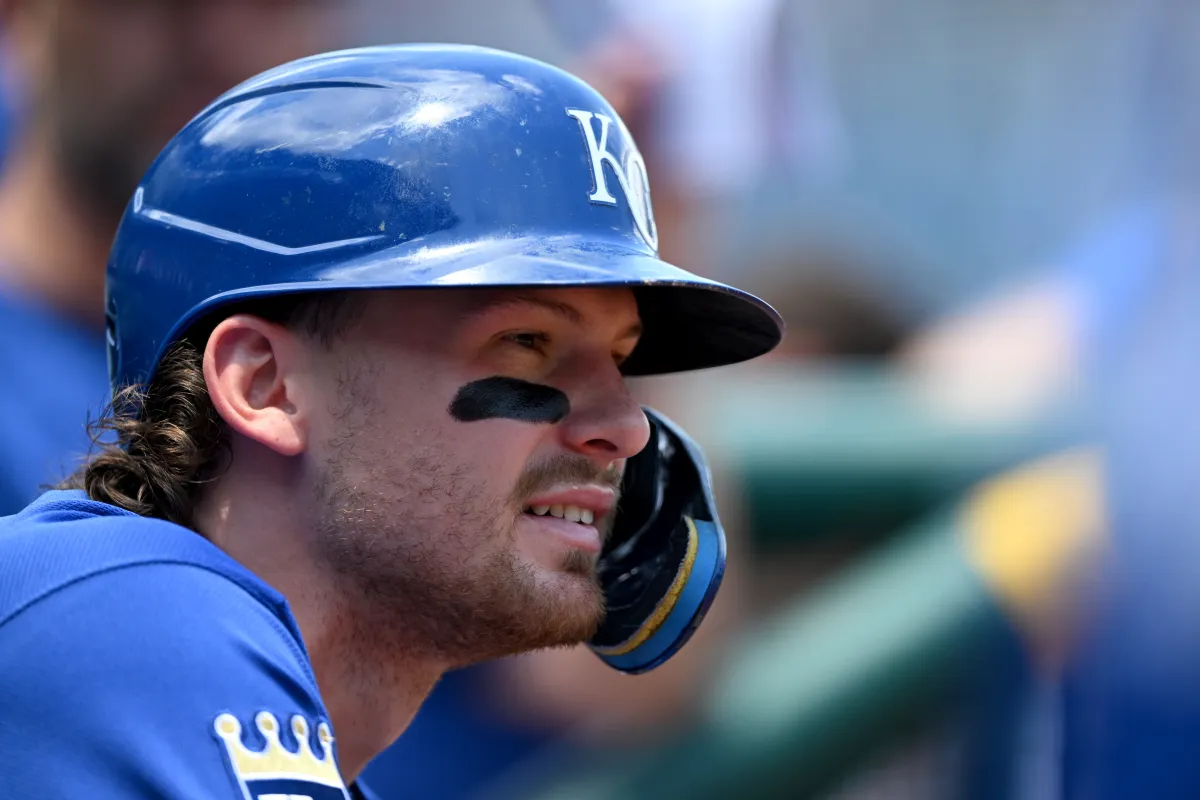
In the heart of America, where baseball is less of a hobby and more of a multi-generational covenant, the fortunes of the Kansas City Royals carry an emotional weight that transcends the standings. This year, that entire weight has rested squarely on the young, extraordinarily capable shoulders of shortstop Bobby Witt Jr. At just 25 years old, Witt has transitioned seamlessly from a highly touted prospect into the undisputed heartbeat of the franchise—a player whose breathtaking speed, brilliant defensive instincts, and explosive bat offer a bright beacon of hope in an otherwise dreary landscape. For Royals fans, watching Witt play is like watching poetry in motion, a rare and beautiful spectacle during a long, arduous season of rebuilding. But on June 18, during a game against the cross-state rival St. Louis Cardinals, that poetic rhythm was suddenly and violently interrupted. While the team was coasting through a dominant, joyous 14-6 blowout victory, the collective breath of the city caught in its throat when Witt grimaced in pain, clutching his knee. A chill went down Kansas City’s collective spine as their franchise cornerstone gingerly walked off the field. This wasn’t just about the temporary loss of a key player; it was the terrifying realization that the centerpiece of the city’s baseball renaissance was vulnerable, reminding everyone of how quickly a promising future can be jeopardized by a single unfortunate step.
The human body, even one as finely tuned and athletic as Bobby Witt’s, remains stubbornly susceptible to the high-impact physics of Major League Baseball. Only weeks prior, on June 7, Witt had given the fan base its first major scare when he exited a game against the Minnesota Twins with what the medical staff officially labeled as “right knee soreness.” To the relief of fans and commentators alike, the resilient young shortstop showed a trademark Midwestern grit, refusing to miss a single game and continuing to play through the discomfort. However, the human knee can only withstand so much stress before it demands a pause, and the subsequent diagnosis of a Grade 1 medial collateral ligament (MCL) sprain after the Cardinals game represented a much more tangible, unavoidable obstacle. A Grade 1 sprain means that while the ligament has been stretched and micro-torn under immense pressure, the crucial fibers remain largely intact. While this is the best-possible diagnosis for a ligament sprain, it still presents substantial pain, swelling, and instability. For an elite athlete whose entire game is predicated on explosive lateral cuts, sudden defensive stops, and violent hip rotations during a swing, an MCL sprain is a severe impedance. It requires a patient, methodical recovery process—a virtue that is notoriously difficult to cultivate for a hyper-competitive superstar who wants nothing more than to be on the dirt with his teammates.
From a strictly organizational standpoint, the Royals find themselves in a position where caution must absolutely override competitive desperation. Sitting at a discouraging 33-46 record—the fifth-worst in all of Major League Baseball—Kansas City is mathematically playing for the future rather than a miracle postseason push this summer. In this rebuilding context, there is absolutely zero rationale for rushing Bobby Witt Jr. back to the active roster before he is completely healed. Witt is not merely a player on the current roster; he is the face of the franchise for the next decade, representing a massive long-term investment that the front office has committed to protecting at all costs. Shaving a few days off his recovery timeline to win a handful of meaningless hot-weather games in June would be an exercise in extreme, short-sighted recklessness. Manager Matt Quatraro and the Royals’ front office understand this reality deeply, balancing the pressure to remain competitive with the sobering responsibility of preserving a generational talent’s physical longevity. For a struggling franchise, the temptation to rush a star back to boost ticket sales and fan engagement is always present, but the true test of leadership lies in the ability to say “not yet” when every instinct in the young player’s body is screaming for him to grab his glove and run onto the field.
Fortunately, the latest dispatches from the Royals’ training camp suggest that while caution remains the organizational watchword, Witt’s physical resilience is once again working in his favor. Before Monday’s narrow 2-1 victory over the Tampa Bay Rays, manager Matt Quatraro offered a welcomed ray of hope to reporters, noting that the team remains optimistic about Witt’s availability in the coming days. This optimism took on a tangible, exciting shape on the field, as captured by veteran Royals broadcaster Joel Goldberg, who observed Witt “initiating baseball activity” for the first time since the injury. Clad in a heavy, protective knee brace, Witt took the field under the warm sun to throw, run, field ground balls, and swing a bat. The sight of a superstar navigating the early, tentative steps of physical rehabilitation is profoundly humanizing; it strips away the myth of the invincible athlete and replaces it with the reality of hard work, sweat, and careful medical supervision. While the training staff has wisely declined to establish a concrete, rigid timeline for his official return to the lineup, the mere fact that Witt is already testing his body’s limits speaks to his incredible conditioning and his fierce desire to get back to the game he loves.
Beyond the immediate team dynamics, the timing of Witt’s injury carries a deeply bittersweet undertone regarding his individual aspirations. Prior to the sprain, Witt was putting together an absolutely mesmerizing season, slashing .294/.368/.465 with 10 home runs and 32 runs batted in, while leading all of Major League Baseball with 28 stolen bases. His 88 hits ranked fifth in the majors, serving as a testament to his elite consistency and offensive dominance. When New York Yankees powerhouse Aaron Judge, the reigning back-to-back American League MVP, was sidelined indefinitely with a rib injury on June 5, the national spotlight shifted directly to Kansas City, establishing Witt as the odds-on favorite to claim his first AL MVP trophy. For a 25-year-old rising star, the chance to chase such historic baseball immortality is a rare, intoxicating opportunity. Yet, this temporary absence has shifted the narrative once again, allowing Houston’s powerhouse Yordan Alvarez to vault into the favorite position. It is incredibly painful to watch an MVP-caliber season get paused, not by a slump or a drop in performance, but by the cruel arbitrariness of an injury. It serves as a stark reminder of the fragile nature of athletic legacy, where months of historic production can be overshadowed by a single awkward step on the basepaths.
Ultimately, the story of Bobby Witt Jr.’s June injury is not one of tragedy, but of a brief, defining pause in a career that promises to be legendary. At just 25 years old, Witt has his entire professional life ahead of him, with decades of baseball yet to be played, hundreds of home runs left to hit, and countless diving plays waiting to be made at shortstop. While the temporary loss of the MVP lead and the frustration of missing games are difficult pills to swallow, they are merely small chapters in a much larger, more triumphant story. The Royals’ commitment to his methodical recovery ensures that when he does step back onto the field without the brace, he will do so with the full force of his generational talent intact. Fans in Kansas City will continue to watch the daily injury reports with bated breath, but they can take solace in the fact that their franchise player is being handled with the care and reverence he deserves. The road back to relevance for the Royals may be long and winding, but as long as Bobby Witt Jr. is anchoring the shortstop position with a healthy knee and an unyielding spirit, the future of baseball in Kansas City remains incredibly bright.