


The Gainbridge Fieldhouse in Indianapolis was filled with a thick, almost palpable anticipation on raw Monday night. The clash between the rising Indiana Fever and the legendary, veteran-heavy Phoenix Mercury was never going to be just another routine date on the professional basketball calendar; it was a high-stakes battle of contrasting generations, distinct styles, and sheer athletic willpower. When the scoreboard buzzer finally sounded to secure a hard-fought 86-77 victory for the home team, it marked the conclusion of a contest defined by relentless physical grit, taxing tactical chess matches, and an underlying psychological tension that had been steadily building since the very first tip-off. This was not a polished, antiseptic exhibition of modern basket-making, but rather a grueling physical struggle where players routinely threw their bodies into harm’s way, fighting desperately for every single inch of the hardwood floor. As the clock wound down in the second half, this intense competitiveness boiled over into a chaotic, multi-player scrum that threatened to derail the game entirely, resulting in a flurry of five technical fouls and a dramatic ejection that sent shockwaves through the arena. In many ways, the matchup became a living, breathing metaphor for the WNBA’s current era: a league experiencing an unprecedented explosion in popularity, where the expectations are immense, the media lights are blindingly bright, and the raw, human emotions of elite athletes are constantly colliding with the rigid boundaries of professional sports rules. The fans in the stands did not just witness a standard athletic victory; they watched a deeply compelling human drama play out in real-time, observing firsthand how the relentless pursuit of greatness can push competitive spirits to their absolute physical and emotional limits.
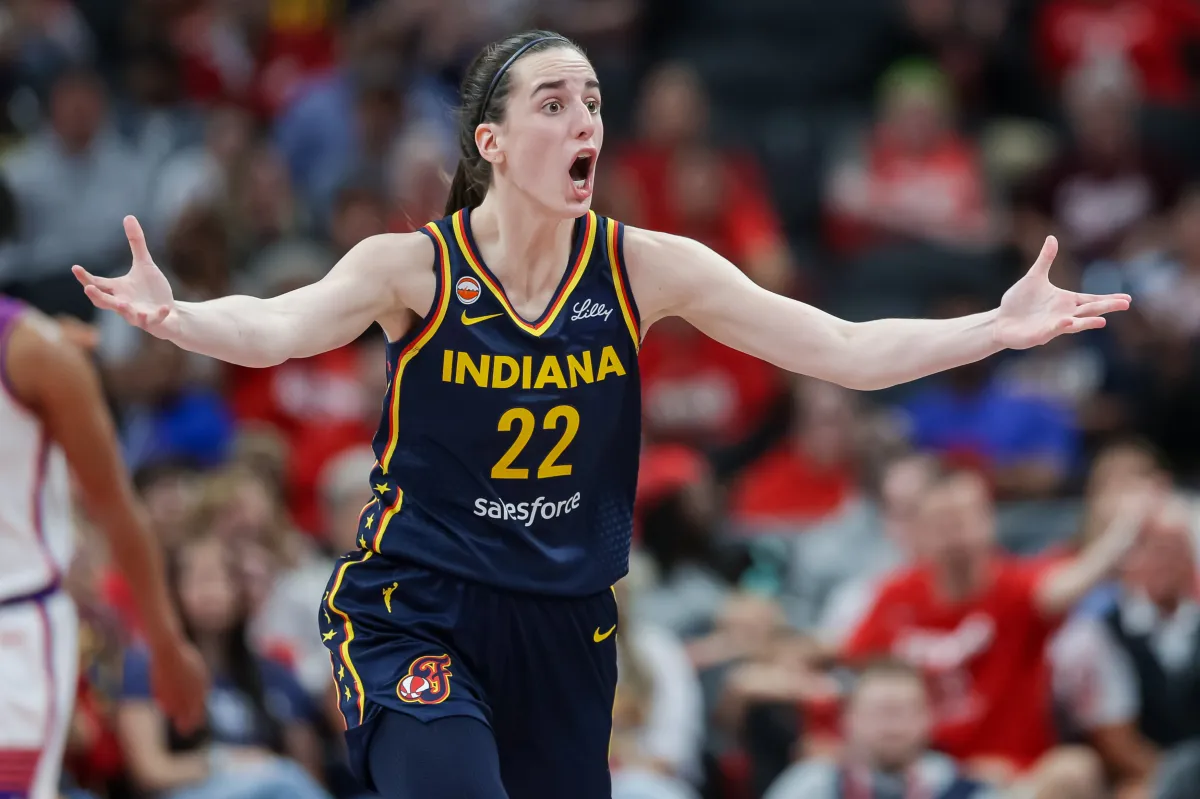
At the absolute epicenter of this high-stakes storm was Caitlin Clark, the rookie sensation whose transition to the professional ranks has been watched with the kind of intense, claustrophobic national scrutiny rarely seen in the history of women’s sports. On this tumultuous evening, she beautifully demonstrated why she is both a magnetic global superstar and a deeply relatable young human being when she was assessed a technical foul that defied basic common sense, leaving players, coaching staff, and thousands of spectators in a state of utter bewilderment. The controversial infraction occurred in the heat of play when Clark, attempting to pump up her struggling teammates and release some of her own boiling competitive energy, simply clapped her hands—a universal, instinctual athletic gesture that game official Gerda Gatling immediately penalized as an active act of “taunting.” This highly contentious whistle marked Clark’s fifth technical foul of the competitive season, placing her in a statistical deadlock with Chicago Sky forward Angel Reese for the most technical infractions in the WNBA this year. This shared statistic is highly telling, as both high-profile rookies represent the new, energetic guard of the league, playing daily under a massive microscope where every sigh, gesture, and facial expression is dissected by millions of viewers. By penalizing a player for something as fundamentally human and harmless as clapping, the game’s officials highlighted a painful disconnect between the lived reality of an athlete fighting in the trenches of competition and the hyper-regulated, sanitary environment that institutional rulebooks try to enforce. It forces us to ask whether we want our sports stars to be emotionally sterile, robotic performers, or if we value the genuine, unvarnished human passion that makes their historic triumphs so incredibly thrilling to watch in the first place.
The emotional fallout from the whistling controversy quickly spilled over into the postgame press conferences, where the media room was thick with frustration, disbelief, and a unified sense of exhaustion from the Indiana camp. Fever head coach Stephanie White did not mince her words when addressing the gathered press, expressing a profound confusion that mirrored the sentiments of the thousands of roaring fans, dryly noting that if clapping is the new threshold for taunting, then the game’s emotional landscape has become dangerously and impossibly restricted. When Clark took her turn at the microphone, she chose to completely bypass the typical, sterile public relations scripts that modern athletes often utilize to protect their corporate image, delivering instead a raw, unfiltered, and deeply human critique of the refereeing crew. She openly labeled the technical foul “ridiculous” and, with a biting sense of humor that endeared her even further to her growing fanbase, suggested that she and her coaching staff should probably just look at the WNBA calendar now and proactively pick out a future game to plan for her unavoidable suspension, assuming that simply clapping her hands is going to continue to be treated as a major administrative infraction. She detailed her direct on-court exchange with referee Gerda Gatling, demanding clarity on the rapid call and emphasizing that if the league has any commitment to logical consistency, common sense, and fair play, this specific technical foul should be immediately rescinded. Her candidness was a refreshing reminder of her everyday humanity, showing a young woman who refuses to be silenced or intimidated by the pressure of her environment, standing up for her basic right to express herself honestly in her athletic workplace.
This ongoing conflict carries massive, season-defining implications for the Indiana Fever’s competitive campaign, as the threat of accumulated technical fouls hangs over Clark’s head like a dark cloud; according to official league regulations, once a player reaches eight technicals, they are hit with an automatic, mandatory one-game suspension that cannot be appealed. When reporter James Boyd of The Athletic asked Clark how she intended to manage her on-court behavior and maintain the delicate self-awareness required to avoid hitting that critical disciplinary threshold, she did not promise to dial back her intensity or pacify the officials. Instead, she offered a profound statement of personal and professional identity, asserting that she will always play the game with raw emotion and deep passion because those are the very elements that define her as a world-class competitor, and if the league chooses to penalize her for clapping, then “so be it.” Her response strikes at the very heart of what it means to be an elite athlete: the fuel that drives someone to practice for tens of thousands of hours, to endure heartbreaking losses, and to achieve historic heights is not a polite, quiet compliance, but a fierce, burning inner fire that cannot be easily toggled on and off. To ask Clark to play without her signature emotional sparkle is to ask her to play as a lesser version of herself, a mental compromise she refuses to make even in the face of strict disciplinary rules. By standing her ground, she challenges the league’s administrative authorities to look in the mirror and decide whether they want to foster an environment that celebrates the raw, genuine humanity of its players, or one that seeks to suppress the very spirit that attracts millions of new eyes to the sport.
While Clark’s sharp public criticism of the officiating crew will almost certainly result in a standard financial fine from the WNBA headquarters, her case for having the technical foul officially overturned is built on a solid foundation of very recent, undeniable league precedent. Earlier in the season, Dallas Wings All-Star guard Paige Bueckers found herself in a virtually identical situation on May 22 during a high-stakes, extremely physical matchup against Atlanta, where she was slapped with a technical foul for clapping during a moment of intense on-court frustration. Recognizing that penalizing such a basic, non-threatening physical expression was a massive overreach of officiating authority, the WNBA brass acted swiftly and officially rescinded Bueckers’ technical foul by May 24, proving that the administrative offices are capable of using common sense and humility to correct on-court errors. This historical context is absolutely crucial for Clark, as it establishes a clear standard of fairness and consistency that the league must uphold if it hopes to maintain institutional credibility among its growing roster of players and coaches. Human beings have an innate, deeply ingrained desire for justice and equal treatment under the law, whether in society at large or within the confines of a basketball court, and any failure by the WNBA to treat Clark’s clapping incident with the same leniency shown to Bueckers would signal a damaging double standard. By appealing to this direct precedent, the Fever can rightfully demand that the league prioritize logic over rigid bureaucracy, ensuring that the game remains focused on the extraordinary athletic talents on display rather than the overzealous whistles of the officials.
Ultimately, the true measure of Clark’s greatness—and what makes her such a compelling and inspiring human figure—is her remarkable ability to channel this emotional turbulence and institutional frustration directly into historic, record-breaking athletic achievement on the hardwood. Despite the endless distractions, the constant whistles, and the physical toll of a chaotic game, she rose beautifully above the noise to orchestrate an absolute masterpiece, finishing the night with 24 points, nine assists, and three rebounds to secure the vital win for her team. This stellar performance marked her sixth consecutive game with at least 20 points and five rebounds, establishing the longest such streak in WNBA history and carving her name even deeper into the annals of professional basketball lore. This historic milestone is a powerful testament to her resilience, demonstrating that her fiery passion is not a distraction that needs to be controlled, but the very catalyst that allows her to transcend pressure and achieve greatness when the lights are brightest. As the Indiana Fever (10-7) and the Phoenix Mercury (5-13) prepare to lock horns once again this Wednesday back at the Gainbridge Fieldhouse, the basketball world prepares for another chapter in a deeply human saga where raw emotion, systemic challenges, and athletic excellence will collide, promising another unforgettable display of women at the absolute peak of their powers.