


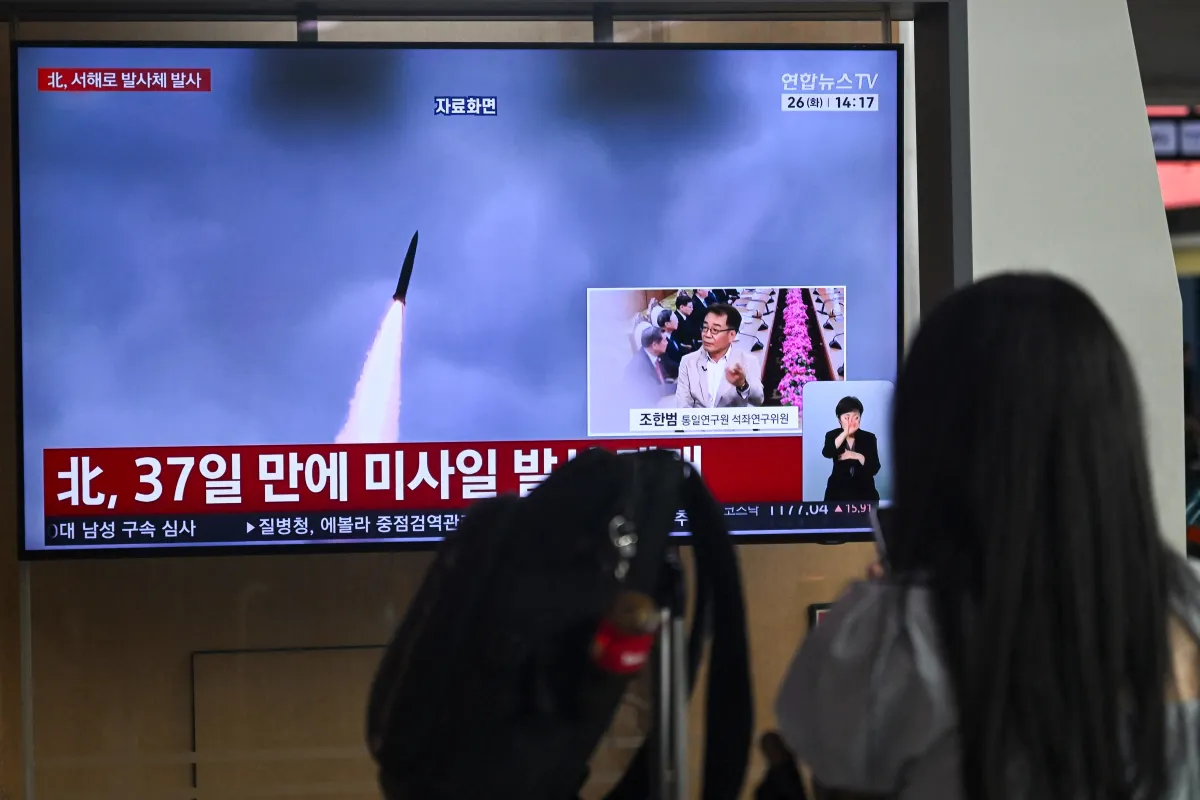
On a seemingly ordinary Tuesday afternoon, the fragile quiet of the Korean Peninsula was shattered once again by the thunder of military engines and the sharp hiss of rocket fire. For the millions of ordinary citizens living in the shadow of one of the world’s most heavily fortified borders, the news of yet another weapons test is never just a headline; it is a visceral, low-frequency hum of anxiety that shapes their daily existence. At approximately 1:00 p.m. local time, as families were finishing their lunches and workers were returning to their desks, North Korean forces initiated a series of launches from Chongju, a scenic coastal area tucked away in the western province of North Pyongan. The projectiles, which included close-range ballistic missiles alongside a barrage of traditional artillery munitions, arched across the sky, tracing a path of steel and smoke before plunging into the cold waters of the Yellow Sea. These missiles, capable of traveling up to 185 miles, flew a distance of roughly 50 miles during this specific demonstration. While military analysts catalog these distances with clinical precision, local coastal communities and fishing fleets feel the immediate, localized disruption of a sea suddenly turned into a live-fire laboratory, reminding everyone in the region of the physical proximity of conflict.
This sudden display of military force instantly set off a complex, highly coordinated chain of human and technological reactions across several time zones. In Seoul, Tokyo, and Washington, military personnel and intelligence analysts were abruptly pulled from their routine tasks to stare at glowing monitors, tracking telemetry data and sat-map heat signatures to decode the exact nature of the North’s actions. The South Korean Joint Chiefs of Staff immediately mobilized their defenses, transitioning into an elevated state of readiness while working hand-in-hand with their American counterparts to unpack the technical parameters of the flight paths. This collaborative reflex is not merely bureaucratic; it represents a deep-seated human alliance where young operators, translators, and commanders work through the night to ensure that a miscalculation does not escalate into an outright catastrophe. South Korea’s military, communicating through the Yonhap news agency, reassured a worried public that they had stepped up surveillance, emphasizing that real-time information was being seamlessly shared with Japan and the United States to maintain an ironclad defensive posture capable of neutralizing any sudden escalation.
This latest barrage marks a tense return to active testing for Pyongyang, representing the first major missile event since April 19, when the regime test-fired short-range ballistic missiles into the sea bordering the eastern coast of the peninsula. The periodic nature of these launches creates a exhausting psychological cycle for the people who call this region home. In South Korea, life goes on with a remarkable, resilient normalcy—subways run on time, cafes are packed, and students study for exams—yet beneath this calm exterior lies the chronic stress of living next to an unpredictable, heavily armed neighbor. Each launch acts as a stark reminder of the unfinished business of the Korean War, a conflict that was suspended by an armistice rather than resolved by a peace treaty. For the older generation who still remember the devastation of the mid-20th century, and for the younger generation who inherit this unresolved legacy, these tests are not abstract political chess moves, but direct threats to the safety of their families and the economic stability of their homeland.
The geography of the launches also highlights the deep, sometimes painful divisions of a shared culture and history, reflected even in the names of the waters where the missiles landed. Known internationally as the Yellow Sea, the body of water is referred to as the West Sea by both North and South Koreans, while the eastern waters are passionately defended by Koreans as the East Sea, despite being known globally as the Sea of Japan. These waters are not empty voids; they are vital maritime lifelines teeming with commercial shipping vessels, regional ferry lines, and small-scale fishing boats operated by generations of mariners. When missiles and artillery shells rain down into these waves, they disrupt the ancient rhythms of coastal life, forcing fishing communities to alter their routes and live in constant fear of stray munitions. The transformation of these productive, beautiful waters into a militarized testing zone is a quiet tragedy for the coastal residents who rely on the sea’s bounty for their survival and who wish to see these waters serve as corridors of cooperation rather than arenas of brinkmanship.
As international journalists scrambled to cover the breaking news, reaching out to agencies like the United States Indo-Pacific Command for official assessments, the immediate vacuum of certainty underscored the delicate balance of global diplomacy. In Washington and other Western capitals, policymakers view these events through the lens of global non-proliferation and regional stability, calculating how each launch affects the broader geopolitical balance of power. Yet, the human element can easily be lost in these high-level calculations. The true cost of this endless cycle of provocation and military readiness is borne by the families divided by the Demilitarized Zone, who have spent decades hoping for a peaceful resolution that would allow them to reunite, and by the young conscripts on both sides of the border who spend their youth holding rifles in cold guard towers. The reactions of global leaders, while necessary for national defense, often struggle to address the deep-seated humanitarian yearning for a lasting peace that transcends military statistics.
Ultimately, this latest launch remains a rapidly developing story, a fluid situation where the final political and military implications are still being analyzed by experts worldwide. But beyond the trajectory charts, the range estimates, and the official press releases from Seoul and Washington, the core narrative remains one of human endurance and the persistent hope for peace. The people of Korea, who have built a vibrant, prosperous, and culturally rich society despite decades of existential tension, continue to look toward the horizon with a mixture of vigilance and hope. They dream of a future where the western skies above Chongju and the waves of the West Sea are defined by the peaceful transit of trade and the migration of birds, rather than the fiery arcs of test missiles. Until that day arrives, the global community must remain not only vigilant in its defense, but deeply empathetic to the human lives residing at the heart of this enduring geopolitical struggle.