






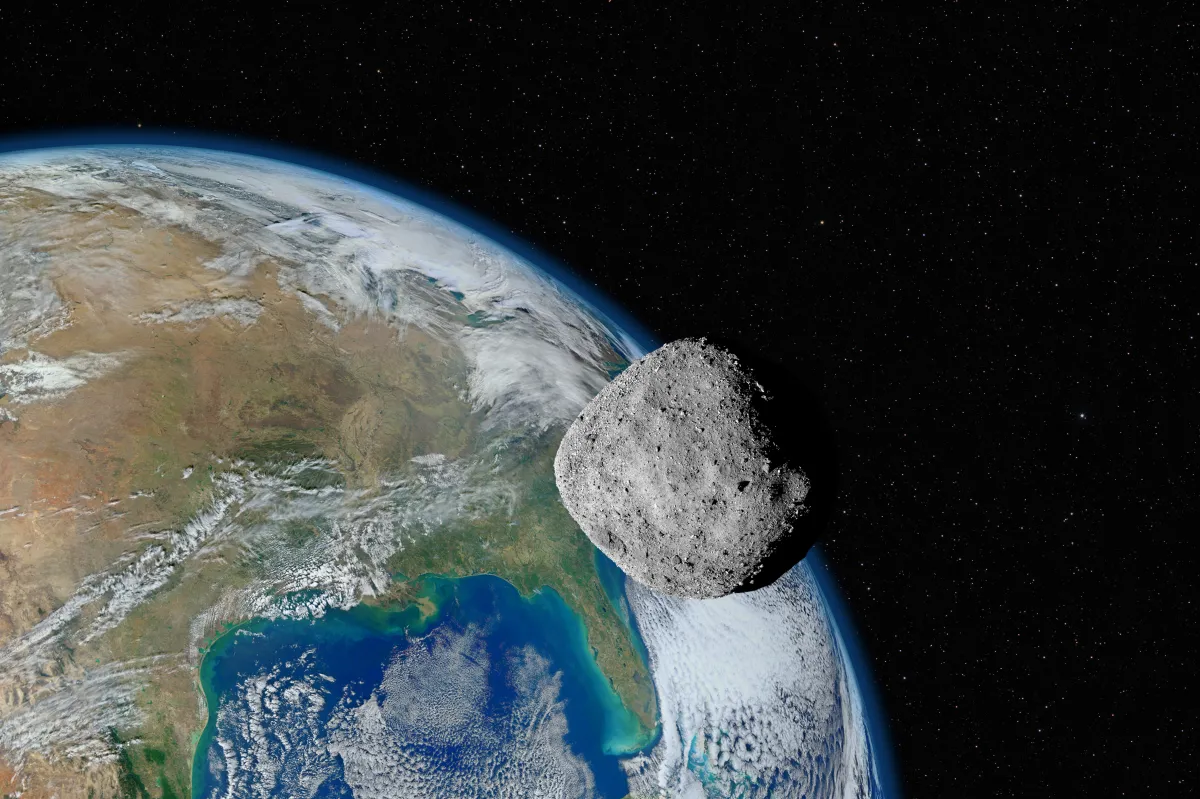
Space has a beautiful way of making our daily earthly worries feel wonderfully small, and this week, the cosmos is giving us yet another gentle reminder of our place in the grand celestial theater. Astronomers at NASA are currently keeping a close, watchful eye on a cosmic traveler known as 2003 LN6—an asteroid roughly the size of a commercial passenger airplane that is quietly hurtling through the dark void at an astonishing speed of 8,768 miles per hour. For context, while that speed is several times faster than a jet fighter, in the vast, silent stretches of our solar system, it manifests as a steady, graceful glide. Estimated to measure anywhere between 98 and 223 feet (about 30 to 68 meters) across, this ancient rocky relic of our solar system’s birth is scheduled to make its closest approach to our home planet on Thursday, June 18. While the phrase “close approach” might easily conjure up dramatic, heart-pounding Hollywood imagery of impending doom, NASA’s Jet Propulsion Laboratory (JPL) in Pasadena, California, has reassured the public that this visitor will keep a very safe, comfortable distance of 880,000 miles away from Earth. To put that into perspective, that is nearly four times further than the Moon is from us, meaning we will have front-row seats to a marvelous cosmic flyby without needing to worry about a sudden impact interrupting our week. Under the quiet glow of the stars, this passing rock serves as a beautiful testament to the precision of modern astronomy, allowing us to calculate its path with remarkable certainty. It is an extraordinary opportunity to appreciate the immense scale of the cosmos, reminding us of the dynamic, ever-changing environment in which our little blue planet resides as we drift together through the galaxy.
For those curious soul-searchers who love to slip away into their backyards at night, turn their faces upward, and search the heavens for a deeper connection to the universe, 2003 LN6 is currently making its journey through a very famous patch of the night sky. The asteroid is situated in the constellation Lyra, a beautiful and ancient northern constellation symbolizing the lyre of Orpheus from classical mythology, which is also home to Vega, one of the brightest stars in our sky. Currently resting at a distance of about 1,481,400.6 kilometers (roughly 920,000 miles) from Earth at the time of its tracking, this silent wanderer is tracking along incredibly precise celestial coordinates: a Right Ascension of 18h 27m 16s and a Declination of +44° 39′ 01″. As Earth slowly rotates on its axis, the asteroid is expected to reach its highest point in the sky—a moment astronomers call “transit”—at precisely 01:11 UTC. For observers equipped with professional gear in the right locations, it will climb to a dramatic maximum altitude of 77.5 degrees above the horizon, nearly straight overhead, offering an ideal viewing angle for the sophisticated telescopes designed to peer into the deep dark. Though invisible to the naked human eye due to its relatively modest size and lack of self-illumination, knowing that a plane-sized fragment of the early solar system is quietly sailing right overhead through Lyra adds an undeniable sense of magic to our evening stargazing. It transforms the sky from a flat, two-dimensional tapestry of twinkling lights into a deep, three-dimensional harbor where ancient debris from the birth of our stellar neighborhood still navigates the steady currents of gravity.
It is entirely natural to feel a tiny shiver of apprehension whenever news of an asteroid flyby makes the rounds, but celestial experts are quick to offer reassurance that our planet is quite safe. In a recent conversation with Newsweek, Tony Rice—a NASA Ambassador who works daily as an information security engineer and data scientist—emphasized that close cosmic encounters are actually a completely normal, everyday reality for our planet. June alone has been an incredibly busy month for celestial visitors: we have already witnessed three other notable asteroids, named 2026 LS1, 2026 LX, and 2026 LB, zip past us, with some passing well within the distance of our own Moon. To help ease our instinctual anxieties, NASA divides these space rocks into manageable categories of risk. Small asteroids, about 30 feet wide, harmlessly collide with Earth’s atmosphere about once every decade, disintegrating into beautiful, glowing fireballs and occasional sonic booms that might rattle a window but cause absolutely no lasting damage. Larger rocks measuring over 500 feet across could indeed cause devastation across a major metropolitan area or state, but statistical models show these only cross paths with Earth once every 20,000 years. As for the massive, mountain-sized asteroids measuring over 3,000 feet wide—the kind capable of triggering global climate shifts and widespread devastation—they are estimated to strike our planet only once every 700,000 years, making them an incredibly remote worry for humanity’s foreseeable future.
Behind the scenes of these reassuring statistics is a dedicated global community of scientists who act as our planet’s ultimate celestial neighborhood watch. NASA’s Center for Near-Earth Object Studies, commonly known as CNEOS, works tirelessly around the clock to scan the darkness, keeping a watchful eye on any space rock that ventures within a 30-million-mile radius of our home planet. When an object wanders within 5 million miles of Earth—roughly twenty times the distance to the Moon—CNEOS and its global partners ramp up their monitoring, tracking its speed, trajectory, and size with agonizingly precise mathematical accuracy. This planetary tracking effort is not just about passive observation; it is a collaborative, global human endeavor fueled by the shared passion of professional astronomers and dedicated amateur observers around the world. These observers constantly feed fresh data into centralized systems to refine the orbits of these traveling rocks, ensuring that we are never caught off guard. Knowing that humanity has evolved to a point where we can peer millions of miles into the pitch black of outer space to map the coordinates of a single, cold, fast-moving rock is a profound testament to our collective curiosity, intelligence, and survival instinct. It replaces the ancient, paralyzing fear of unpredictable falling stars with the calm, organized predictability of modern astronomical science and peaceful international cooperation.
What truly marks our current era as unique in human history is that we are no longer helpless spectators to the whims of the cosmos; we are actively learning how to defend our home. In 2022, humanity proved it has the technological muscle to alter the course of the heavens when NASA successfully executed the Double Asteroid Redirection Test, or DART mission. Scientists deliberately crashed a high-tech spacecraft directly into a small, harmless asteroid named Dimorphos, which was orbiting a much larger companion rock, specifically to see if we could alter its orbital path. The mission was a resounding, historic triumph, successfully shortening Dimorphos’s orbital period by a highly impressive 33 minutes and proving beyond a shadow of a doubt that kinetic impactors are a viable planetary defense strategy. While Dimorphos itself never posed any danger to Earth, the success of the DART mission sent a wave of relief and excitement through the scientific community, demonstrating that if we ever do find a hazardous asteroid on a collision course with Earth, we possess the ingenuity and technology to gently nudge it out of our way. It was a monumental shift in our relationship with the universe, moving us from a species that merely hides from natural disasters to one that can actively steer them away, protecting our global family and future generations.
Looking ahead, this collective effort to secure our celestial neighborhood is only growing stronger and more sophisticated. NASA is actively developing the Near-Earth Object Surveyor, or NEO Surveyor, a state-of-the-art space-based infrared telescope scheduled to launch in 2027 that will allow us to spot dark, elusive asteroids and comets long before they ever get close to our atmosphere. This advanced observatory will search the heavens from a unique vantage point, finding potentially hazardous objects that are otherwise hidden by the glare of the Sun or the vast darkness of space. As Tony Rice pointed out, the ultimate key to our safety lies in early detection, a goal made possible by astronomers from every corner of the globe who generously contribute their time, observations, and calculations to predict asteroid paths years, decades, or even centuries in advance. This shared mission transcends international borders and political disagreements, bringing humanity together in a quiet, unified effort to safeguard our shared home. So, as 2003 LN6 silently glides past our planet tonight, high above the clouds and far beyond the reaches of our atmosphere, we can look up with a sense of wonder rather than fear, comfortable in the knowledge that we are protected by a global network of watching eyes and brilliant minds dedicated to keeping the Earth safe. If you find yourself captivated by these cosmic travelers and have questions of your own—or perhaps a tip on a fascinating science story you believe Newsweek should cover—feel free to reach out and share your thoughts directly with their science team at science@newsweek.com.