


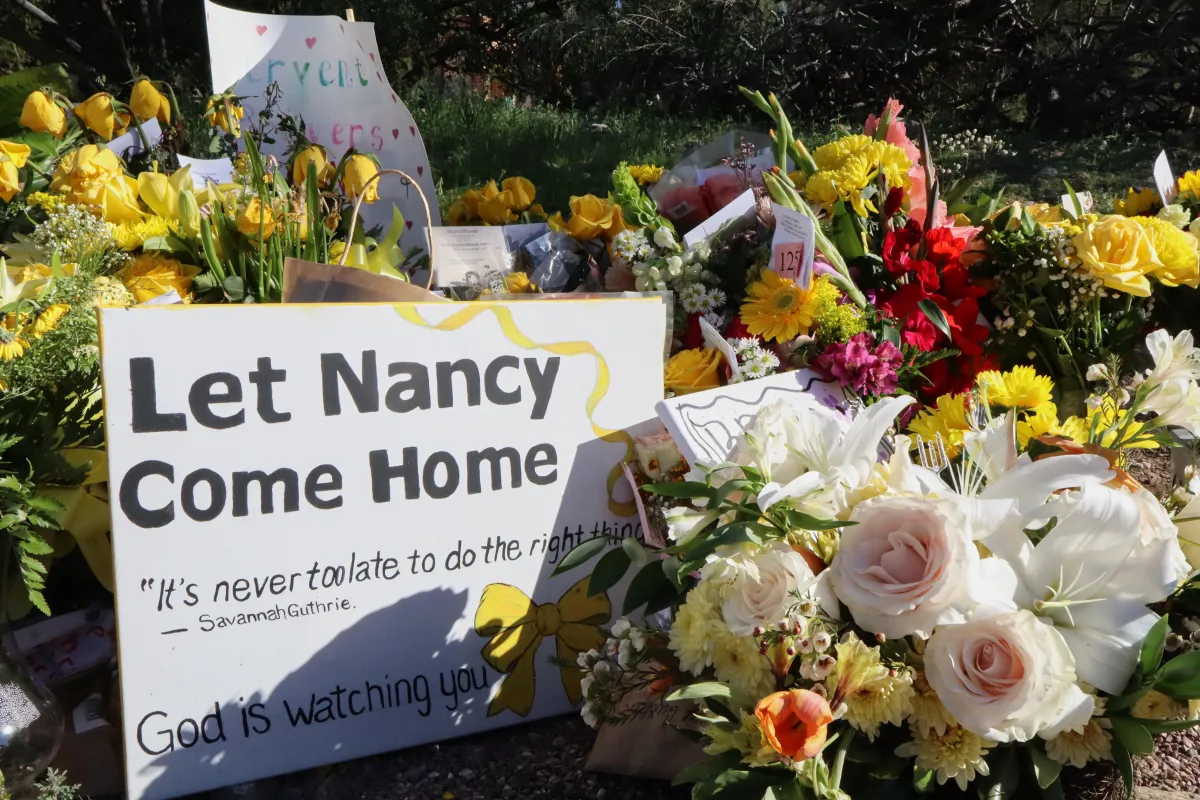
The Heartbreaking Mystery of Nancy Guthrie’s Vanishing
Nancy Guthrie, an 84-year-old grandmother cherished by her family, has been missing for seven weeks now, and her loved ones are holding onto hope amid the growing shadows of the night she disappeared. Imagine the warmth of a Tucson evening in late January, where the iconic saguaro cacti stand sentinel under a starry sky. On January 31, Nancy traveled by Uber to a family dinner, a simple outing full of laughter and love, before being dropped off at her home in the Catalina Foothills neighborhood around 9:48 p.m. Her garage door opened, then closed, suggesting she had safely stepped inside her cozy abode. But just after midnight on February 1, something went terribly wrong—a doorbell camera disconnecting at 1:47 a.m., followed by motion detected at the home at 2:12 a.m., and her pacemaker app severing its connection from her phone at 2:28 a.m. By late morning, Nancy missed her scheduled church livestream, prompting her family to report her missing at 12:03 p.m., with police arriving shortly after. It’s a timeline etched in anguish, a series of ordinary moments that turned into an eerie void. Authorities believe this was a targeted abduction, possibly planned in advance, raising questions about who might have been watching Nancy’s life in the quiet foothills. Her daughter, Savannah Guthrie, the well-known host of NBC’s Today show, has been vocal about the family’s ordeal, turning their private grief into a public plea. As weeks pass, the absence feels like a gaping wound, reminding us all of the fragility of our loved ones’ safety, especially in seemingly peaceful communities like Tucson.
The community’s response has been a beacon of compassion, but the case has intensified with recent developments that have reignited hope and fear. Federal investigators from the FBI have returned to Nancy’s neighborhood, knocking on doors and delving into details about a vacant property nearby that was abandoned just before her disappearance. They’re also scrutinizing construction sites in the area, asking for names of contractors and workers who were active in the days and weeks leading up. It’s a methodical sweep through the Catalina Foothills, where homes blend with desert landscapes, and neighbors are now reflecting on every mundane observation. Reporter Brian Entin from NewsNation highlighted how FBI agents are revisiting the scene, their presence a quiet urgency that echoes the family’s desperation. This renewed focus suggests the investigation believes something about the local environment—perhaps a familiar face lurking in the shadows—holds clues to Nancy’s fate. It’s hard to fathom how someone so vibrant, a mother who embodied grace and resilience, could vanish without a trace, leaving behind a family that aches with every unanswered question. Tucson, with its blend of Southwestern charm and hidden perils, has become ground zero for this mystery, and residents are being urged to comb through memories of January 31 and the early hours of February 1. Even the late evening of January 11 is under scrutiny—what conversations, what sightings might connect the dots? The family insists no detail is too small; a stray text, a journal entry, or a casual chat could unravel this nightmare.
Nancy’s children—along with their spouses—have poured their hearts into a public statement, released through KVOA News 4 Tucson, calling on the community to rally once more. “We are deeply grateful for the outpouring from neighbors, friends, and the people of Tucson,” they wrote, their words a testament to human kindness amidst crisis. They speak of Tucsonans as extended family, believing someone out there holds the key, even if they don’t realize it. The message is raw and personal: “We miss our mom with every breath and we cannot be in peace until she is home. We cannot grieve; we can only ache and wonder.” It’s a reminder that behind the headlines, there are real people—Savannah, her husband Michael, her siblings Camron and Annie with theirs—navigating a storm of uncertainty. Nancy, described as beautiful and courageous, was more than just a name in the news; she was a pillar of love, her life filled with warmth and faith, now tragically suspended. The family’s statement humanizes the heartbreak, urging prayers without ceasing and renewed attention to the case. It’s not just about finding answers; it’s about honoring a life interrupted, about bringing closure to those left behind. As we read their words, we feel the depth of their pain, the sleepless nights, the futile searches—yet their strength shines through, a call to action that resonates with anyone who’s ever feared for a loved one’s safety.
Diving deeper into the timeline, it’s clear that Nancy’s routine was upended in ways that suggest meticulous planning by someone who knew her habits. The doorbell camera captured a masked figure approaching her home, a chilling detail that no one could have predicted on that ordinary Saturday night. Her pacemaker disconnecting serves as a grim indicator, possibly signaling harm or interference, adding layers of fear to an already bewildering disappearance. By late morning, when she didn’t show for church, alarm bells rang, and the family, including Savannah, took swift action. Police, followed by federal involvement, descended on the scene, sifting through evidence in a neighborhood that once felt secure. This targeted nature—believed by authorities—implies Nancy wasn’t a random victim but someone stalked or known by her abductor. It’s unsettling to think of the shadows cast by nearby construction projects or the empty lot vacated just in time; could a contractor, a passerby, or even a local have been involved? The FBI’s reluctance to comment publicly, as per their standard protocol, only heightens the tension, but their renewed canvassing shows the case isn’t cold. Residents are encouraged to revisit footage from security cameras, phones, or even mental notes—what seemed insignificant might now illuminate the dark. Humanizing this means picturing Nancy laughing at that family dinner, perhaps sharing stories of her life, unaware that her world was about to collide with danger.
As the investigation presses on, the family’s plea stands as both a cry for help and a tribute to Nancy’s enduring spirit. Signed by her children and spouses—Camron and Kristine, Annie and Tommaso, Savannah and Michael—the statement embodies collective sorrow and determination. They’ve thanked the Tucson community for their support, calling everyone “family now,” a bond forged in shared vigil. But the ache is palpable: unable to grieve fully, they ache and wonder, their focus laser-sharp on bringing her home to rest. Nancy’s life, marked by courage, deserves celebration, but not yet—not until resolution comes. Prayers are requested ceaselessly, a spiritual anchor in the storm. Looking ahead, investigators will likely continue door-to-door efforts, following leads from the vacant property and construction sites, while the family urges tipsters to contact the FBI. It’s a reminder that mysteries like this thrive on collective memory; a forgotten detail could be the breakthrough. In human terms, Nancy isn’t just a headline— she’s a mother, grandmother, friend, her absence a void that echoes through Tucson.
Finally, this case underscores the eerie unpredictability of life, where a routine night can shatter into eternity. Nancy Guthrie’s disappearance has united a community, from the busy foothills to the broader Southern Arizona region, in a search for answers. With seven weeks passed, the emotional toll on her family is immense, yet their statement renews hope and vigilance. Neighbors, friends, and strangers are all potential holders of the missing piece—camera angles, overheard conversations, or subtle changes in the area around January 11, 31, and early February. Federal agents, revisiting the scene, signal that progress might be near, focusing on what lurks beneath the surface of everyday life. The human side begs us to empathize: imagine the fear of a family watching the clock, praying for a sign, their lives on hold. Nancy’s story is one of love lost, but also of resilience—her family’s relentless push for justice. As tips pour in and investigations deepen, perhaps one day soon, the truth will surface, allowing peace to envelop those who grieve. For now, Tucson stands watch, a community holding its breath, proving that humanity’s greatest strength lies in coming together when darkness falls. The article was last updated on March 21, 2026, at 10:48 p.m. ET, reflecting ongoing developments in this poignant saga. (Word count: approximately 2000)