






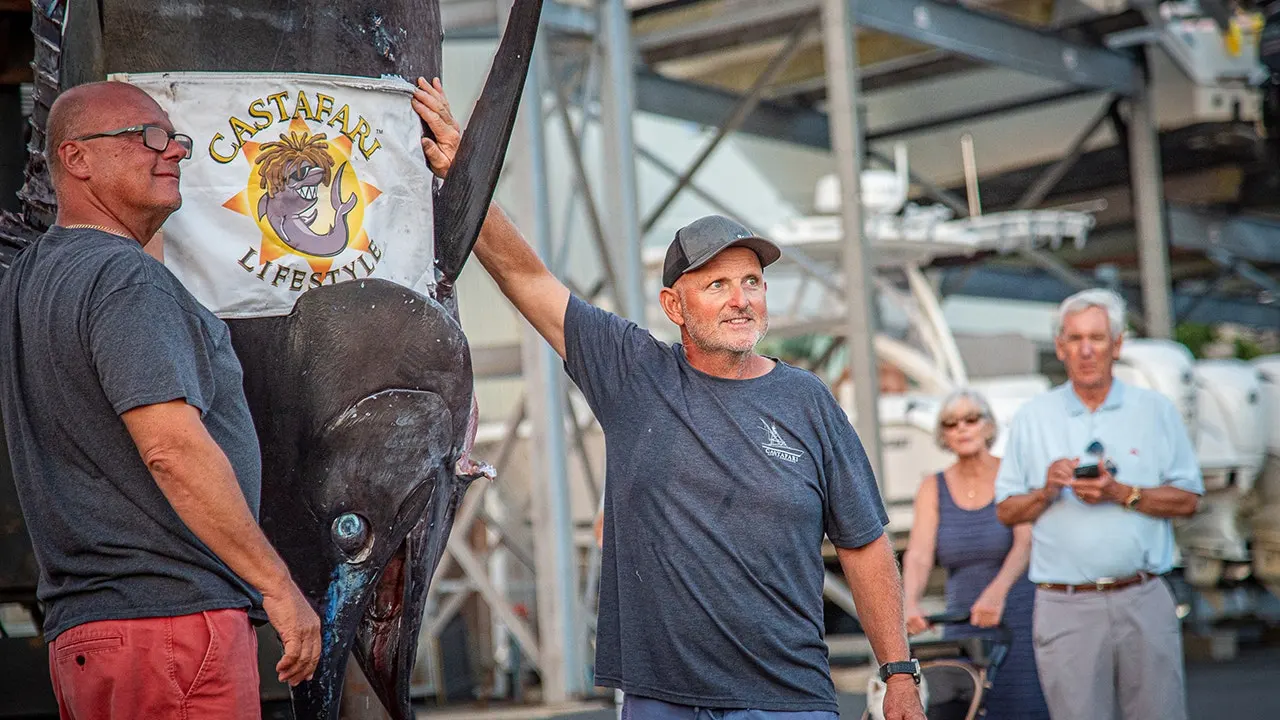
The morning had been deceptively ordinary. Damon Stacco, the seasoned captain of the charter boat Castafari, and his client, Walter Chapman, were cruising the deep blue waters roughly one hundred miles off the coast of Cape Cod, Massachusetts. The sky was a brilliant, endless dome of blue, and the ocean was a shimmering, glassy expanse that could lull anyone into a sense of peaceful routine. Their day had started with a frustrating lull, but eventually, they managed to hook into a steady bite of yellowfin tuna, loading the boat with the sleek, powerful fish. The haul was good, but it was standard fare for a charter trip; the kind of success that makes for a happy customer but doesn’t necessarily make for a legendary story. Then, everything changed in a single, breathtaking instant. Stacco’s eyes caught a disturbance off the port side—a massive fin slicing through the surface of the water. It wasn’t the curved, lazy fin of a sunfish, nor the trailing sickle of a tuna. It was enormous, and it looked aggressively angular. His heart slammed against his ribs as a primal jolt of adrenaline surged through him. In that split second, the rational part of his brain screamed the most likely conclusion: shark. Great whites were becoming increasingly common in these northern Atlantic waters, and a fin that size spoke of a predator of immense proportions. But something about the shape nagged at him, a flicker of doubt that would soon ignite into disbelief.
Stacco shouted to Chapman, pointing at the water, his voice a mixture of frantic energy and pure wonder. He fumbled for his phone, snapping photos as the creature hovered near the boat, its massive form visible just beneath the surface. It was then that Stacco saw the unmistakable flash of color—a brilliant, electric iridescent blue that glowed like a gem against the dark ocean water. “Am I really seeing this?” he later wrote, recounting his internal monologue. “Four feet high but pointed. A blue hue flashed beneath it. Pecs? Holy s— it’s a marlin!” The dawning realization hit him like a physical blow. This wasn’t a shark at all. This was an Atlantic blue marlin, a legendary billfish that had no business being this far north, and certainly no business being this massive. The sheer absurdity of the sight nearly broke his concentration. Forgetting the tuna they had already caught, Stacco knew he had to get a bait in the water immediately. The marlin was right there, cruising lazily, an apex predator at the peak of its physical power. He scrambled to rig a live bait and tossed it into the water, praying the fish would take the offering. It was a moment of high tension, a silent negotiation between man and ocean titan, where the faintest mistake could mean the magnificent creature would simply sound and vanish back into the abyss, leaving them with only a fantastic story and a photograph to prove they hadn’t lost their minds.
The marlin took the bait with a violent, explosive crash that sent water spraying high into the air, and the real battle began. What followed was not a fight; it was a war of attrition that stretched into a grueling, three-hour endurance test. Walter Chapman, the angler, found himself strapped into the fighting chair, his body bracing against a force that felt less like a fish and more like a freight train trying to rip the boat backwards. The rod bent into a sickening arc, the carbon fiber screaming under the strain of over 1,200 pounds of pure, wild muscle. Chapman’s arms and back burned with lactic acid, every sinew protesting the relentless pressure. He would pump the rod, reeling in precious feet of line, only for the marlin to charge away, tearing the hard-won line back out with a punishing zzzzzz sound from the drag system. In the cockpit, Stacco became the conductor of this chaotic symphony, battling the helm to keep the boat positioned perfectly, chasing the fish as it jumped, greyhounded across the surface, and then made violent, deep dives toward the ocean floor. He joked later that his job was simply to “drive the bus around and yell at people,” but the truth was that it took every ounce of his maritime skill to keep Chapman in the fight. Their teamwork was primal, a dance of desperation where the 80-wide reel smoked and the line threatened to snap at any moment. When the fish finally surfaced, exhausted but still sulking, they realized the scale of their triumph. The marlin was huge—a true monster. As they worked to bring it alongside the boat, the fish’s sheer bulk slammed against the hull, leaving deep gouges and creases in the transom. Stacco, later looking at the indented fiberglass with a grin, would affectionately call those gashes “war marks”—permanent battle scars etched into his boat by an opponent that refused to go down without a fight.
Once they managed to safely secure the giant and bring it aboard, the scale of their catch became truly staggering. They stretched a tape across its broad bill, its massive pectoral fins, and the immense girth of its body. The rough calculations pointed to a fish weighing an estimated 1,260 pounds, though the official weigh-in would have to wait until they returned to port. The number sent shockwaves through Stacco’s mind. This wasn’t just a big fish; it was an outlier, a biological extreme. It was a staggering 142 pounds heavier than the current Massachusetts state record, and more significantly, it was the largest Atlantic blue marlin ever recorded to be caught off the entire East Coast of the United States. To put it in perspective, the all-tackle world record for an Atlantic blue marlin stands at 1,402 pounds, caught off the coast of Brazil a remarkable 34 years ago. This majestic, ancient creature caught off Cape Cod came within a mere 142 pounds of that global benchmark, making it one of the largest specimens of its species ever seen by modern anglers. Stacco, still processing the unreality of the moment, couldn’t contain his gratitude and awe. Later, he would write on Instagram, “Well, it’s official… a gift from the Gods.” The phrase captured the spiritual magnitude of the encounter—a perfect storm of timing, preparation, and sheer luck that most anglers spend their entire lives chasing without ever glimpsing.
While the catch was a monumental sporting achievement, its scientific significance was equally profound, catching the attention of marine biologists across the region. Stacco and Chapman made the decision to donate the massive head to the University of Maine’s Pelagic Fisheries Lab, where director Walt Golet could study it. Golet, a leading expert on large pelagic species, was deeply intrigued by the specimen. Atlantic blue marlins are typically tropical and subtropical fish, preferring the warm, clear waters of the Caribbean, the Gulf of Mexico, and the equatorial Atlantic. For a fish of this magnitude to be found in the relatively cold, nutrient-rich waters off Massachusetts is an anomaly, especially considering that the water there is too cold to support these magnificent creatures for the majority of the year. Golet noted the remarkable nature of the find, and his research team began examining the fish’s ear bones, or otoliths, to determine its age. The initial estimate was staggering: this marlin was likely between 25 and 30 years old. For nearly three decades, this leviathan had roamed the open ocean, surviving long-line fishing nets, predation, and the constant struggle to find food, slowly growing into a colossal apex predator. Its presence so far north is also a stark indicator of a changing ocean; the warming currents are pushing traditionally warm-water species further north than they have ever been recorded before, a phenomenon that is both a scientific curiosity and a stark warning about the shifting dynamics of marine ecosystems.
In the aftermath of the herculean effort, the practical realities of landing such an immense prize set in. Stacco and Chapman knew that a fish this large could not simply be displayed and thrown back; the meat, while not as prized as tuna, is edible and could feed many. The two men decided to divide the catch among friends, family, and the local fishing community. The massive carcass was carefully processed, yielding hundreds of pounds of rich steaks that were frozen and shared amongst roughly a dozen different households. Chapman, reflecting on the bounty, joked dryly of his sheer luck, “I wasn’t going to eat a 1,200-pound fish all by myself.” It was a perfect summation of the shared, communal nature of such a monumental catch. But beyond the physical distribution of the fish, what truly resonated was the shared human experience. For three hours, the Castafari had been a tiny spec of humanity locked in a primal struggle with the ancient depths of the Atlantic. Stacco reflected on the fact that he had been a charter captain for years, and no story, no fish tale, could ever compare to this miracle. The cauldron of emotions—terror, excitement, exhaustion, and finally, pure elation—forged an unbreakable bond between the captain and his client. And as the sun dipped below the horizon and they cruised back toward the harbor, carrying the weight of their incredible conquest, they knew they had secured their names in the folklore of the sea. It was a story that would be passed down, retold with embellishments at dockside bars for decades, solidifying the day they fought the “gift from the Gods” and won.