


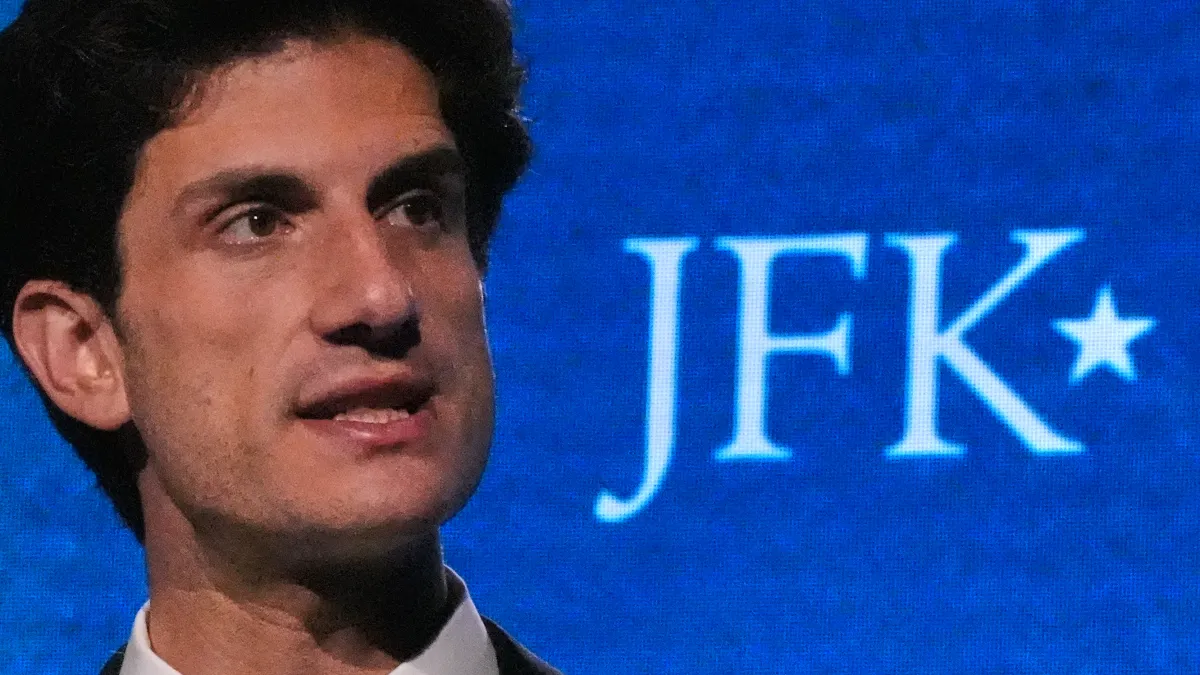
Under the bright, relentless glare of the New York media spotlight, a quiet shift in American political history occurred on a seemingly ordinary Tuesday night. Jack Schlossberg, the thirty-three-year-old only grandson of former President John F. Kennedy, stepped into the electoral arena in New York’s 12th Congressional District, carrying with him the heaviest, most glittering, and legendary surname in the history of the Democratic Party. To look at Schlossberg is to see the ghosts of his family’s glamorous past; he possesses the sharp jawline, thick hair, and unmistakable, effortless charisma that once defined the era of Camelot. Recognizing the modern media landscape, he did not run a traditional, stuffy campaign; instead, he sought to bring a refreshing, almost goofy human energy to the race, leveraging a massive and highly engaged social media following filled with quirky political monologues, self-deprecating humor, and a genuine attempt to bridge the gap between a youthful, disillusioned electorate and an aging Democratic establishment. Yet, when the final ballots were cast, the spell appeared to have broken. Schlossberg managed to capture a mere eleven percent of the vote, finishing a distant and sobering third behind the eventual victor, state Assemblymember Micah Lasher, who pulled in thirty-nine percent, and Assemblymember Alex Bores at thirty-five percent. For a political newcomer who had hoped his digitized version of the classic Kennedy charm would ignite a firestorm of youthful optimism, the result was a chilling reminder that in the pragmatic, rough-and-tumble world of local New York politics, a famous name is no longer a golden key. It was a deeply personal defeat that left political analysts and ordinary citizens alike wondering if the unique, almost magical ability of the Kennedy family to convert geopolitical celebrity into electoral victories had finally reached its expiration date, leaving its youngest heir stranded in the cold reality of a changing political landscape.
To understand the profound depth of Schlossberg’s defeat, one must journey back to the origin of the national romance that began more than six decades ago. In 1960, the election of John F. Kennedy to the presidency did not merely change the occupant of the Oval Office; it forever altered the visual and emotional vocabulary of American politics. Together with his elegant wife, Jacqueline, JFK introduced an unprecedented aura of youth, intellectual vigor, sophistication, and raw optimism to a nation navigating the icy anxieties of the Cold War. The concept of “Camelot”—a brief, shining moment of grace and idealism—became inexorably linked to the Kennedy brand, a modern-day fairy tale that was tragically cemented in the national consciousness by the president’s sudden and devastating assassination in Dallas. This unbearable public grief only deepened the country’s emotional investment in the family, transforming their political ambitions into a collective, almost sacred duty. In the years that followed, JFK’s brothers, Robert F. Kennedy and Edward “Ted” Kennedy, rose to become towering, mythic figures who championed the civil rights movement, fought against systemic poverty, and helped define the modern legislative backbone of the Democratic Party. For generations, the family functioned as a political powerhouse that seemed uniquely capable of translating personal tragedy into collective triumph, generating a steady stream of heirs who stepped naturally from the private tragedy of their gilded lives straight into the halls of public service. From Patrick Kennedy’s sixteen-year congressional career representing Rhode Island to various cousins holding municipal and state offices across the country, the surname Kennedy was a political currency of unmatched value. They experienced their private tragedies under the glare of public flashbulbs, yet always returned to the service of their country. This loyalty was reciprocal; the American voting public embraced them as a surrogate royal family, viewing their triumphs as proof of the American dream, and their catastrophic losses as shared national traumas in search of redemption.
This legendary political machinery, however, has been quietly stalling for years, losing its momentum as the memories of the mid-twentieth century fade into history. The first genuine crack in the armor became visible to a stunned public in 2020, when Representative Joe Kennedy III, a highly respected and articulate grandson of Robert F. Kennedy, decided to challenge the incumbent Senator Ed Markey in a highly charged Democratic primary in Massachusetts. For generations, Massachusetts had been the family’s ancestral home and unassailable political fortress, a place where the Kennedy name was considered completely bulletproof at the ballot box. Yet, in a historic and symbolic shift, the younger Kennedy was decisively defeated by Markey, a septuagenarian progressive who successfully framed himself as the candidate of genuine grassroots change, while subtly depicting his opponent as a relic of dynastic privilege. This defeat was not merely a localized political upset; it was a profound psychological turning point for both the family and the Democratic electorate, showing that modern voters, especially younger progressives, were no longer willing to pledge their allegiance to a brand simply out of historical reverence. The traditional Kennedy playbook—relying on a network of wealthy legacy donors, relying on moving speeches about public service, and presenting an idealized image of youthful leadership—collided head-on with a new era of politics defined by systemic frustration, grassroots organizing, and a demand for deep ideological commitment over familial prestige. As the older, commanding figures of the dynasty passed away or retired, a younger generation of Kennedys found themselves trying to navigate an electorate that was increasingly cynical of political royalty, viewing the family’s storied past not as an inspiring call to action, but as a privileged legacy discordant with the struggles of everyday working-class Americans. In this rapidly evolving landscape, the romanticism that once surrounded the family’s political ambitions began to curdle into skepticism, leaving the newer generation to discover that the heavy crown of their lineage was becoming far more of an electoral liability than an asset.
Denied their traditional path through the ballot box, modern members of the Kennedy family have increasingly channeled their instinct for public service through administrative appointments and diplomatic postings rather than grueling electoral campaigns. Caroline Kennedy, Jack Schlossberg’s mother, has maintained a dignified and highly respected career as a diplomat, representing the United States as Ambassador to Japan under President Barack Obama and subsequently as Ambassador to Australia under President Joe Biden, while Joe Kennedy III returned to government service in 2022 as a special envoy to Northern Ireland for economic affairs. However, the most visible, influential, and deeply divisive Kennedy active in American national politics today represents a radical and disorienting departure from the family’s traditional establishment values. Robert F. Kennedy Jr., after abandoning a controversial 2024 presidential campaign that began in the Democratic primary before transitioning into an independent run, shocked the nation by endorsing Donald Trump and subsequently being selected to lead the Department of Health and Human Services. This alliance represents a startling irony for a family whose very name has long been synonymous with the core of the democratic establishment. RFK Jr. built his substantial national platform not on the progressive social policies of his father or uncles, but on a foundation of intense skepticism toward scientific institutions, public health mandates, and traditional media—stances that have drawn fierce, public condemnation from his own siblings and cousins, who have openly characterized his political choices as a betrayal of their father’s values. This public fracturing of the Kennedy brand has laid bare a profound truth: the cohesive, unified dynasty that once commanded the loyalty of millions has dissolved into a complex, fragmented web of individuals, where the shared family name is no longer a guarantee of unified purpose, but rather a contested battlefield for the soul of the family’s legacy.
Despite this fragmentation and the undeniable decay of their electoral influence, the American cultural obsession with the Kennedy mystique remains as vibrant and insatiable as ever, highlighting a fascinating paradox in the national psyche. We seem to have reached a point where we are deeply in love with the idea of the Kennedys as cinematic characters, yet deeply resistant to them as actual political leaders. This cultural fascination is currently experiencing a massive revival in popular media, as evidenced by the recent debut of the highly publicized television drama Love Story, which meticulously chronicles the romantic, tragic, and intensely scrutinized relationship between John F. Kennedy Jr. and Carolyn Bessette. Simultaneously, production is currently underway at Netflix for a landmark biographical series titled Kennedy, inspired by Fredrik Logevall’s definitive biography, with two-time Oscar nominee Michael Fassbender set to portray the family patriarch, Joseph P. Kennedy Sr. This series, along with an endless stream of documentaries and books, continues to repackage the family’s triumphs and tragedies for a new generation of consumers, treating their lives as an American epic on par with Greek tragedy. Yet, this intense cultural hunger for Kennedy content does not translate into actual political power at the voting booth, as Jack Schlossberg’s stinging defeat so clearly demonstrated. It suggests that contemporary Americans prefer to keep the Kennedys safely locked away in the realm of comfortable nostalgia—viewing them as beautiful, tragic figures of a bygone golden age rather than active agents of modern governance. We are eager to consume their personal lives as entertainment, to weep over their premature deaths, and to admire their impeccable mid-century style, but when it comes to the practical, gritty decisions of local zoning, taxation, and school funding, voters are choosing neighbors and local activists over the descendants of political royalty. The romantic illusion of Camelot remains highly effective at selling books and streaming subscriptions, but it has lost its power to persuade a pragmatic, modern voter who is looking for concrete solutions rather than nostalgic mythology.
Ultimately, Jack Schlossberg’s third-place finish in a local New York primary may well be remembered as the quiet, definitive end of an era—the moment when the torch, rather than being passed to a new generation of Kennedys, was gently set down. It represents a deeper, more profound transformation in the way Americans view authority, leadership, and the concept of political legacy. In an era marked by intense polarization, widespread institutional distrust, and a chaotic, decentralized digital landscape, the idea of a benevolent political dynasty feels increasingly outdated, a charming blueprint from a simpler time that no longer fits the messy realities of our modern democracy. We no longer look to a singular family to provide us with hope, nor do we believe that leadership is a quality that can be inherited through genetic lineage. Schlossberg’s loss is a reminder that the true magic of the Kennedy family did not lie in their DNA, but in a specific, historical moment when their unique qualities aligned perfectly with the deep aspirations of a rapidly changing nation. As the sun sets on their electoral dominance, we are left to appreciate the Kennedys not as a living political machine, but as a historic monument—a beautiful, tragic, and incredibly influential chapter in the story of America that has finally run its course. For Jack Schlossberg and the younger generation of his family, this realization, though undoubtedly painful, may also bring a strange kind of freedom; the freedom to step out from the long, imposing shadow of their ancestors and to forge their own paths in a world that no longer demands they be kings, but merely asks them to be human. In this new light, the loss of political power might actually be a gift, releasing these young heirs from the immense, crushing burden of living up to a myth that was always impossible to maintain. As the Kennedy story transitions from active political news into the quiet halls of American history, we are reminded that even the most powerful dynasties must eventually fade, leaving behind only the memories of their brief, shining moment under the sun.