



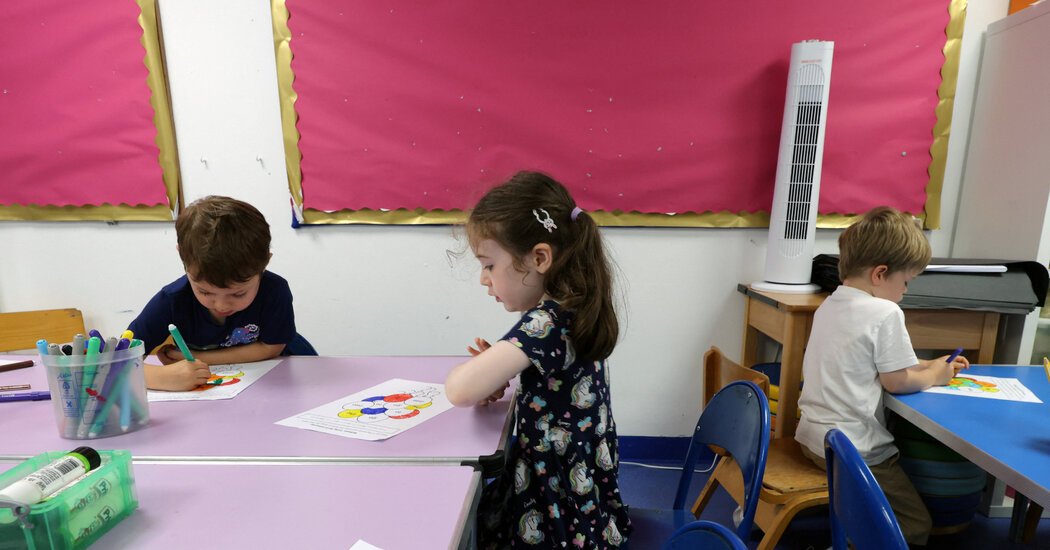
Inside vintage European classrooms that have stood for decades—some even for over a century—the air has turned heavy, thick, and suffocating as an unprecedented summer heatwave takes hold. For young students like seven-year-old Raya Petrova, the historic stone and brick walls of her London school no longer represent a sanctuary of learning; instead, they feel like the inside of a baking oven. With temperatures soaring into the 90s, children are discarding their shoes, loosening their collars, and slumping over desks in a desperate attempt to find a cooler patch of air. Western Europe, a region historically accustomed to mild, damp summers and long, biting winters, is being scorched by a relentless dome of high pressure. Yet, despite the blistering conditions, school remains resolutely in session for millions of young people across Britain, France, and neighboring nations. Unlike their peers in modern or climate-controlled schools in other parts of the world, these pupils are trying to absorb math, literature, and science in rooms completely devoid of air conditioning. Historically, European education systems avoided this crisis because the academic calendar traditionally wound down before the brutal peak of late summer. However, the rapidly accelerating reality of global climate change has shifted the seasons, pulling intense, suffocating heatwaves forward into June and early July. Consequently, the final weeks of the school year have transformed into a grueling test of physical endurance, exposing vulnerable children to indoor environments that are increasingly hostile to both health and learning.
This meteorological shift has thrust school administrators and education officials into a painful, high-stakes dilemma: they must constantly weigh the cognitive cost of lost instructional time against the immediate physical dangers of extreme heat. Modern educational research confirms that high temperatures severely degrade cognitive focus, memory retention, and testing outcomes, yet closing schools carries a heavy social price, especially on the heels of the academic disruptions caused by the COVID-19 pandemic. At the Sheldon School in Chippenham, southwestern England, headteacher Pete Lynch found himself cornered by the limitations of his state-funded facilities, comparing his school to a giant greenhouse where children are trapped for six hours a day. With windows designed to open only a mere sliver for safety and energy insulation, and with only fifty fans available to cool sixty classrooms—twenty of which he personally rushed to purchase just last week—Lynch had no viable choice but to send his students home early. The stark reality is that these public buildings were simply never engineered to cope with extreme heat; they were designed to trap warmth during the chilly, grey European winters, leaving them completely ill-equipped for a warming world. When the winter chill arrives, these classrooms are freezing, but when summer strikes, they become intolerable solar cookers, leaving dedicated educators with virtually no infrastructure to protect their students from the elements.
In the absence of systemic solutions, the burden of adaptation has fallen squarely onto the shoulders of local teachers, parents, and community businesses, who are relying on ad-hoc DIY strategies just to get through each day. In Paris, where Deputy Mayor Emmanuel Grégoire announced an urgent initiative to purchase 1,200 fans for the city’s 620 preschools and elementary schools, bureaucratic delays meant that only a fraction of those fans had actually been deployed by the start of the week. Frustrated and exhausted by the stifling atmosphere, preschool teacher Violaine Guéguen described the working conditions as nearly unendurable, noting that parents have resorted to hauling their personal fans from home to keep classrooms functional. To keep the children hydrated and calm, teachers are constantly reorganizing their schedules, abandoning structured curriculum plans to play outdoor water games in the relatively cool morning hours, loosening strict uniform dress codes, and canceling physical education classes altogether. Meanwhile, across the border in Belgium, where national weather services issued severe heat warnings as temperatures climbed toward 95 degrees Fahrenheit, some schools suspended afternoon classes entirely. In a heartwarming display of community solidarity, one primary school in the town of Hoegaarden took the extraordinary step of moving entire classes out of their suffocating schoolhouse and into the air-conditioned conference rooms generously offered by local businesses, illustrating the desperate, patchwork solutions communities must assemble when public infrastructure fails.
This logistical chaos has reignited deep-seated divisions among parents, teachers, and policymakers, echoing the highly polarized and emotionally charged debates that characterized the pandemic era. On one side of the argument are parents like Emma Hergest of London, who stood outside school gates under a relentless 92-degree sun, carefully applying layers of sunscreen to her three young children before sending them into a building she knew was fundamentally unsafe. This protective parental instinct often clashes with official government guidance; for instance, the British Department for Education released public statements strongly discouraging school closures, asserting that consistent school attendance remains the absolute best pathway for pupils to achieve their educational potential and that hot weather can be managed safely through basic administrative adjustments. However, this centralized optimism offers little comfort to headteachers on the ground who must bear the personal and legal responsibility for heatstroke or dehydration among their pupils. In France, Education Minister Édouard Geffray adjusted to the grim reality by reporting that nearly 10,000 of the nation’s 60,000 schools had already been forced to shut down or alter their schedules to cope with the heatwave. This lack of a unified, cohesive strategy across Europe has left individual communities to flounder, forcing parents to navigate a confusing, constantly shifting landscape of half-day closures and last-minute schedule changes.
The sudden wave of school cancellations has also triggered a cascade of socioeconomic pressures for working-class families, highlighting the profound intersection between climate vulnerability and economic inequality. For many parents, the sudden closure of schools presents a logistical nightmare, forcing them to choose between their livelihoods and their children’s safety. Sofia Georgieva, a London-based hairdresser and mother of a seven-year-old, pointed out the sheer pointlessness of keeping children in classrooms where the heat makes any real learning impossible, yet she noted that as a self-employed worker, she does not get paid if she stays home to care for her daughter. This financial precarity transforms a weather event into a direct threat to household survival, especially when public officials fail to provide structured backup child care or state-sponsored cooling centers. Furthermore, keeping children home does not guarantee a cooler environment, as very few residential homes in cities like London or Paris are equipped with air conditioning, prompting pediatricians like Dr. Silvia Pierini to argue that staying in school is often the safer option because it guarantees adult supervision and structured hydration. At the same time, some parents from warmer climates, such as Claire Demetriou, shrug off the warning headlines as overreactions, pointing out that children successfully attend school in much hotter countries year-round. This cultural divide underscores the psychological friction of an entire continent struggling to normalize a hostile new climate reality while lacking the basic infrastructure to support it.
Ultimately, this seasonal crisis exposes a deep, structural vulnerability that goes far beyond the summer schedule of primary schools; it reveals a continent whose foundational architecture and urban planning are physically outdated for the 21st century. The charming brick, stone, and mortar buildings that define Europe’s historic educational landscape were built for a temperate past—a world where coal fires and heavy insulation were the primary defenses against a naturally chilly environment. As climate change permanently alters the global thermostat, these architectural monuments are increasingly functioning as dangerous heat traps, threatening the physical well-being and academic development of the next generation. The current reliance on temporary, improvised solutions—such as paper fans, plastic water bottles, and borrowed corporate office spaces—is clearly unsustainable for a future where extreme heatwaves will only grow more frequent, prolonged, and intense. Until governments commit to massive, systemic investments in green infrastructure, retrofitting historic public spaces with modern cooling systems, heat-reflective materials, and smart ventilation, the annual school calendar will remain at the mercy of the elements. For families, educators, and children, the baking classrooms of London, Paris, and Brussels are a silent warning that our physical world must rapidly adapt, or we will continue to ask our children to learn, grow, and build their futures in an environment that is slowly catching fire.