

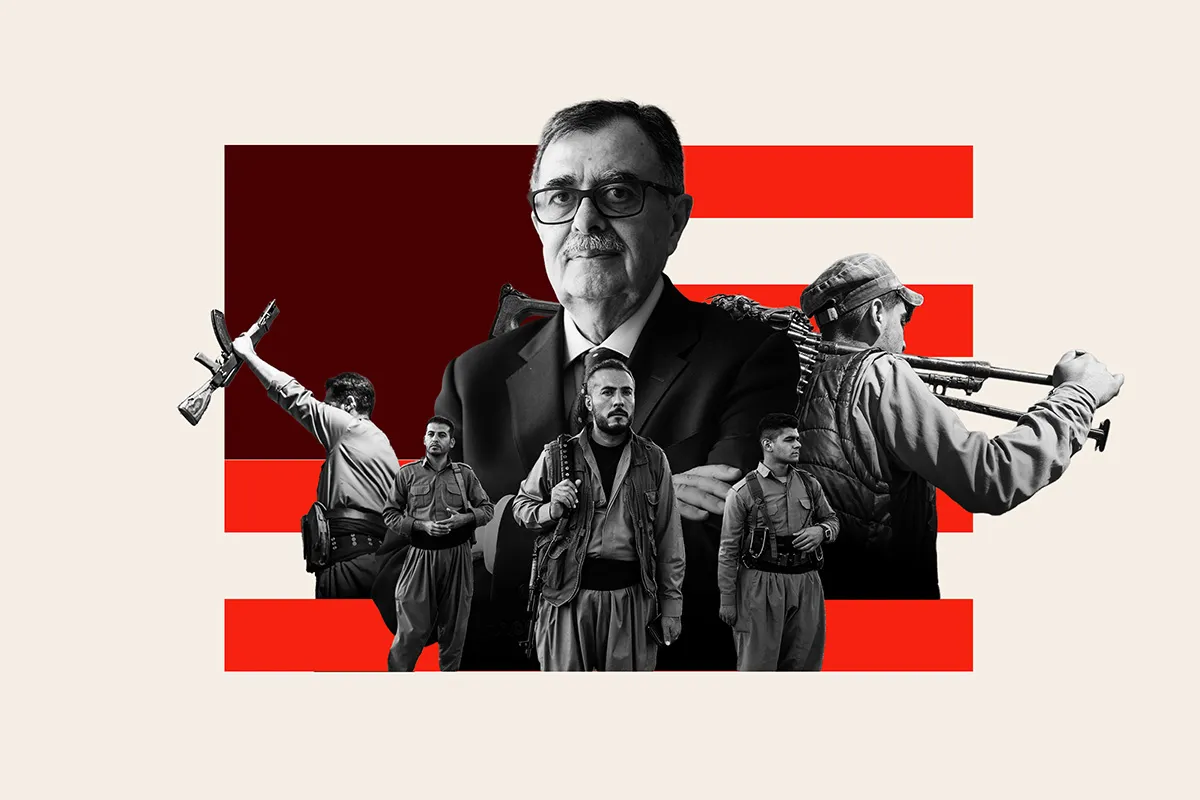
In the heart of a turbulent Middle East, where the echoes of the U.S.-Israeli air campaign against Iran reverberate like a distant thunderstorm rolling across the desert, one man’s words stand out as a beacon of quiet resolve. Abdulla Mohtadi, the Secretary-General of the Komala Party of Iranian Kurdistan, sat down with Newsweek to share a conversation that feels more like a candid chat over strong tea than a formal political interview. He’s not just outlining strategies; he’s painting a picture of hope and caution, rooted in decades of struggle. Imagine waking up every day knowing your community could be the spark that tips the scales in a fight for freedom. Mohtadi explained that if President Donald Trump pledged real support—maybe through air cover, supplies, or even tacit approval—the Kurdish forces he’s part of could shift the battlefield. “We could play a very, very significant role,” he said, his voice steady but passionate, envisioning not just classic warfare but a protective shield for civilians. Picture this: Kurdish fighters surging into cities in their ancestral lands, not to conquer but to liberate, shielding families from regime massacres, maintaining order to prevent chaos, and boosting morale across Iran like a rallying cry that unites the downtrodden. It’s not about glory; it’s about survival and a chance for Iranians from all walks to stand taller against oppression. He emphasized that such a move could be a game-changer, a “big advantage for the people against the regime.” Yet, in that same breath, he revealed that initial White House outreach didn’t crystallize into solid plans—no binding agreements—just whispers of what could be, setting the stage for speculation and unease.
To truly grasp Mohtadi’s stance, you need to walk back through history, a tapestry woven with threads of resilience and heartache that make these Kurdish fighters feel like everyday heroes striving for a simple life. Iran, a nation of about 90 million souls, boasts a mosaic of ethnic groups, with Persians at the forefront and Kurds forming a sizable minority—perhaps 8 to 17 percent of the population, mostly clustered in the verdant northwest provinces like Kurdistan, Kermanshah, West Azerbaijan, and Ilam, with pockets stretching into Hamadan and Lorestan. It’s a land where mountains cradle ancient stories of rebellion, dating back over a century. Unlike some ethnic tensions that simmer quietly, Kurdish insurgency in Iran burned bright after the 1979 Islamic Revolution, which installed the Islamic Republic. Some groups even sided with Saddam Hussein’s Iraq during the grueling eight-year war, a controversial alliance born of desperation and divided loyalties. Fast-forward to today, and many Kurdish factions, including Komala, operate from the relative safety of northern Iraq’s semi-autonomous Kurdistan Regional Government—a haven carved out after the 1991 Gulf War and shaped further by the 2003 U.S.-led invasion that toppled Saddam. While Iraqi Kurds have navigated tricky relations with Baghdad, balancing autonomy and national ties, Iranian Kurds like Mohtadi often base themselves abroad, their peshmerga forces a testament to enduring vigilance against Tehran’s reach. It’s easy to see why they’ve been partners in past conflicts, from battling ISIS in Syria to the broader Mideast insurgencies—a legacy Mohtadi cherishes. “The alliance with Iranian Kurds would be a big, big step,” he mused, reflecting on potential future collaborations that could bridge divides for Kurds, Iranians, and even Americans.
Just a month ago, as the Gaza war still dominated headlines and the tension with Iran simmered toward the current standoff, something remarkable happened among the Iranian Kurdish groups—a unity that felt like long-lost siblings reuniting at a family gathering. Against the backdrop of internal rivalries that had kept them fractured, five major factions—the Democratic Party of Iranian Kurdistan (KDPI), Kurdistan Freedom Party (PAK), Kurdistan Free Life Party (PJAK), the Organization of Iranian Kurdistan Struggle (Khabat), and Komala of the Toilers of Kurdistan—came together to form the Coalition of Political Forces of Iranian Kurdistan. Komala itself had splintered before, with the Toilers faction breaking away in 2007, but the urgency of the Iran crisis dissolved old grievances. Mohtadi initially hesitated, pushing for clarifications on unifying peshmerga forces and establishing a joint Kurdish administration in Iranian territories. But as the first strikes escalated, he realized the bigger picture: time for petty debates had passed. Imagine the relief in their voices as they signed on earlier this month, prioritizing a united front over perfection. “It’s better to unite and pursue our aim through and within the coalition,” Mohtadi shared, his tone reflective of a man who knows alliances aren’t forged in calm but in the storm. This coalition isn’t just about fighting; it’s about forging a shared identity, a bulwark against chaos, much like neighbors banding together during a crisis to protect their homes from an impending flood.
Now, weave in the American perspective, and the narrative gets even more complex, like a chess game where every move ripples across borders. Reports of White House overtures to these Kurdish groups ignited rumors last week, hinting at a ground offensive amid the aerial ballet of U.S. and Israeli attacks. Trump, ever the unpredictable showman, first seemed enthusiastic—telling reporters it would be “wonderful” if Kurds stepped in, signaling full support. But by the next day, his demeanor shifted, a rare outright rejection that left observers scratching their heads. On Air Force One, he declared, “I ruled it out. I don’t want the Kurds going in. I don’t wanna see them get hurt, get killed.” It’s a paternalistic pivot, born perhaps from lessons learned in Syria or Iraq, where Kurdish allies risked everything and faced uphill battles afterward. Iran didn’t wait idly; with the IRGC promising to crush any “separatist” moves, they’ve launched strikes against Kurdish positions in Iraqi Kurdistan, echoing past attacks on dissident hideouts. Iran’s broader retaliation—drone and missile barrages against U.S. bases in Gulf states—paints a picture of a regime rattled, lashing out like a cornered animal. Meanwhile, Israel’s own history with Kurds and minorities, like last year’s gestures to Syria’s Druze, adds layers of intrigue, yet the cautionary tale from Syria looms large, where U.S.-backed Kurds now face integration demands from Damascus. Neighbors like Iraq and Turkey further complicate things, with Baghdad vowing no cross-border ops and Ankara’s long anti-Kurdish campaigns forcing Mohtadi to pledge: “We would not provoke Turkey or any other neighbor.” He stresses their past reliability to the U.S.—from 1991 to the ISIS fights—and a wiser approach, focused on not antagonizing, while highlighting deep ties to Iran’s internal opposition.
But not everyone’s on board with this Kurdish surge; it’s stoking fears of seismic shifts that could shatter Iran like a fragile vase dropped from height. Trump’s casual remarks about Iran’s post-war map “probably not” looking the same fueled separation anxieties, painting Kurds as potential dividers rather than protectors. Iranian officials, from Deputy Foreign Minister Esmail Baghaei to the new Supreme Leader Ayatollah Mojtaba Khamenei, lambast the idea as a Western ploy to create “failed states” by exploiting ethnic rifts—accusations that hark back to January’s deadly protests, where foreign infiltrators supposedly inflamed chaos. Baghaei’s words cut deep: “They love to create bloodshed… abusing ethnicities.” Even opposition figures like Reza Pahlavi, exiled son of Iran’s last shah, drew a hard line, calling the Kurdish coalition’s aims “baseless and contemptible” threats to Iran’s unity, despite past alliances with groups like Komala during the 2022 hijab protests. Those coalitions crumbled under ego clashes, Mohtadi admits, with Pahlavi’s camp now seeming “divisive” and “aggressive.” It’s a human drama of mistrust, where old comrades grow estranged, highlighting how fragile unity can be in the face of ambition. Mohtadi pushes back, arguing for dialogue over division, envisioning negotiations that respect rights without Balkanizing Iran.
Looking ahead, Mohtadi sketches a future that’s pragmatic yet hopeful, like a family discussing inheritance after a long illness. He rejects outright separatism, framing Kurdish goals as part of a negotiated Iran—educational rights in mother tongues, local parliaments for self-rule, all within a semi-democratic framework of free speech and elections. “It’s not something we want to impose,” he insists, emphasizing consultations with Iranians of all stripes. But this vision hinges on the Islamic Republic’s fall, something Mohtadi sees as imminent, given its weakening grip amidst the war: “They’re weakened, and there’s a glimpse of hope.” Yet, he’s haunted by “what if” scenarios—regime survival leading to massacres or vengeful crackdowns. “For them, the definition of victory is survival,” he notes, echoing the stark realities of authoritarian fights. In this realm, where hope dances with dread, the Iranian Kurds offer a bridge not just to victory but to a more equitable future, urging the world to support them as stewards of peace, not provocateurs. It’s a call that’s as personal as it is profound, reminding us that behind geopolitics are real lives, dreams, and the quiet courage to fight for something better. As the campaign unfolds, these voices from the margins might just reshape the narrative, proving that unity, when genuine, can outlast even the loudest storms.