





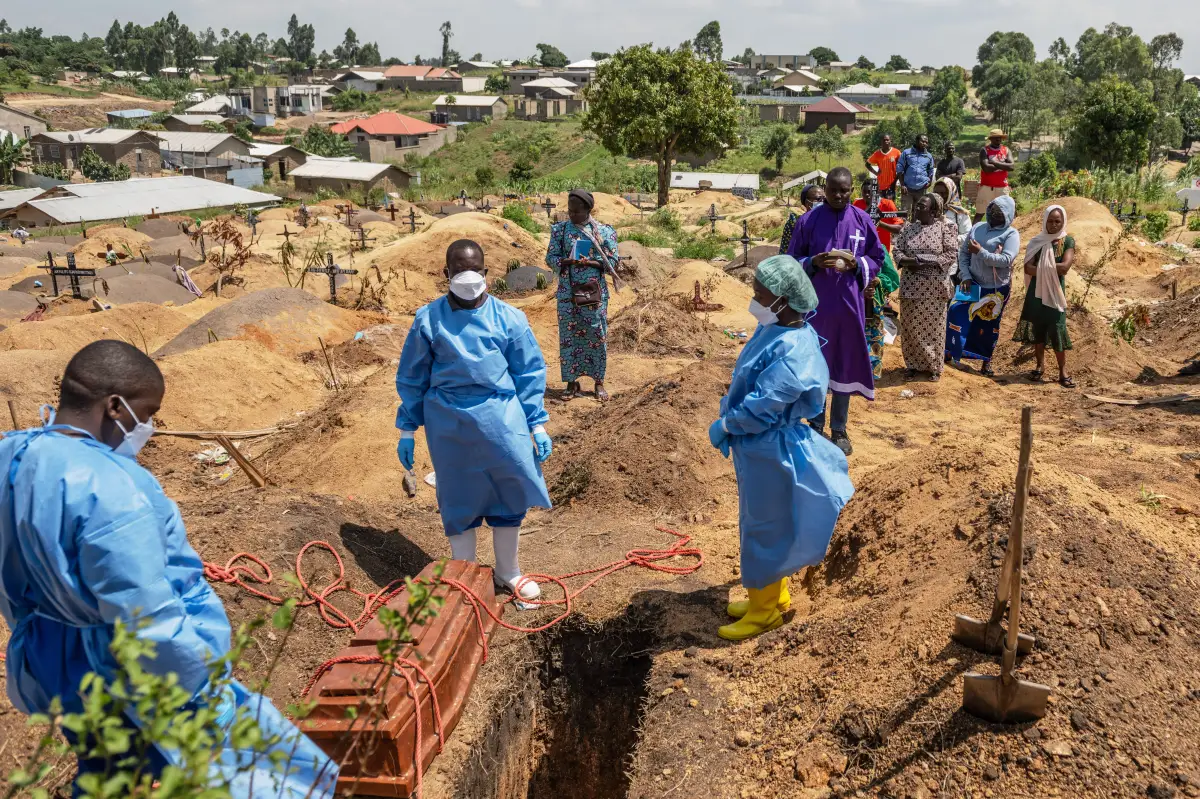
The rich, red soil of Bigo Cemetery in the northeastern Congolese city of Bunia is deeply accustomed to bearing the heavy weight of premature grief, but the burial of six-month-old Vanisa Anifa earlier this week carried a distinct and agonizing stillness that shook even the most veteran groundworkers. There were no gentle, hands-on embraces from grieving extended family members, no traditional passing of the infant’s swaddled body through the loving arms of elder women, and no soft lullabies whispered closely to her tiny face in a final, heartbreaking farewell. Instead, the solemn landscape was dominated by the stark, sterile yellow of positive-pressure hazmat suits, as heavily protected health workers meticulously lowered her small wooden casket into the earth under a persistent, chemical cloud of chlorine spray designed to neutralize any trace of the virus. Vanisa, a defenseless orphan who had already known the profound loss of her mother, became the third child to die in a highly concentrated, devastating cluster of Ebola infections at a local orphanage in the Ituri province. Her tragic death has cast a piercing spotlight on a quiet, catastrophic crisis unfolding within the walls of a sanctuary that was built to offer hope and protection, but has instead become a battleground against one of the world’s most feared and lethal pathogens. In eastern Congo, where the daily hum of life is so often punctuated by conflict, displacement, and systemic hardship, the loss of this baby girl is a painful reminder that the most vulnerable always pay the heaviest price when health systems fracture. This orphanage, transforming rapidly from a haven of safety into a strict quarantine zone, embodies the acute, compounding tragedy of a region currently grappling with a relentless and volatile surge of the disease. Beyond the cold walls of the isolation wards, the true human cost of this plague is measured not merely in data points on an official’s clipboard, but in the devastating silence of empty cribs, the unaddressed cries of surviving infants, and the mounting terror of caregivers who must choose between the natural human instinct to physically comfort a suffering child and the cold, survival-driven mandate of medical isolation.
The devastating trajectory of the outbreak within this specific orphanage provides a harrowing, eye-opening look into how easily the virus exploits the essential, non-negotiable human acts of love and caregiving. The nightmare began with an index case that was tragic from its very inception: a newborn baby, brought to the facility seeking refuge and nourishment after her mother had just died in a remote village from what was then an undiagnosed, mysterious illness. Within days of her arrival, the vulnerable infant developed a burning fever and quietly slipped away, with posthumous laboratory tests later confirming that she had carried the highly contagious Ebola virus directly into the shared nursery. This invisible enemy quickly found its next targets in an environment where physical distancing is a biological and moral impossibility, spreading through the dormitory with terrifying ease. Soon after the index case passed, a second infant—one of a set of orphaned triplets under a year old—succumbed to the infection, leaving behind siblings who had to be immediately isolated and monitored under the constant, agonizing shadow of viral replication. The virus did not stop with the children; it ruthlessly jumped to the very adults who had dedicated their lives to protecting them, quickly infecting multiple caregivers at the facility, including a beloved Catholic nun who had spent years acting as a maternal anchor for the region’s displaced and abandoned youth. Because Ebola spreads through direct contact with physical fluids—including the saliva, sweat, vomit, and tears that are an inescapable, everyday part of nursing a sick, distressed infant—the very acts of love required to rock a weeping baby to sleep, wipe a feverish brow, or feed a fragile newborn became direct pathways for transmission. It is this cruel dynamic that makes the orphanage crisis so uniquely painful: the staff could not protect the children without exposing themselves, and they could not isolate the children without leaving them to suffer in terrifying, heartbreaking solitude, trapping the caretakers in an agonizing moral dilemma that no human should ever have to face.
Adding to the sheer dread of this latest outbreak is the biological identity of the culprit itself: the rare and formidable Bundibugyo strain of the Ebola virus, which strips away many of the modern medical advantages doctors have fought for decades to secure. While the global community has made historic strides in combating the more common and infamous Zaire strain of Ebola—developing highly effective, field-tested vaccines like Ervebo and advanced monoclonal antibody treatments that have dramatically lowered mortality rates in recent epidemics—the Bundibugyo variant offers no such medical safety net. First identified during a deadly 2007 outbreak in Uganda, this particular strain currently has absolutely no approved vaccines and no targeted antiviral therapies, leaving frontline medical teams and local doctors with nothing but the blunt, exhausting instrument of aggressive supportive care. This means that when a patient like young Vanisa contracts the virus, healthcare workers can do little more than administer intravenous fluids, manage pain, balance electrolytes, and treat secondary infections, essentially leaving the patient’s body to fight a desperate, uneven war of attrition against an elite viral invader. The clinical progression of the Bundibugyo strain is a brutal, agonizing ordeal, beginning with a sudden, crushing onset of high fever, profound fatigue, and debilitating muscle pain that quickly progresses to severe vomiting, uncontrollable diarrhea, and the rapid deterioration of liver and kidney function. In its most advanced and devastating stages, the virus causes extensive internal and external hemorrhaging, as the body’s circulatory system collapses under the weight of the infection, often leading to multi-organ failure and a lonely, painful death. For infants and toddlers, whose immune systems are still in their infancy, this systemic onslaught is almost always too hostile to survive, making the lack of specialized medical tools a death sentence for the smallest victims who find themselves in the path of the disease.
This localized tragedy at the orphanage is a microcosm of a much larger, rapidly expanding geopolitical and epidemiological emergency that is sweeping across the borders of East Africa with alarming speed. According to the latest reports released by the Africa Centres for Disease Control and Prevention (Africa CDC), the weekly caseload of this outbreak has exploded by an astronomical 38 percent in a matter of days, pushing the virus into 32 distinct health zones across the eastern provinces of the Democratic Republic of the Congo. The epicentre of this storm remains firmly rooted in the conflict-ridden Ituri province, which currently accounts for more than 90 percent of all registered infections in the country, creating a double crisis of public health and regional instability. As of the critical reporting window in mid-to-late June 2026, the cumulative numbers tell a story of immense, widespread suffering: in the DRC alone, there are 896 confirmed cases and 232 confirmed deaths, while the virus has slipped across the eastern border into neighboring Uganda, where officials have recorded 19 confirmed cases, 2 confirmed deaths, and at least one highly probable death. Collectively, these figures represent a regional toll of 915 confirmed infections and 234 lost lives, a grim ledger that continues to rise daily as surveillance teams hunt for undetected chains of transmission in remote areas. These statistics are not abstract integers; they represent a sprawling network of grieving families, deeply traumatized communities, orphaned survivors, and exhausted medical personnel who are watching a familiar, deadly ghost re-emerge in a region that has already been pushed to its absolute limit by decades of war and systemic economic neglect.
The battle to contain this rapidly moving virus is severely hampered by a complex matrix of social, cultural, and structural obstacles that make standard clinical protocols exceptionally difficult to implement on the ground. Chief among these challenges is the profound community resistance to strict, safe-and-dignified burial protocols, which require that victims of the virus be handled exclusively by specialized teams in protective gear to prevent the highly contagious post-mortem shedding of the virus. In many Congolese and Ugandan cultures, the final rites of passage are deeply sacred, communal affairs that involve washing, dressing, and embracing the deceased; denying families these final moments of physical connection often breeds intense suspicion, grief-fueled anger, and active resistance against health authorities. This cultural friction is compounded by a chronic and severe scarcity of essential medical resources, including personal protective equipment, clean water, rapid diagnostic kits, and secure isolation tents, leaving local clinics completely overwhelmed and dangerously under-equipped to stop the spread. Furthermore, eastern Congo has long been fractured by armed conflict, displacement, and a deep-seated distrust of outside interventions, meaning that armed rebel activities often cut off remote villages from medical aid, while misinformation spreads faster than the virus itself. The combination of these factors creates a perfect storm where healthcare workers must navigate not only the biological threat of a deadly pathogen but also the social minefields of fear and historical trauma, making the simple act of contact tracing or community engagement an exercise in extreme diplomacy and personal danger.
In the face of such overwhelming odds, the tragedy of Vanisa Anifa and the children of the Bunia orphanage must serve as a global wake-up call, demanding that the international community shift its focus toward genuine health equity and rapid-response solidarity. Containing an outbreak of the Bundibugyo Ebola strain requires more than just reactive emergency funding; it demands a sustained, compassionate investment in local infrastructure, community-led education, and the accelerated research and development of vaccines and therapeutics specifically targeting neglected tropical diseases. The brave caregivers, the grieving families, and the children fighting for their lives in eastern Congo and Uganda cannot be treated as distant, unfortunate statistics in a recurring news cycle, but must be recognized as our shared human responsibility. Every life lost of an infant like Vanisa, or the unnamed triplet who preceded her, represents a profound failure of global systems to protect those who have no voice and no power of their own. As doctors and volunteers continue to work around the clock under the scorching heat of the equator, risking their own lives in heavy protective suits to comfort the motherless and the sick, the world must stand with them—not just with words of sympathy, but with the material resources, trust-building initiatives, and medical breakthroughs needed to finally extinguish this fire and ensure that no more children are forced to die in the shadows of neglect.