



Paragraph 1: The Thunderclap of Loss and the Seeds of Tribute
For many Americans, the news of Dolly Parton’s passing on Tuesday at the age of 80 struck like a thunderclap, a sudden, profound absence in the cultural landscape. It wasn’t just the loss of a legendary singer-songwriter; it was the extinguishing of a radiant, self-made star who defied every stereotype of the Nashville establishment. Parton was a beautiful paradox: a savvy business mogul who dressed in glittering rhinestones and towering wigs, yet whose heart was as genuine as the Tennessee dirt she walked on. Her discography is the soundtrack of American life—the plaintive, jealous cry of “Jolene,” the anthemic, working-class rebellion of “9 to 5,” and the timeless, aching ballad “I Will Always Love You.” News anchors solemnly announced her death, social media flooded with tributes from celebrities and ordinary fans alike, and in front of her homes in Nashville and Brentwood, bouquets and handwritten notes formed a makeshift memorial. Yet, beneath the carefully crafted public persona lay a private world of profound generosity. She funded a COVID-19 vaccine research with a $1 million donation, she raised millions for wildfire victims in her native Sevier County, and she quietly paid for scholarships and community infrastructure. Of all her philanthropic projects, the most enduring is the Imagination Library, a literacy initiative so brilliant in its simplicity that it now spans the globe. In the immediate wake of her death, fans have sought tangible ways to honor her memory, and in Alabama, that grief has manifested in a remarkable grassroots surge. A nascent campaign to create a specialty license plate dedicated to funding the Imagination Library has exploded in popularity, transforming from a frustratingly slow effort into a flood of support, as hundreds of residents eagerly sign up to carry her legacy on their car bumpers. It is a beautiful, organic tribute—a testament to a life that truly mattered.
Paragraph 2: The Mechanics of a Movement, Ignited by Grief
The logistics of this tribute are concrete and highly regulated by Alabama state law. To issue a specialty license plate, the state requires a minimum of 1,000 solid commitments from motorists who will pay an extra annual fee over the standard registration cost to display that plate on their vehicle. The process of collecting these commitments is grueling work, typically done by the sponsoring non-profit’s staff and volunteers—tabling at community festivals, posting on social media, and calling local civic groups. Before Parton’s death, the campaign was languishing at a mere 40 signatures, a demoralizing number that seemed to render the goal nearly unattainable. Kaelyn Christian, the Alabama state director for the Imagination Library, was the woman coordinating this uphill battle, a mother and advocate who has become a beacon of hope for the program. Then tragedy struck, and something shifted. As the news of Parton’s death spread, so did awareness of the plate. Christian found her phone buzzing constantly with inquiries and pledges. By Wednesday afternoon, the count had skyrocketed past 550, blasting past the halfway mark in under 48 hours. “It’s exploded over the last 24 hours really,” Christian said, her voice reflecting a mix of astonishment and gratitude. “It’s been amazing. If you had asked me last week if I thought we would make a thousand, I would have said I’m not sure. But now I’m really confident we’ll hit that 1,000 mark.” The economics are elegantly straightforward: for a modest annual fee of roughly $50, a driver can directly channel funds into the local Imagination Library program operating in their home county. This turns a daily commute into a visible act of charity. While the specific plate design hasn’t been finalized, early concepts show a joyful graphic of an open book with a butterfly, a perfect nod to the metamorphosis of a child’s mind. Christian notes that the recurring basis of the fee is crucial; it’s not a one-time donation, but a sustainable yearly commitment, making it a reliable revenue anchor for the program’s budget for years to come.
Paragraph 3: The Heartbreak Behind the Genius: A Father’s Legacy
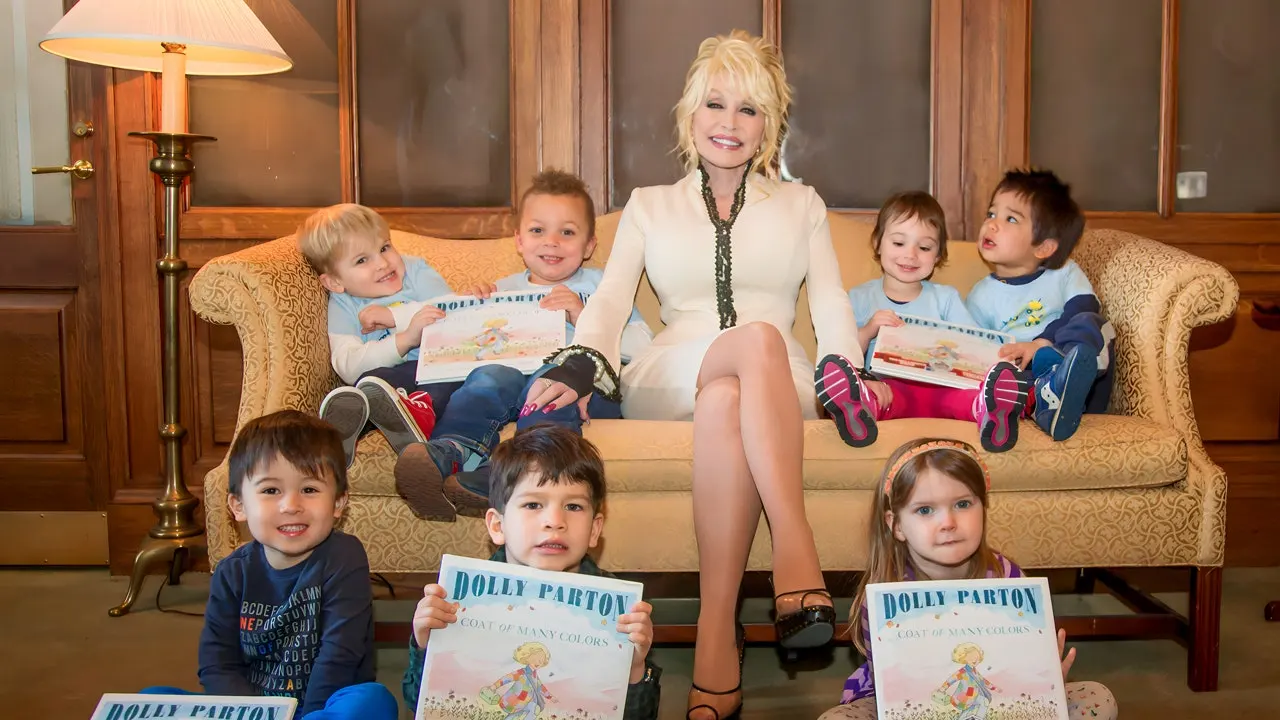
To truly appreciate the emotional resonance of those signed commitments, one must delve into the heart of the Imagination Library’s origin story. Parton’s motivation was heartbreakingly personal. Her father, Robert Lee Parton, was an illiterate sharecropper and farmer in the hills of East Tennessee, a man of great strength who bore the silent shame of his inability to read throughout his life. He couldn’t sign a check, read a newspaper, or participate in the simple, cherished act of reading a bedtime story to his twelve children. Dolly watched his struggle—his intelligence trapped behind a barrier of print—and it haunted her. When she achieved wealth and fame, she vowed to do something about it. In 1995, she launched the Imagination Library in her home county of Sevier, Tennessee. The model was unlike any other literacy program: she would partner with a publisher—working closely with Penguin Random House to print special editions—and a local charity. A child is registered by a parent or guardian, and then, magically, a book arrives in the mail, addressed personally to the child by name. The first book each child receives is universally the beloved classic, The Little Engine That Could, with its timeless message of perseverance and positivity. Every month thereafter, a new, age-appropriate title is selected by a panel of early childhood experts, ranging from classics like Charlotte’s Web to modern favorites, ensuring that children from birth to age five are continuously challenged and engaged. The culminating graduation book, usually a personalized Look at Me, I’m a Reader, makes the child feel like a true scholar. In total, a child receives 60 books over the course of five years. Thirty years later, that simple idea born from a daughter’s love for her father has distributed over 300 million books, not just in the United States, but across Canada, the United Kingdom, Australia, and the Republic of Ireland. It is a staggering legacy, built one page at a time.
Paragraph 4: Alabama’s Embrace: A State United for Literacy
Alabama has embraced the Imagination Library with particular ardor, largely due to a state-level commitment to education reform and equitable access. With over 114,000 children currently enrolled, the program serves as a vital safety net for families across the socio-economic spectrum, especially in rural communities where bookstores are scarce and libraries are miles away. Given that Alabama often ranks low in national literacy scores and nearly one in five children lives in poverty, the free books act as a powerful equalizer, ensuring a child’s potential isn’t determined by their parents’ income. In 2023, Governor Kay Ivey, a Republican who champions early learning, made a decisive move. She signed a budget allocation that permitted the state to match local fundraising efforts dollar-for-dollar, effectively doubling the financial capacity of the program overnight. By early 2025, the program achieved the crown jewel: universal coverage across all 67 counties. This means a child born in the rugged hills of Jackson County or the Delta region of Greene County has the same access to books as a child in suburban Birmingham. The partnership is structured as follows: the state contributes 50% of the cost per child, local partners raise the other 50%, and the national organization handles the book purchasing and distribution logistics. The proposed license plate would feed specifically into that local 50% share, easing the burden on county-level partners. Christian outlined the practical impact with precise, compelling math. “The $50 fee from a plate roughly covers the cost of providing books to two children for an entire month,” she explained. Over a year, that single plate yields about 48 individual, high-quality books. Consider that per year, a family with a child enrolled pays nothing, yet receives a value exceeding $100 in hardcover books. The license plate fee essentially allows a driver to sponsor another child’s literary journey, creating a virtuous cycle where the fortunate help the young, and the entire state’s educational foundation is strengthened.
Paragraph 5: Human Stories: From “Ms. Dolly” to a 200-Book Reader
The statistics, however powerful, pale in comparison to the human narratives that unfold in living rooms across Alabama every day. Christian herself experiences the magic personally with her own son, who is now nearly five. “He just loves the books that we get every month,” she said with a warm smile in her voice. “He talks about them all the time. And he talks about ‘Ms. Dolly sent me another book.'” That phrase—”Ms. Dolly”—is repeated by millions of children who feel an intimate, personal connection to the generous lady in the big hair who sends them gifts. Often, older siblings will linger to listen when the books are read to the youngest, extending the educational thread to the entire household. Christian also recounted a deeply poignant interaction during the license plate campaign. A mother, whose children had long since graduated from the program, decided to commit to the plate as a way of giving back. She told Christian a story that sent chills down her spine: “We couldn’t afford books for our home, and so we enrolled in this program.” The mother paused, reflecting on the journey, before revealing the astonishing outcome. “Now my middle school child reads 200 books a year.” That transformation—from a child without books to a voracious, lifelong reader—is the ultimate goal. Christian emphasized the program’s holistic impact. It doesn’t just teach letters and sounds; it builds a routine of nurturing, a quiet cuddle time between parent and child, and a foundation of curiosity that carries into high school and beyond. For families living paycheck to paycheck, the arrival of a free book is more than a gift; it’s a message that someone believes their child is worth investing in. It is an antidote to the constant glow of digital screens and a bridge to a brighter future, delivered straight to the mailbox.
Paragraph 6: A Rolling Eulogy and an Eternal Heartbeat
As the surge of support propels the campaign ever closer to its 1,000-commitment goal, the deeper meaning of this endeavor becomes crystal clear. This license plate is not merely a commemorative trinket to be filed away in a drawer; it is a viable financial instrument for the sustainability of a crucial community service. “I think it really gives them the security that they will be able to continue their local program long term,” Christian said, referencing the dedicated local partners—Rotary Clubs, libraries, churches, and Head Start programs—who serve as the “boots on the ground” for the operation. These volunteers handle the patient work of sign-up drives at WIC clinics, farmer’s markets, and community centers, ensuring every eligible family knows the program exists. They also bear the delicate responsibility of fund-raising the local 50% match every year, an annual task that is always precarious. A guaranteed revenue stream from license plates would alleviate that anxiety, allowing partners to shift their focus from budget sheets back to outreach. Inside the next year, if the goal is reached, Alabamians will see these plates on regular commuter cars, on minivans in school drop-off lines, and on pickups in the most rural counties. Each one will be a small act of remembrance, a rolling eulogy for a woman who gave more than she ever took. Dolly Parton once said, “If you see someone without a smile, give them yours.” In her death, thousands of Alabamians are giving hers back. Though her voice has been silenced, her message endures in every book that lands on a doorstep, in every “The Little Engine That Could” read aloud for the hundredth time, and in the ever-growing number of children who learn that they, too, can become anything they dream. And in the rustle of pages turning, the sound of a little voice stumbling over a new word, and the proud smile of a parent watching their child read, Dolly Parton’s heart beats forever.