



On a gray London afternoon, the NFL brought its peculiar brand of chaos to Tottenham Hotspur Stadium, and the fans who showed up expecting a straightforward American football game got something far more delightful. The scoreboard eventually read Indianapolis Colts 30, Washington Commanders 13, and yes, the Colts cruised to a victory that looked comfortable in the box score. But the game will be remembered less for the final tally and more for one gloriously ridiculous play that made even the most casual observer laugh out loud. The Commanders were already having a rough day. They were down quarterbacks the way a rainy English sky drops water, and their offense was sputtering against a determined Indianapolis defense. With the game late and the result basically settled, Washington was still fighting for pride, trying to put together one more drive to show they hadn’t given up. And then, out of nowhere, a 320-pound offensive lineman became a pass catcher, a folk hero, and a confused Londoner’s favorite player all in the span of a single snap. It was the kind of play that makes American football so strangely magnetic—a sport where the biggest, least likely athlete can suddenly find himself holding the ball with open field ahead and defenders stumbling around him. Londoners may have arrived as curious tourists in the world of the NFL, but after watching that moment, many of them probably left with a new understanding of why the game inspires such passion. It is not always about precision and perfect quarterback throws. Sometimes it is about a massive man with hands not designed for catching, making a play that nobody could have scripted.
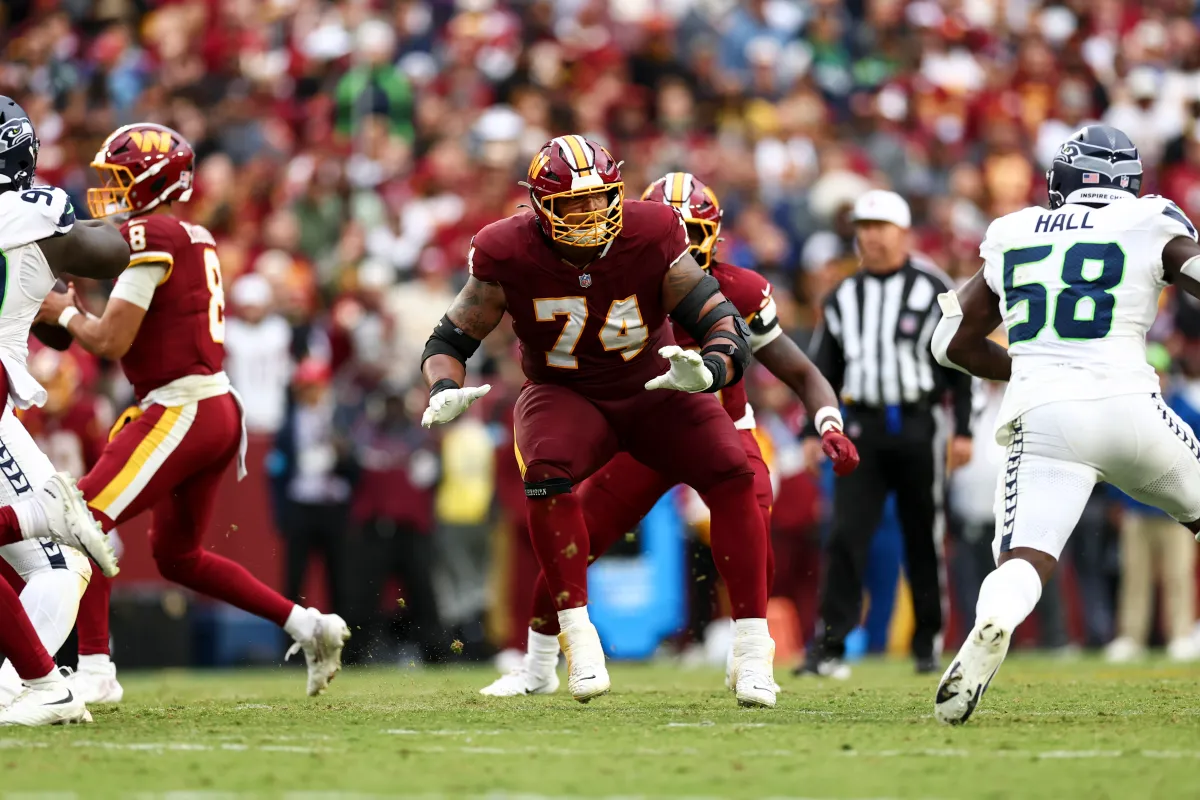
The play itself unfolded late in the fourth quarter, when the Commanders were desperate to manufacture some kind of positive momentum. Athan Kaliakmanis, a rookie seventh-round pick, had been thrust into the game after Marcus Mariota went down with a knee injury in the first quarter, and Mariota himself had only been playing because Jayden Daniels was unavailable. So Washington was running on their third quarterback, a young man trying to survive an NFL moment that must have felt like a hurricane. Kaliakmanis dropped back, surveyed the field, and released a pass. It was tipped at the line of scrimmage, that chaotic moment when everything changes and the defense suddenly smells blood. Two Colts defenders converged, both leaping for what looked like an easy interception. But they collided with each other, and the ball, as if guided by some mischievous football god, ricocheted into the hands of Brandon Coleman, the 320-pound offensive tackle. Coleman is not paid to catch footballs. He is paid to protect quarterbacks and open running lanes, to exist as a human wall. But there he was, suddenly clutching the ball like it was a precious artifact, rumbling forward with all the grace of a refrigerator that had decided to run a route. He dragged several defenders with him and somehow picked up 13 yards and a fresh set of downs. The sideline erupted. The London crowd, many of whom might not have known an offensive lineman from a defensive end, roared with pure joy. It was absurd, it was improbable, and it was absolutely wonderful. Coleman even left the game briefly with what appeared to be an injury after the play, but he returned after missing just one snap, as if to say that nothing was going to steal his moment.
The quarterback situation behind that play was a story in itself, a reminder of how fragile NFL rosters can be. Jayden Daniels, the Commanders’ bright young starter, was already out of the lineup, and Marcus Mariota had been called upon to lead the team. But Mariota’s day ended early when he injured his knee in the first quarter, leaving Washington in the hands of Athan Kaliakmanis, a seventh-round rookie who was suddenly responsible for the entire offense in an international game thousands of miles from home. Kaliakmanis did not look like a savior, but he did look like a competitor. He completed 15 of 33 passes for 186 yards, threw a touchdown, and also threw an interception. He took hits, made mistakes, and kept getting up. His numbers were not pretty, but there was something admirable in the way he kept firing, kept trying to make something happen even as the Colts’ defense smelled blood. For a young quarterback, the experience was probably overwhelming. Yet he got to witness one of the most improbable moments of the NFL season, and he got to be the guy who threw the pass that ended up in the hands of his own 320-pound lineman. It is the kind of memory that no statistic can capture. The turnover on downs that eventually ended Washington’s final drive might have wiped out the immediate significance of Coleman’s catch, but it could not erase the image of a massive offensive tackle dragging defenders across the green grass of a soccer stadium in London. That image is going to live in highlight reels for a long time.
The Colts, meanwhile, were probably just happy to get out of London with a victory. They did not dominate the game in the way the final score might suggest. In fact, they collected fewer total yards than Washington, managing 257 yards to the Commanders’ 317. The difference was that Indianapolis made the plays that mattered most. Jonathan Taylor was the engine of the offense, grinding out 95 rushing yards and scoring two touchdowns. He was the kind of reliable, powerful presence that the Colts needed, especially on a day when their passing game was not exactly setting the world on fire. Taylor’s running helped keep the chains moving and put points on the board, and his touchdowns gave the Colts enough breathing room to survive whatever chaos the Commanders could throw at them. Washington, for all their yardage, could not convert that production into points. They turned the ball over, they missed opportunities, and they never quite found the rhythm that had made them dangerous in previous weeks. The final score made the game look like a comfortable win, but the reality was a little messier. The Colts had to work for it, and they made enough big plays to keep the Commanders at arm’s length. It was not a masterpiece, but it was a victory, and in the NFL that is all that matters. For the neutral fans in London, though, the result was probably secondary to the sheer entertainment value of a game that featured a lineman catching a pass and a defense colliding with itself at the worst possible moment.
There is something special about watching American football in a foreign country, especially in a stadium like Tottenham Hotspur’s home, which was packed with fans from all over Europe and beyond. The NFL has been trying to build a global audience for years, and games like this one are exactly why the experiment works. It is not just about showcasing the speed and violence of the sport, although that is certainly part of it. It is about sharing the unexpected, human moments that make football so beloved. A tipped pass, a collision, a big man rumbling downfield—that is the kind of thing that transcends language and culture. British fans who grew up on soccer might not fully understand the intricacies of a zone defense or a blocking scheme, but they can understand a massive athlete catching a ball he was never supposed to catch and celebrating like he had just won the lottery. That is universal. That is the human side of sports. The Commanders lost the game, and they will fly home to face questions about their quarterback situation and their inability to finish drives. But for a brief moment, they gave the London crowd something to cheer about, something that had nothing to do with statistics and everything to do with the beautiful, ridiculous unpredictability of football. It was a reminder that no matter how much strategy goes into the game, there is always room for chaos, luck, and a 320-pound man having the time of his life.
Now the Commanders have to leave behind the London fog and the memory of that improbable catch and get back to business. They will return across the pond to prepare for the New York Giants in Week 5, and they will need a much more conventional offensive performance if they want to get back in the win column. They cannot rely on tipped passes finding their way into the hands of offensive linemen, nor can they keep cycling through quarterbacks and hoping for the best. The roster needs to heal, the offense needs to find its identity, and the coaching staff needs to make some tough decisions. But football is a strange sport, and sometimes the strangest moments can spark something. Brandon Coleman’s catch was not the Immaculate Reception. It will not be immortalized in the same way as Franco Harris’s legendary touchdown, and it will not be shown in black-and-white NFL Films specials for decades to come. It was just a fun, weird, human moment in a game that had already lost its competitive edge. But for the fans who were in London, and for the players who were on that field, it will be a memory they carry with them. The Colts got the win, the Commanders got a lesson, and the sport of American football gained a few more believers on the other side of the Atlantic. Sometimes that is exactly what sports are supposed to do. They make us laugh, they make us gasp, and they remind us that anything can happen. Even a 320-pound offensive lineman can become a hero for one beautiful, ridiculous play.