


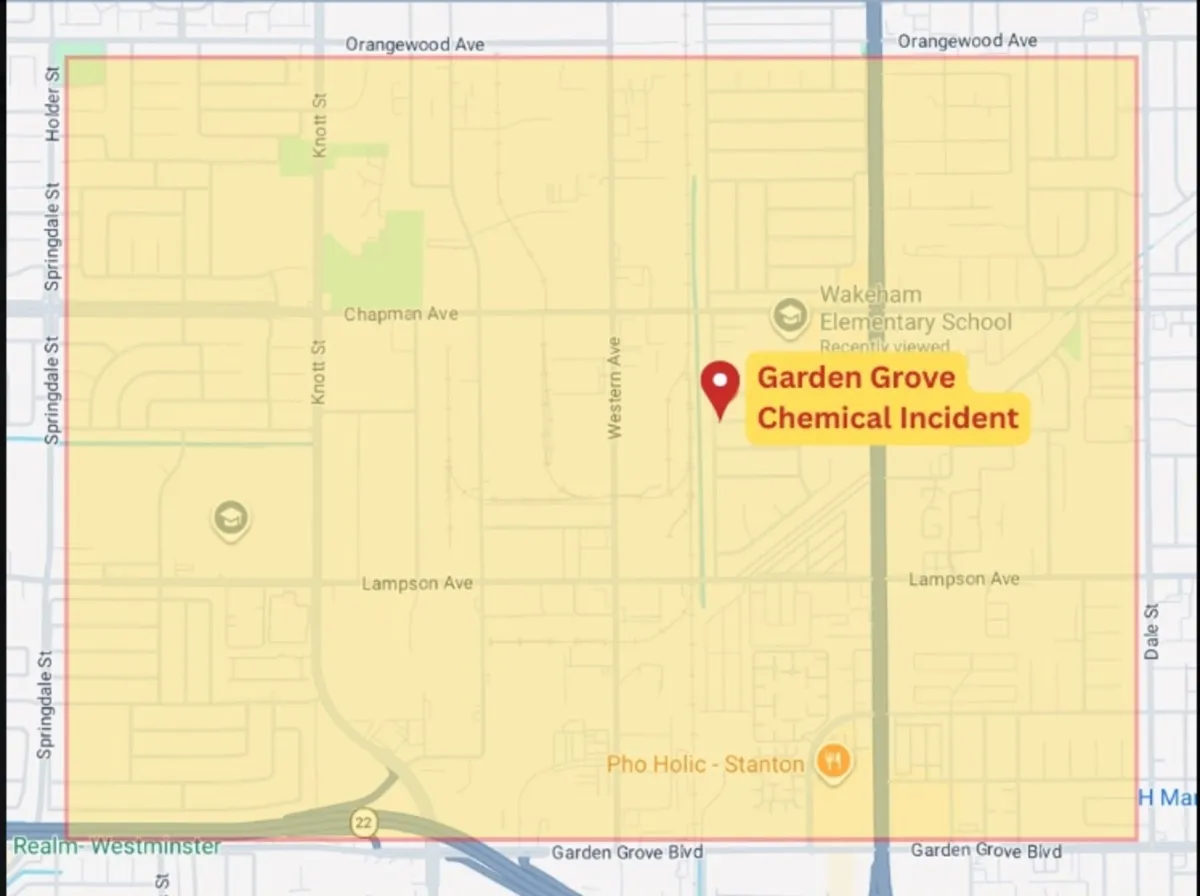
Morning in Garden Grove, Southern California, usually begins with the gentle hum of early commuter traffic, the warm golden light of the Pacific coast filtering through palm trees, and the familiar, comforting routines of a community waking up to another beautiful day. But on this particular Friday, the atmosphere was shattered by an ominous, low frequency dread that quickly materialized into flashing red lights, blaring sirens, and the terrifying crackle of emergency broadcast systems ordering thousands of residents to flee. What began as a normal week ended in absolute chaos as families scrambled to pack their most cherished belongings, wrestle distressed pets into carriers, and abandon their homes under the shadow of an invisible, toxic threat. The evacuation zone, a massive grid meticulously mapped out by emergency personnel, stretched across a sprawling section of the city, encompassing neighborhoods north of Garden Grove Boulevard, south of Orangewood Avenue, and tucked between the busy arteries of Springdale Avenue and Dale Street. Standing on these streets, one could feel the palpable tension in the air, a mixture of collective panic and disbelief as ordinary citizens looked back at their houses, wondering if they would still be standing when they were finally allowed to return. This was not a natural disaster like a wildfire or an earthquake, which residents are accustomed to navigating; rather, it was a man made nightmare waiting to unleash its fury, forcing thousands of mothers, fathers, children, and elderly residents to become overnight refugees in their own city as they fled the impending doom of a catastrophic industrial failure. Neighbors knocked on neighbors’ doors, ensuring that those living alone were aware of the chemical danger creeping closer by the second. The sheer suddenness of the evacuation disrupted the fragile peace of the suburbs, replacing the sound of playing children with the urgent commands of police megaphones echoing off stucco walls, reminding everyone that their lives had been placed on hold by a leaking giant just down the street, waiting to crack open.
At the dark heart of this terrifying neighborhood crisis is a massive, towering storage tank containing thirty four thousand gallons located at a local aerospace manufacturing facility, designed to hold the building blocks of modern aviation technology but now transformed into a ticking time bomb. Inside this containment vessel lies a volatile and highly flammable chemical known as methyl methacrylate, a volatile organic compound primarily utilized in the production of acrylic plastics, resins, and various high strength polymers essential for aerospace engineering. The trouble began on Thursday afternoon when a sudden and insidious leak was detected, releasing toxic vapors into the atmosphere and immediately painting the local sky with an invisible but highly hazardous plume of gas that triggered an immediate, full scale tactical hazardous materials response. As the hours ticked by and the orange hue of the sunset gave way to a tense, sleepless night, the situation within the tank grew exponentially more unstable, shifting from a localized leakage site into a regional emergency of unprecedented proportions. Methyl methacrylate is not just an ordinary industrial pollutant; it is a severe respiratory irritant that can cause acute breathing difficulties, painful dizziness, and long term neurological damage upon inhalation, alongside being incredibly susceptible to catching fire from a single spark. The sheer scale of the storage tank meant that any compromise in its structural integrity put the entire surrounding ecosystem and thousands of human lives at immediate, devastating risk. First responders immediately recognized the severity of the threat, cordoning off the area as specialized hazmat teams donned heavy protective suits and deployed atmospheric monitoring equipment to track the invisible poison wafting through the suburb. The sweet, sharp chemical scent of the leaking compound served as a physical warning to anyone downwind that a catastrophic failure was brewing nearby, turning the peaceful aerospace yard into a high stakes battleground against science, forcing experts to confront the frightening reality that their standard emergency playbooks were becoming completely invalid as the hours slipped away.
By Friday morning, any lingering optimism that specialized technical teams could patch the leak or safely siphon off the dangerous cargo evaporated into the hot Southern California air, forcing emergency authorities to present a chillingly realistic picture of the situation. In an urgent, somber video update broadcasted over social media platforms, Orange County Fire Authority Division Chief Craig Covey delivered a sobering assessment that sent shockwaves through the evacuated communities and the wider metropolitan area. Speaking directly to the camera with a heavy weariness born of sleepless hours on the frontlines of this developing crisis, Chief Covey frankly explained that despite the tireless work of hazmat units and engineers, the tank was in the midst of a terminal crisis and could not be secured or mitigated using any of the traditional protocols recommended by the chemical’s manufacturers. The advanced engineering safety systems had failed, the contingency plans were exhausted, and the emergency responders were left standing at the volatile mercy of physical laws and chemical reactions that they could no longer control or contain. Covey explained to a frightened public that all available technical data suggested the tank was entering its final, most unpredictable phase, stripping away any hope of a clean, painless resolution to the industrial accident. For the first responders on the scene, who continued to put their own safety on the line to monitor the failing infrastructure, the weight of this announcement was immense, transforming their duty of active protection into a tense, agonizing game of waiting for an inevitable disaster to unfold in the heart of their community. The chief’s honest, direct approach on the internet provided no false comfort, reflecting the gravity of an engineering failure that had outpaced modern technology, leaving officials with the grim task of preparing for a disastrous outcome that could happen without any warning to uninvolved civilians who were completely unprepared for such a sudden disruption to their lives and were forced to depend on the vital expertise of weary local first responders.
The options left on the table by the Orange County Fire Authority were stark, uncompromising, and offered absolutely no comfort to the displaced families waiting in distant hotel rooms and temporary shelters. According to Chief Covey, the situation had deteriorated into a volatile standoff with only two distinct, terrifying outcomes remaining for the failing aerospace facility’s storage tank. The first scenario involves a catastrophic physical failure of the tank’s internal structure, which would result in a massive spill of approximately six thousand to seven thousand gallons of highly toxic and corrosive chemicals directly onto the parking lot. While this would still represent an environmental disaster of epic proportions, it was considered a far better outcome because the hazard would at least remain localized to the immediate industrial site, allowing specialized mitigation teams to begin chemical neutralization, containment, and cleanup. The far more terrifying second scenario, however, is the occurrence of a thermal runaway, which is a dangerous chemical process where an increase in temperature changes the conditions in a way that causes a further increase in temperature, leading to a rapid, uncontrollable explosion. Such a blast would not only obliterate the primary tank itself but would also instantly puncture and detonate nearby storage tanks that contain additional highly hazardous materials, creating a massive chemical fireball and releasing a lethal cloud of toxic fumes that would disperse far beyond the current boundaries of the established evacuation zone. This dual threat created an incredibly complex tactical challenge for emergency services, who had to prepare for two completely different types of disasters simultaneously, knowing that a single misstep could trigger the very explosion they were desperately trying to prevent, complicating their rescue efforts and putting thousands of neighboring residents in mortal peril as the clock continued to tick down toward an unpredictable climax that threatened to rewrite the very safety standards of the entire region, keeping everyone on edge as they waited for news concerning the unfolding event from local emergency response command centers operating nearby.
For the thousands of residents of Garden Grove, this scientific breakdown of chemical reactions translated directly into a profound, heart wrenching human struggle as they grappled with the uncertainty of their immediate futures. Neighbors who had lived next door to one another for decades stood in shopping center parking lots just outside the evacuation boundaries, sharing whispers of concern, checking on elderly friends who might have struggled to escape, and searching for any shred of hopeful information on their smartphone screens. The crisis stripped away the comfortable veneer of suburban security, revealing how quickly a community’s daily life can be upended by the silent industrial facilities operating just behind the walls of their residential neighborhoods. Young parents tried desperately to soothe crying infants in makeshift community center shelters, while local animal rescue organizations worked frantically to assist those who had been forced to leave their beloved family pets behind in the hurried, chaotic rush to escape the chemical fumes. There is a deeply unsettling vulnerability in realizing that the physical safety of your home, your memories, and your community depends entirely on whether a metal structure in a nearby business park decides to leak slowly or explode into a catastrophic fireball. Neighbors opened their homes to strangers, online community forums filled with offers of help, and local businesses donated supplies, showing the resilience of the community in the face of fear. Yet, as the sun began to slowly set, casting long shadows across the empty streets, the anxiety only deepened. The realization that their homes might be within the blast radius of a thermal runaway explosion kept families awake, staring at hotel ceilings and scrolling through updates, waiting for any sign that the nightmare was ending and that they could return to the lives they had so abruptly left behind just twenty four hours before this unbelievable incident, wondering if their entire world would be different by the time the next morning arrived with new answers from the weary officials directing the response effort.
As the afternoon light faded completely and night began to drape over Southern California, the situation in Garden Grove remained a tense, unresolved standoff between fragile human intervention and unpredictable chemical volatility, with the entire region holding its breath in anticipation of the next official update. This breaking story highlights a growing, increasingly uncomfortable conversation nationwide about the ultimate safety of choosing to build heavy industrial and aerospace facilities in close proximity to densely populated residential neighborhoods, raising complex planning and environmental questions that will surely be debated long after this immediate danger has passed. For now, however, the primary focus remains entirely on immediate survival and preservation of life, as hundreds of dedicated firefighters, hazmat specialists, and local police officers continue to patrol the empty, ghost town streets of the evacuated zone or watch the facility from safe vantage points, maintaining a protective perimeter to ensure no lives are lost should the worst case scenario occur. The ultimate, final fate of the aerospace facility’s failing storage tank remains hanging in a delicate, incredibly dangerous chemical balance, leaving thousands of displaced Californians to wait, watch, and pray that they will eventually return to intact homes rather than ash. But even as they face this unparalleled disruption, the spirit of solidarity among the displaced residents shines as a beacon of hope in a dark, uncertain moment. Neighbors comfort neighbors in shelters, sharing supplies and stories, turning a logistical nightmare into an inspiring demonstration of human resilience under extreme stress. As the community waits in limbo, the dedication of the responder crews serves as a powerful shield against a volatile chemical threat, illustrating that even when modern technology fails, the strength of the human community and the courage of those on the front lines remain completely intact, ready to face whatever tomorrow brings to them, showing the world that no matter the technical dangers, the bonds of shared humanity will always remain the most durable force, capable of weathering any storm, now and in the days ahead.