





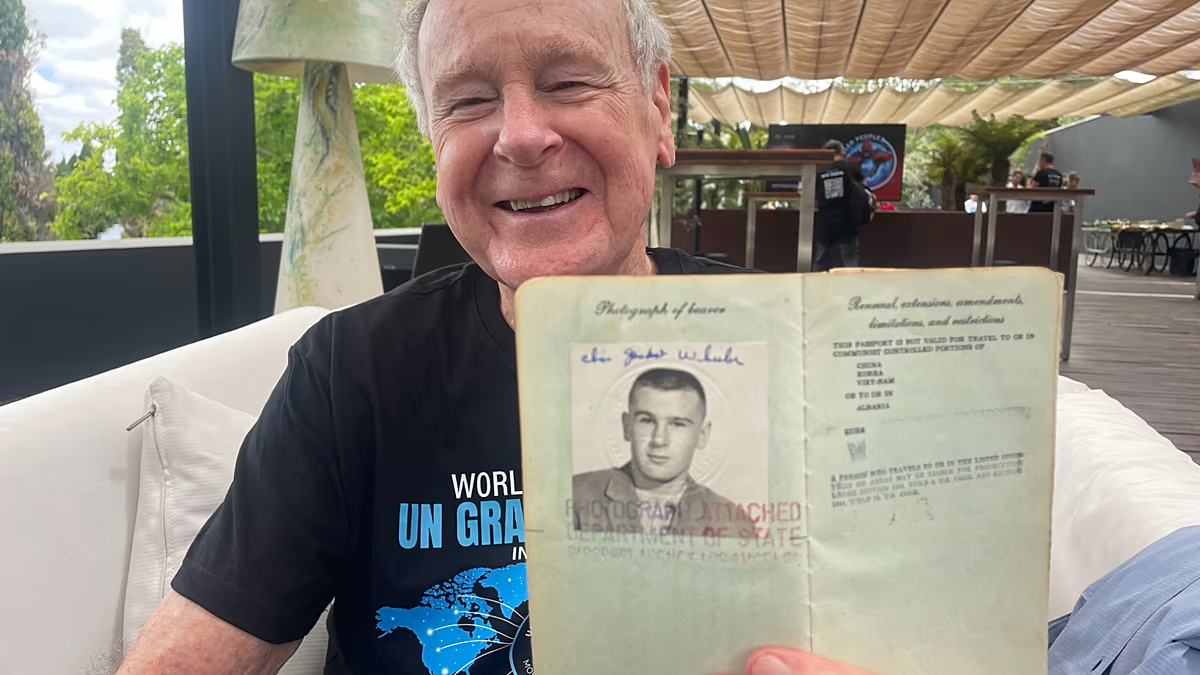
With a weathered smile and a unmistakable glint of triumph in his eyes, eighty-two-year-old Jack Wheeler gently unfurls a collection of dog-eared, stamp-saturated passports, pointing with quiet pride to an old document issued in the rebellious, hopeful era of the 1960s. These booklets are not mere pieces of government paper; they are physical testaments to a life lived without borders, acting as tangible proof that this energetic American has touched foot in every single sovereign nation on Earth. Currently residing in the picturesque landscapes of Portugal alongside his supportive wife, Jack’s journey toward the ultimate travel milestone began not with a grand, calculated master plan, but with a simple, lighthearted domestic conversation roughly two decades ago. “My wife asked me how many countries I had actually been to over the course of my life, and when we sat down to count them, the number stopped at a respectable one hundred and forty,” Jack recalls, a warm chuckle escaping him. “She looked at me and said, ‘Well, why not just go ahead and visit them all?’” Embracing her spontaneous challenge, Jack transformed the daunting task into a strategic global game, making it a rule that whenever his business or personal life took him to a far-flung corner of the world, he would deliberately explore the most fascinating neighboring countries nearby. This methodical, joy-filled pursuit of the horizon finally reached its grand finale in 2014, when he touched down in the tranquil, island-nation of São Tomé and Príncipe, officially completing one of the most exhaustive travel lists in human history.
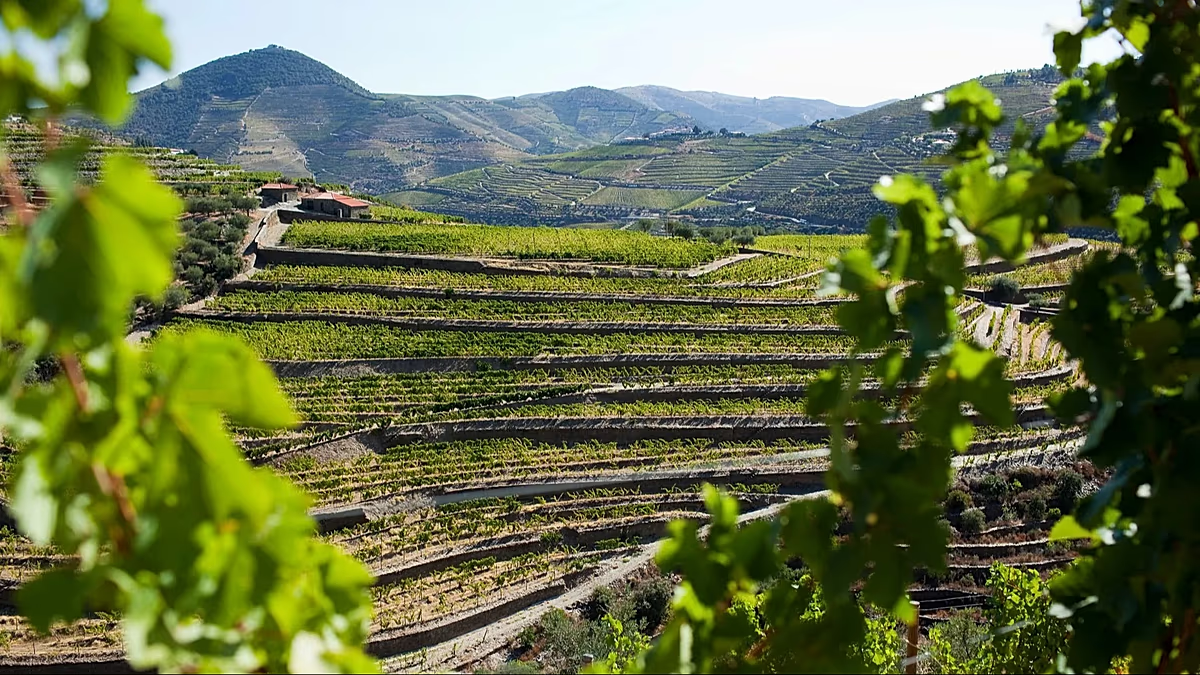
While Jack completed his odyssey a decade ago, other travelers are only recently crossing their own final frontiers, often navigating immense geopolitical hurdles to do so. Wendy Arbeit, a resilient German-American traveler, reached the parallel, elusive milestone of global completion just last year, conquering the final and perhaps most notoriously insulated piece of the puzzle: North Korea. Traveling as part of the very first authorized tourist group allowed to enter the secretive nation since the earth-shattering lockdowns of the Covid-19 pandemic, Wendy’s experience was nothing short of surreal. “It was an absolutely incredible experience—very safe, extraordinarily clean, and deeply memorable because I was the very first non-Russian tourist to cross into the country after they reopened their borders,” she explains, still marvelling at the quiet, regimented streets that few Western eyes have seen in recent years. This shared passion for breaking through geographic barriers and experiencing the unknown recently brought Wendy and Jack together in Azeitão, a scenic, wine-soaked region of Portugal, where they joined around two hundred other elite globetrotters for a historic international gathering. This meeting of minds was hosted by the Most Traveled People (MTP) organization, an exclusive yet warm community that serves as a sanctuary for those who view the globe not as a collection of distant states, but as a neighborhood waiting to be explored.
The origins of this unique community of nomadic souls trace back to 2005, a time when a passionate Californian named Charles Veley found himself searching for a way to validate his own monumental journeys. Charles had harbored hopes of being officially recognized as the world’s most traveled human being, but his ambitions were temporarily derailed when the Guinness Book of World Records decided to retire that specific category due to the sheer complexity of verifying such claims. Refusing to let the spirit of global exploration lose its competitive and collaborative spark, Charles poured his energy into creating the “Most Traveled People” platform, transforming a personal quest into an interactive web portal that has since blossomed to include over fifty thousand registered members. Today, the platform functions as both a database and a motivational ladder, allowing users to painstakingly catalog their journeys down to the level of obscure islands, territories, and provinces, while checking their standing on a global leaderboard of systemic wanderlust. “We organize remote expeditions to hard-to-reach places and compile comprehensive rankings, which really serve to keep people motivated because they suddenly have a definitive, structured list to conquer,” Charles explains, smiling as he acknowledges that the system works to push even the most casual travelers beyond their comfort zones. Out of the thousands of active members on the site, those who can legally verify they have visited all one hundred and ninety-three UN-recognized nations are crowned with the legendary status of “Grandmasters”—and at the recent gathering in Azeitão, an astounding one hundred and three of these elite grandmasters walked the same halls, sharing stories of remote border crossings. Yet, Charles, who personally spent an exhausting but exhilarating three hundred and fifty days away from his own home last year, insists that MTP is far more than a shallow exercise in checking off boxes on a digital list. He passionately believes that real travel requires leaving the sanitised bubbles of tourist resorts, noting that if someone merely visits a country’s capital city without venturing into the rural towns, vibrant local markets, and wild landscapes, they have not truly tasted the authentic soul of that culture.
For the devoted members of this global family, the annual MTP gatherings provide a vital, therapeutic space to socialize, speak a common language of airline routes, and share hair-raising tales of survival that make ordinary vacation stories pale in comparison. Many of these explorers have ventured deep into active war zones and politically volatile territories where the safety nets of modern embassies disappear entirely. Nicolas Pasquali, an adventurous and daring traveler from Argentina, vividly recalls his journey through the Central African Republic, a nation he characterizes as the absolute most dangerous territory he has ever traversed. Despite the country being in the violent grip of an ongoing civil war and heavily patrolled by mercenary forces like the notorious Wagner Group, Nicolas chose to cross the rugged terrain on a motorcycle, finding safety not in armed guards, but in the surprising, overwhelming hospitality of local villagers who offered him food and shelter when he needed it most. However, his most terrifying encounters with state authority didn’t happen in active combat zones, but rather behind the cold bars of foreign prison cells. “I actually ended up in prison in Iraq after being falsely accused of spying for the Italian government,” Nicolas says with a wry grin, recalling the terrifying confusion of the interrogation process. This nightmare of unjust detention repeated itself under different circumstances in the Democratic Republic of Congo, where a tense standoff over a demanded bribe for a visa extension landed him temporarily behind bars once again. Remarkably, these harrowing experiences did not breed resentment or fear in Nicolas’s heart; showing the true, resilient spirit of a world traveler, he has since returned to the Democratic Republic of Congo, navigating the borders smoothly and experiencing the country’s beauty without further incident.
Other travelers within the community have managed to find peace and human connection in places the mainstream media often labels as irredeemable hazard zones. David Langan, a gentle and soft-spoken Irishman who achieved his dream of visiting every country on Earth in 2022, carries with him a fascinating and nostalgic tradition: he makes it a personal rule to seek out and visit a local post office in every single country he enters, using the act of sending mail as a direct way to engage with domestic civil services. He successfully maintained this endearing ritual even in Mogadishu, the war-torn capital of Somalia, which is widely considered by international security agencies to be one of the most perilous urban areas on the face of the earth. “People hear the name Mogadishu and immediately assume the worst, but like any challenging destination, it is largely a matter of arranging proper, professional security, keeping your wits about you, and remaining highly vigilant,” David reflects thoughtfully, emphasizing that with the right combination of respect and preparation, he felt remarkably safe during his time there. This ability to look past geopolitical headlines and connect directly with local communities is what separates these individuals from typical holidaymakers. They prefer to be called “travelers” rather than “tourists,” signifying a commitment to deep cultural immersion, personal growth, and an active desire to seek out understanding in places that the rest of modern society has largely written off as too dangerous or too distant to care about.
Of course, pursuing a passion of this magnitude naturally raises practical questions about the sheer financial cost of constantly moving across oceans and borders, but the members of MTP are quick to point out that fulfilling this dream is more accessible today than ever before. While some might assume that visiting all one hundred and ninety-three countries is a luxury reserved solely for the ultra-wealthy, seasoned explorers argue that the dramatic decline in global airfares and the rise of the shared economy have democratized long-distance travel. “With the proliferation of low-cost carriers and alternative budget accommodation, the financial barrier has dropped significantly; it’s really just a matter of sacrificing luxury, choosing budget guesthouses, or staying directly in the homes of hospitable locals,” David Langan suggests, emphasizing that flexibility is far more valuable than a massive bank account. Nicolas Pasquali proves this point with his own impressive financial discipline, revealing that he managed to fund his entire, exhaustive journey to every nation on earth with a total lifetime expenditure of just one hundred and fifty thousand euros by meticulously saving on transport and choosing simple lodgings. For those who want to travel without depleting their life savings, Jack Wheeler offers an alternative blueprint of converting passion into a sustainable career, having spent fifty years running a highly successful expedition company that takes paying clients to extraordinary, remote destinations. Now, at eighty-two years of age, Jack shows absolutely no signs of slowing down, summarizing his lifelong adventure with a simple, inspiring truth: “I turned my deepest passion into my daily business; people pay me to guide them to the most breathtaking places on Earth, and that is how I keep going.” As the lively gathering in Portugal drew to a close, with plans already underway for their next massive assembly in Chengdu, China, the diverse members of the Most Traveled People community stood united by a shared philosophy—that the world is not something to be feared or viewed through a screen, but a beautiful, complex home to be actively explored, one border crossing at a time.