



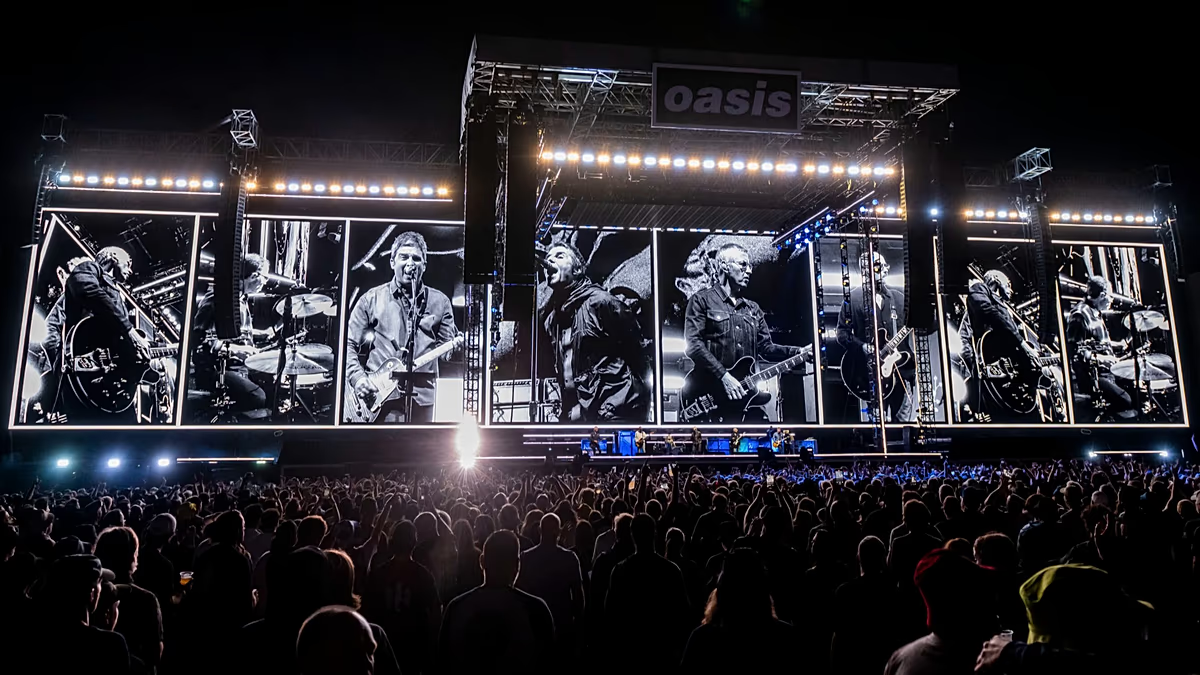
It is a truth universally acknowledged by members of a certain generation, that a band in possession of a good back catalogue must be in want of a reunion tour. And for Oasis, the architects of the Britpop era, this is more than just a want; it’s a full-blown cultural event that has gripped the globe. The confirmation of their 2027 tour dates has done more than just set the pulses of Noel, Liam, and the rest of the band racing; it has sent a shockwave through the travel industry. Before a single ticket has even been sold, a frenzy of anticipation has erupted, with fans not just planning to attend concerts, but to build entire holidays and pilgrimages around them. The result is a staggering, unprecedented surge in online travel searches to every city lucky enough to host a date on their comeback trail, proving that the power of a band to move people—both emotionally and physically—is as potent as ever.
The scale of this preliminary excitement is truly immense, as revealed by data from the global online travel agency eDreams. Searches for travel to Glasgow, the historic starting point of the tour, have exploded by an eye-watering 2,400%. That’s a 25-fold increase compared to the same period last year, as fans scramble to secure flights, trains, and dynamic holiday packages to the Scottish city that will host the opening five nights. This isn’t just a minor blip; it’s a seismic shift in travel demand, driven by the simple promise of hearing “Live Forever” performed live in a stadium. The ripple effect extends far beyond Glasgow, with Manchester seeing an 846% increase in travel searches, Rome up 659%, Barcelona climbing 655%, Dublin soaring 614%, Amsterdam up 592%, and Paris experiencing a 279% rise. Even across the Atlantic, the pull is undeniable, with Las Vegas and Boston seeing their search volumes jump by 692% and 487% respectively. The entire globe seems to be reconfiguring its travel plans around the schedule of a group of men who famously once argued over a jam sandwich in the back of a van.
This phenomenon is not entirely new, but the scale and speed of the reaction underscore a fundamental shift in how fans interact with live music. As Pablo Caspers, Chief Travel Officer at eDreams, explains, fans are no longer merely buying a ticket to a show; they are crafting entire experiences around a single event, turning a concert into the cornerstone of a vacation. This trend was powerfully illustrated by Taylor Swift’s Eras Tour, which saw search interest in host cities like Edinburgh and Liverpool more than double almost overnight. We’ve seen it with the Eurovision Song Contest, where cities are flooded with visitors, and with festival lineups like Coachella and Primavera Sound. However, the data suggests the Oasis effect is on a different plane entirely. The cultural pull of the Gallagher brothers, with their anthems of working-class defiance and soaring, melancholic hope, has proven to be a truly global force. They have the unique ability to not just fill a stadium, but to generate a surge in travel demand that reshapes economies and fills hotels, restaurants, and transport links from the moment the dates are announced.
This fervor speaks to a deeply human desire for connection, nostalgia, and shared experience. For millions of fans, Oasis is not just a band; they are the soundtrack to their youth, a reminder of a specific time and place, and a symbol of a particular brand of British cool. The 2025 reunion tour was a cathartic, record-breaking event that solidified their place as the ultimate heritage act, and the announcement of a 2027 tour taps directly into that vein of collective memory. The act of traveling to a different city or country to see them is about more than just the gig itself. It’s a pilgrimage. It’s the chance to reclaim a piece of one’s past, to meet with like-minded “madferit” fans from across the globe, and to create new memories that echo the old ones. It’s the story of booking a flight to a city you’ve never visited, all for the shared moment when the opening chords of “Wonderwall” ring out, and you and 80,000 strangers sing every word in perfect, blissful harmony.
The economic impact of this passion is proving to be as significant as the cultural one. The 2025 reunion contributed to a record-breaking year for UK music tourism, and the early surge for 2027 suggests the trend is not only continuing but accelerating. Cities like Glasgow, Manchester, and Dublin are set to receive a massive financial boost, not just from ticket sales but from the ancillary spending on hotels, food, and attractions. This is a powerful reminder to city planners and tourism boards that culture is a genuine economic driver. When an artist like an Oasis or a Taylor Swift announces a tour, they are effectively providing an instant, multi-million pound stimulus package for the host cities. It transforms the business case for tourism, showing that investing in infrastructure to host large-scale events yields considerable returns, as fans from Denver to Dortmund reprioritize their budgets and their vacation time to be a part of the moment.
As the ticket sale dates approach—spread across three days of high anxiety and furious refreshing—the world waits with bated breath. But for those who are successful in securing their golden tickets, the adventure will have only just begun. They are part of a new wave of travelers, the “tourists of the moment,” whose itineraries are dictated not by landmark sights, but by the strum of a guitar and the swagger of a frontman. The 2027 tour, kicking off at Celtic Park in Glasgow and concluding at the hallowed grounds of Knebworth, is shaping up to be more than just a series of concerts; it is a testament to the enduring power of music to unite people, to drive commerce, and to inspire a level of devotion that borders on the fanatical. It proves that in an increasingly digital world, the desire for a real, tangible, and loud communal experience remains irresistible. The search data is the clearest signal yet that Oasis have not only reunited, but they have once again become a global phenomenon that can shift the travel patterns of the entire planet, one song at a time.