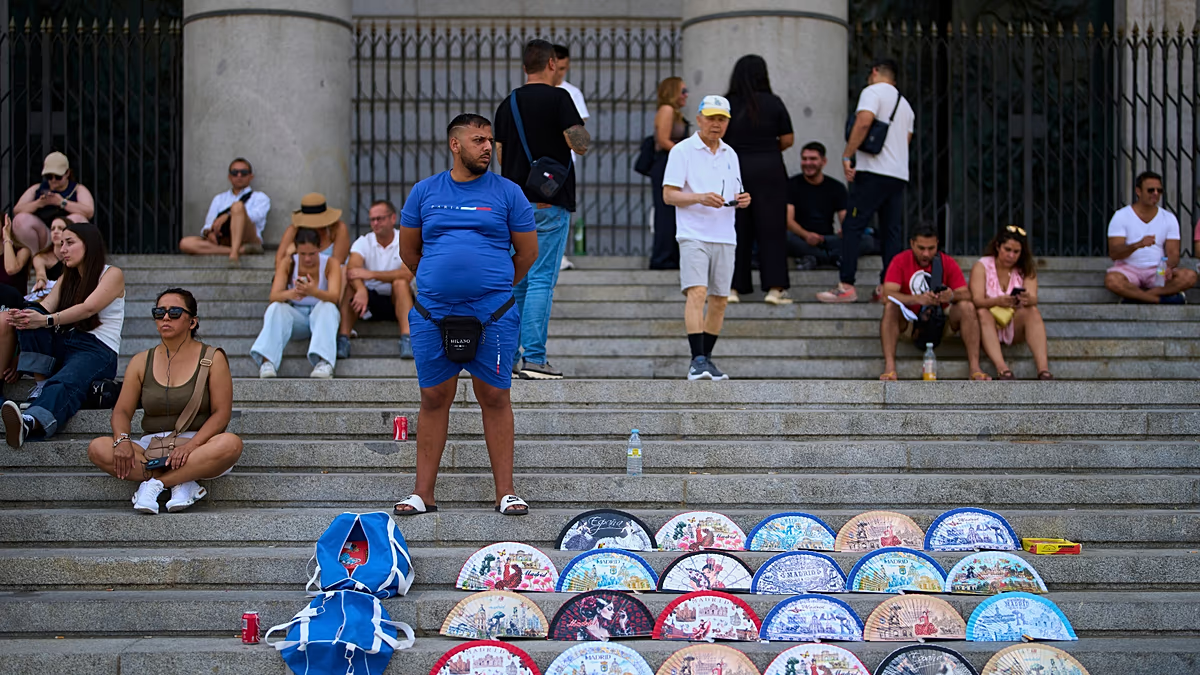






Travel is supposed to be one of life’s great liberations—a chance to step away from routines, see something new, and feel a little more human. But in many of the world’s most famous destinations, liberation has quietly turned into a kind of pressure. You arrive at that fabled plaza or postcard-perfect island, only to find not wonder but queues, not peace but shoulder-to-shoulder pavement. For the people who actually call these places home, overtourism has become far more than an inconvenience. It forces long-time residents out, pushes local businesses to turn into gift shops, and leaves once-loved streets feeling drained of local life. The easy response might be to stop traveling altogether. But that would mean letting the crowds dictate where we do and do not go. A more thoughtful approach is to choose places that genuinely need and welcome visitors—places where your presence can still mean something. That’s exactly where Intrepid Travel’s “Not Hot List” comes in. Launched in 2018, it’s not a bucket list in the usual sense. It’s an invitation to look elsewhere, to follow the quieter roads, and to make your tourism matter to people, not just to businesses built on selfies.
Erica Kritikides, Intrepid’s general manager of experiences, captures the motivation nicely when she says: “If we want tourism to continue to be a force for good, we need to constantly rethink how and where we travel.” The old model, in which millions of visitors pile into downtown famous landmarks each year, isn’t sustainable. But telling everyone to stay home is equally not the answer. Instead, the challenge is to steer travel toward the under-the-radar destinations, the ones with the runway in place—infrastructure, shops, trails, guides—but without yet being overwhelmed. The 2027 edition of the Not Hot List, therefore, is not just a scattering of obscure points on a map. Every spot on the list was chosen carefully, with three things in mind: it must have the capacity to welcome more tourists, it must benefit from improved connectivity, new initiatives or significant event, and 2027—with all its travel opportunities—should be the moment to go. At the very top of this year’s list is Kenya’s Sahrah National Reserve. For anyone who had been dreaming of an East African safari, this may be the smarter, wilder counterpart to the busiest parks. Yes, the Serengeti and Masai Mara are wonderful, but they also concentrate crowds. The Reserve offers the same sense of raw, vast Africa—acacia-dotted plains, elephants, silent predators—but with fewer trees and more space to breathe. It is a choice that benefits both travellers looking for the real moment and the local communities whose livelihood and species are strengthened by tourism that cares.
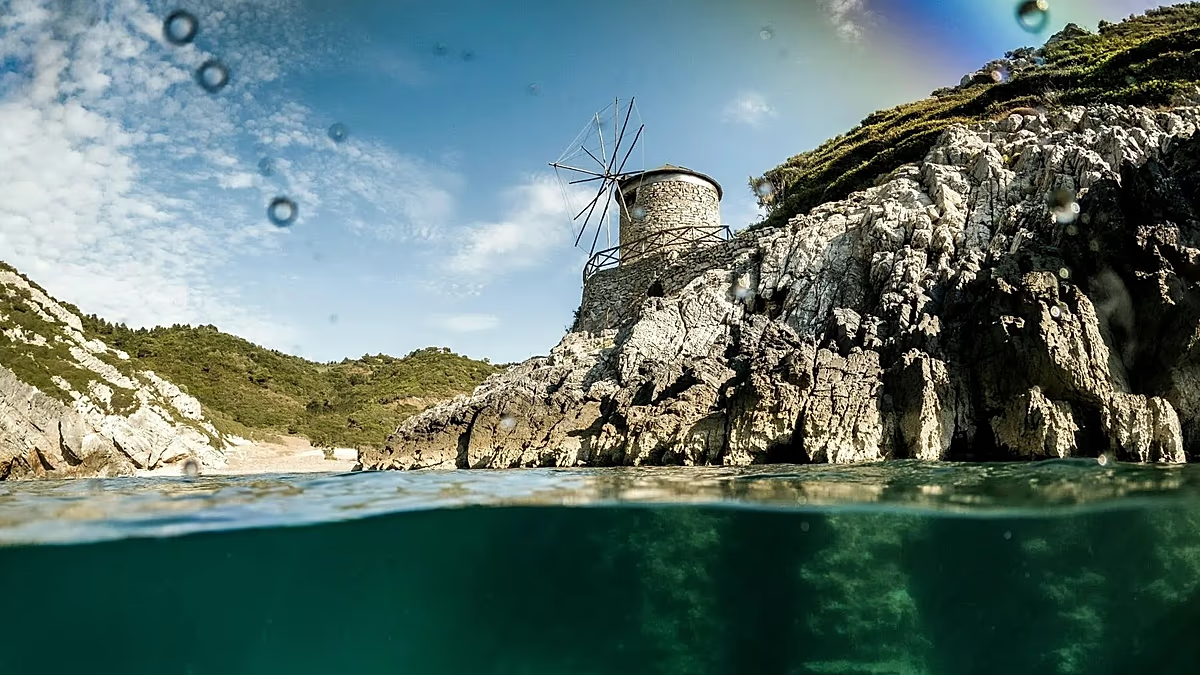
In Europe, the list tackles one of the most grenade-prone issues of all: the Greek islands. To say the islands are overpopular is almost an understatement. During summer, some of them contain more visitors than islanders do on any deck, and the atmosphere can feel more like a festival than a place to relax. But there is a alternative, hidden in the Northern Sporades: Alonnisos. Only reachable by ferry or a private yacht, it welcomed just seventy thousand visitors in 2024—a tiny drop compared to the millions that can wash over the more famous Aegean islands. What makes it especially alluring are the under-the-sea wonders. Those who dive will find the National Marine Park of Alonnisos and Northern Sporades, one of Europe’s largest protected marine areas. There’s also a truly special maritime cultural treasure: the Peristera shipwreck, a dive site friendly for both beginners and experienced aficionados—and the site of Greece’s first-ever underwater museum. Yet you need to steer a tank to appreciate it. On land, visitors will discover the old town Chora, but cobblestones and white walls in that dreamlike way we keep thinking about in Greek postcards. There is no cliff of luxury cars, no barrage of neon signs, just barefoot ease, freshly caught seafood and the feeling that you’ve stepped into a version of the islands that tourists used to find here once.
The more isolated destinations on the list nod to a different story, one of slow travel and greater emotional payoff. Latvia’s Liepā is, for example, a breath of cool air in a Europe that is almost too hot and too crowded in summer. It wasn’t chosen just for its beach—though the eight-kilometre stretch of blonde sand would be enough—but because 2027 is its big moment as it becomes the European Culture Capital. More than five hundred cultural events will take place there in the coming years? It’s enough to. But unlike so many cultural events that become a boomer, the city remains friendly, inclusive and without an inside of using yourself up to the heat of the Mediterranean. A little further north, Dalsland in Sweden is the natural definition of why it’s important to be perfect without attention. It’s Sweden’s own Lake District, a seamless stretch of more than two thousand lakes, forests and gravel trails that somehow nobody seems to have discovered. That may not be forever, especially because new rail link between Malmö and Oslo, which opened in June 2026, has brought it closer to reach. There are 850 km of gravel cycling routes that can carry you and a bike through beech groves, past shorelines and waterfalls. Intrepid puts it best: “The drawcard isn’t so much a specific sight, destination or attraction—it’s the opportunity to travel slowly and the type of freedom that is hard to come by in the modern age.” Does not feel like that when you spend a day crossing? Modern life is cluttered; Dalsland is open. It is not a place to be ticked off but a place to let time dissolve.
If one broadens the view, the rest of the 2025 “Not Hot List” is like a map of the world drawn in rare and less visible places. Mestia, Georgia, sits high in the Caucasus Mountains, a town of old stone towers and mountain paths that feels like something out of a legend. Jordan’s Northern Highlands offer a mesmerizing side of the country beyond Petra and Wadi Rum—dry farm terraces, old castles, and a pace that allows you to actually hear birds, wind and the voices of people hosting you in small villages. Across the Atlantic, Whitehorse, in the Canadian Yukon, is for those who want the north and for the lights. It is not your usual Caribbean trip; it’s wilderness, cold decades and the possibility of eyes on white. Maybe wander into year or not, but the story is not about guaranteed sun—about sacred, northern unfolds. Further southeast, Dili on Timor-Leste invites to discover a young country still new to the world. In Sri Lanka, the Pekoe Trail edges through rolling tea plantations and the grassy heights of the mountains, a new way to experience old, cool Ceylon nobody has ever spoon-fed to packages tour. And finally, the Carretera Austral in Chile cuts a powerful line through the Patagonian wilderness: fjords, glaciers, dense bamboo forests, cowboys and unhurried gravel roads. All these clusters have the same feel as the rest of the list: they are not intended as “off someone’s rail roads” but as places that show respect for tourists, that are prepared to welcome, and that have not yet been consumed by tourism itself.
At its best, the “Not Hot List” is a little revolution in how travellers see the world. It changes the question from “where do I get the best view from?” to “who am I helping when I get there?” There will always be a wide place for the London Bridge, Rome’s Coliseum, Paris’s Louvre—these monuments. But the suggestion is not that we must choose between travel and being kind. It’s that we can choose to distribute ourselves more carefully, so that the places we don’t love never become places we loved to death. That doesn’t require exceptional courage, but it does require care. It asks us to slow down, to look for the road less was marred on the journey. It’s to cancel not the idea that great travel is only where the cameras are, but to open our eyes up to the welcoming, almost unknown places that are waiting. Travel has long been described as a bridge between cultures. But if we keep only crossing the bridge on the same side, the bridge will collapse. The Not Hot List is a gentle but powerful reminder that the world has many more doors. All we have to do is stop fighting for the same one. The next time a holiday season is in your mind, take a moment. Maybe choose via the low route. It is likely that the destination is more than you would ever wish while you may be the only one who knows about it. The wonder of travel is finally not to escape from the crowd; it is to encounter a place where not yet crowd but people. That is what the Not Hot List promises: A little less traffic, a greater meaning, and a chance to make travel— for you and for locals — beautiful again.