




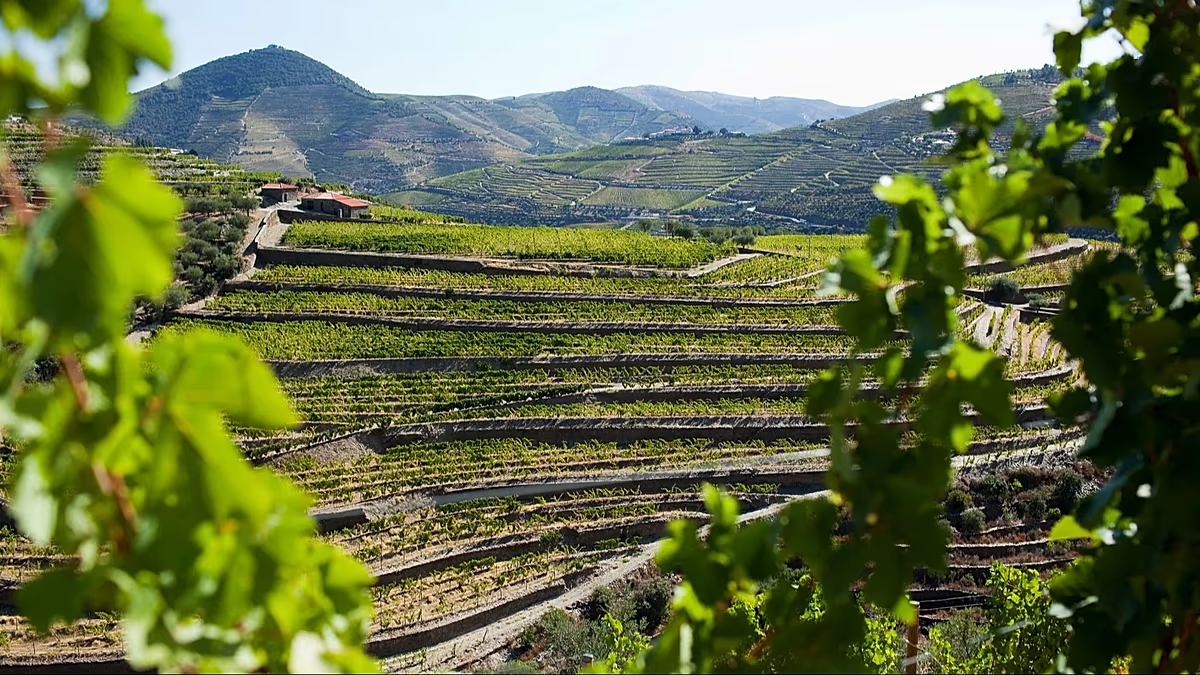
September in Portugal has always been the month of the grape harvest, a time when the vineyards that shape so much of the country’s landscape suddenly wake into urgent, glorious activity. The air fills with the heavy sweetness of ripe fruit, the hillsides are dotted with bent backs and bright buckets, and an ancient rhythm takes over village life. This is, par excellence, the season of the harvest, and in recent years it has also become a season of adaptation. Climate change has reached the vineyards, and its effects are being felt across the country. Frederico Falcão, president of ViniPortugal, the interprofessional organisation that brings together Portuguese wine producers, explained to the Lusa news agency that the greater frequency of intense periods of heat has made grapes ripen more quickly, and as a result the harvest has been brought forward in several regions. Few places show this more clearly than the Douro, whose wines are admired around the world and which has just been crowned “International Wine Region of the Year” in the 2025 Wine Star Awards, organised by the prestigious publication Wine Enthusiast. This year, the Douro harvest began between one and two weeks earlier than usual, Falcão said. Yet the early start has not been a sign of poor fortune. According to the latest estimates from the Instituto da Vinha e do Vinho, the region’s wine production is expected to be 25% higher than in the previous season, reaching a final balance of around 1.4 million hectolitres of wine. There is, in other words, no shortage of reasons to visit the Douro this September, to walk through its terraced slopes, to learn about its winemaking traditions, and to understand what the harvest truly means to the people who live and work there.
For those who want to experience the harvest with a sense of celebration and collective joy, one of the most charming options is to arrive by train. CP – Comboios de Portugal, the country’s state-owned rail operator, is reviving an initiative that has been tried in previous years and has now returned to mark the harvest season. As CP itself puts it, there is no better way to celebrate the grape harvest than to get to know the traditions of the Douro and take part in the wine-making process in the very place where it all happens. The programme is a full-day excursion, departing from and returning to Campanhã station in the city of Porto, aboard a special train with a bar service that leaves shortly after eight in the morning. This year there are two dates on offer, both Saturdays: 19 and 26 September. The first stop is Pinhão, where participants are transferred by coach to Quinta da Avessada, a wine estate in the village of Favaios, a place already known for its wine tourism experiences. Once there, guests are welcomed with a tasting of regional specialities, including traditional bread and a meat-filled savoury loaf, before being invited to join the harvest itself. They are given buckets, clippers and straw hats, and guided through the vines while they are told about the grape varieties, the history of the region, and some of the customs linked to this age-old practice. After the morning in the fields, a generous regional lunch is served, with several classic local dishes on the table, followed by a visit to the estate’s lagares, the traditional wine presses. There, guests take part in the lagarada, the centuries-old method of treading grapes by foot, an experience that is equal parts physical, sensory and deeply fun. The day ends with a guided tasting of fortified wines in the estate’s wine bar, before the train leaves from the nearby station at Régua and makes its way back to Porto in the evening. Prices vary according to age group and whether one travels as part of a group, but for individual adults, the base price is 93 euros in first class and 86 euros in second class, a small investment for a day that promises laughter, mud between the toes, and a much deeper appreciation of what goes into every bottle.
But the Douro reveals itself in many different moods, and one of the most spectacular is seen from the water. The river that gives the region its name is Portugal’s second-longest, and its banks are lined by terraced vineyards that descend dramatically toward the water, creating one of the most breathtaking landscapes in Europe. For almost the whole year, tour operators offer cruises that travel along large stretches of the river, but some of them use the harvest season to create programmes that are more immersive, designed for travellers who want to do more than simply admire the view and who are willing to roll up their sleeves and take part in the work. There are one-day and two-day packages in September, during which participants not only get to know Pinhão and its surroundings from the deck of a boat, but also visit a local wine estate, where they can join in a series of themed activities. These typically include wine tastings, the cutting of the grapes, transporting the fruit to the lagares, and treading the grapes to the sound of traditional Douro songs. In the case of the two-day package, accommodation in a boutique hotel is included, adding an extra layer of comfort and intimacy to the experience in a region where the production of Port wine is one of the central threads of local identity. For those who truly want to disappear into the harvest for a while, there is an even longer option: a three-day or five-day programme on board the Douro Serenity, a river-cruise hotel that makes its way through the region with the harvest as its guiding theme. This itinerary includes a visit to Quinta da Avessada, the same estate featured in the railway experience, and offers a wide range of activities, from picking grapes with bucket and clippers in hand to listening to folk music played among the vines, tasting Port wine in the cellar, and sitting down to a regional dinner. Some additional excursions are available at an extra charge, such as a visit to the Raposeira cellars, famous for their sparkling wines, the Penascosa Rock Art Centre, the Museum of Foz Côa, and the village of Castelo Rodrigo, which includes a tasting at a local winery. The base price per adult ranges between 495 and 800 euros, depending on the length of the trip, and two dates remain in September: the 10th for the five-day programme and the 11th for the three-day programme.
Beyond the organised train journeys and river cruises, there is another way to enter the world of the Douro harvest: by choosing one of the many estates that open their doors in September and turning the season into a personal, slow and sensory encounter. One such place is Ventozelo Hotel & Quinta, an estate in Ervedosa do Douro that is one of the largest and oldest in the region. The property has 29 rooms spread across seven different buildings, and among the more unusual accommodation options, guests can spend the night inside a former wine storage vat or in an old barn that has been transformed into a comfortable and atmospheric space. Prices range from 180 to 2,950 euros per night, depending on the season and the kind of accommodation chosen. Ventozelo offers a full calendar of wine-related experiences throughout the year, not only for overnight guests but also for visitors who are simply passing through. Among the most intriguing is the so-called “Visit to the Place of Pleasures,” a multisensory journey centred on the Douro Valley that includes a guided tour of the estate’s main hub, with stories about its history and daily operations, followed by a tasting of the wines produced at the quinta. Nearby, in Peso da Régua, stands Torel Quinta da Vacaria, a five-star boutique hotel whose history goes back to 1616 and which has its own Michelin-starred restaurant, Schistó, as well as a spa offering vinotherapy treatments that use wine and grape-based products to rejuvenate the skin and body. The hotel has created a special harvest programme that, for 180 euros per person during September and October, gives participants access to the estate’s winery, where they can learn about the winemaking process and sample several of the wines made there. The evening continues with dinner at the winery’s restaurant, Fumus, where the menu is inspired by the traditions of the harvest, and ends, quite appropriately, with grape treading accompanied by traditional music. It is the kind of experience that manages to be both refined and earthy, elegant and joyful, a reminder that wine is, at its heart, a product of human hands and feet.
Further into the Douro, at Quinta Nova de Nossa Senhora do Carmo in Covas do Douro, the wine and the vineyards also take centre stage. This estate, which operates as a luxury hotel and is part of the prestigious Relais & Châteaux association, has built its reputation on the art of harvesting, the pleasure of tasting, and the deep connection between local cuisine and the landscape that produces it. Throughout the year, visitors can take part in activities that explore these themes, but on Thursday 10 September, the estate has arranged a special experience designed around the actual work of the harvest. Guests are invited to join the cutting of the grapes alongside the roga, the group of workers who carry out this labour, and to share in the rhythm of the fields, the concentration, the quick movements of the hands, and the satisfaction of seeing the baskets fill. After the morning’s work, the experience continues with two tastings of different styles of wine, each one telling its own story about the grapes and the soil. It all culminates in lunch at the estate’s restaurant, Terraçu, where the food pays homage to the local traditions of the Douro and to the generosity of the harvest. The total cost of this experience is 290 euros per person, and it offers something that no museum or wine bar can quite replicate: the chance to stand inside the harvest itself, to be part of the human chain that transforms grapes into wine, and to understand, in a very direct way, why this region has been shaped by the vine for centuries.
What all of these experiences share is a quiet but powerful invitation to slow down and to connect. The harvest in Portugal is not simply a logistical exercise in picking fruit and filling barrels; it is a living, breathing cultural event, woven into the identity of entire communities. It brings people into the fields, into the cellars, into long shared meals, into songs that have been sung for generations, and into a relationship with the land that cannot be hurried. The effects of climate change make these traditions more fragile, but they also make them more precious. The early ripening, the earlier harvest dates, the shifting rhythms of the season are reminders that this world is always changing, and that the people who tend these vines are adapting, learning, and continuing to make wine with remarkable skill and passion. For the visitor, the harvest season offers an exceptional chance to be welcomed into that world, whether by boarding a festive train in Porto, sailing down the Douro on a river cruise, sleeping in a converted wine vat, or standing among the vines with clippers in hand, listening to the stories of those who have done this work all their lives. September in the Douro is a feast for all the senses: the taste of freshly pressed juice, the smell of earth and yeast, the sight of golden light on terraced slopes, the sound of stomping feet and old songs, the feeling of being part of something much older and larger than oneself. From the first train to the final tasting, from the most luxurious boutique hotel to the simple pleasure of bread and wine shared after a long day in the fields, the grape harvest is a reminder that wine is not just a drink but a story, and that the best way to understand it is to take part in the season that gives it life.