





Paragraph 1
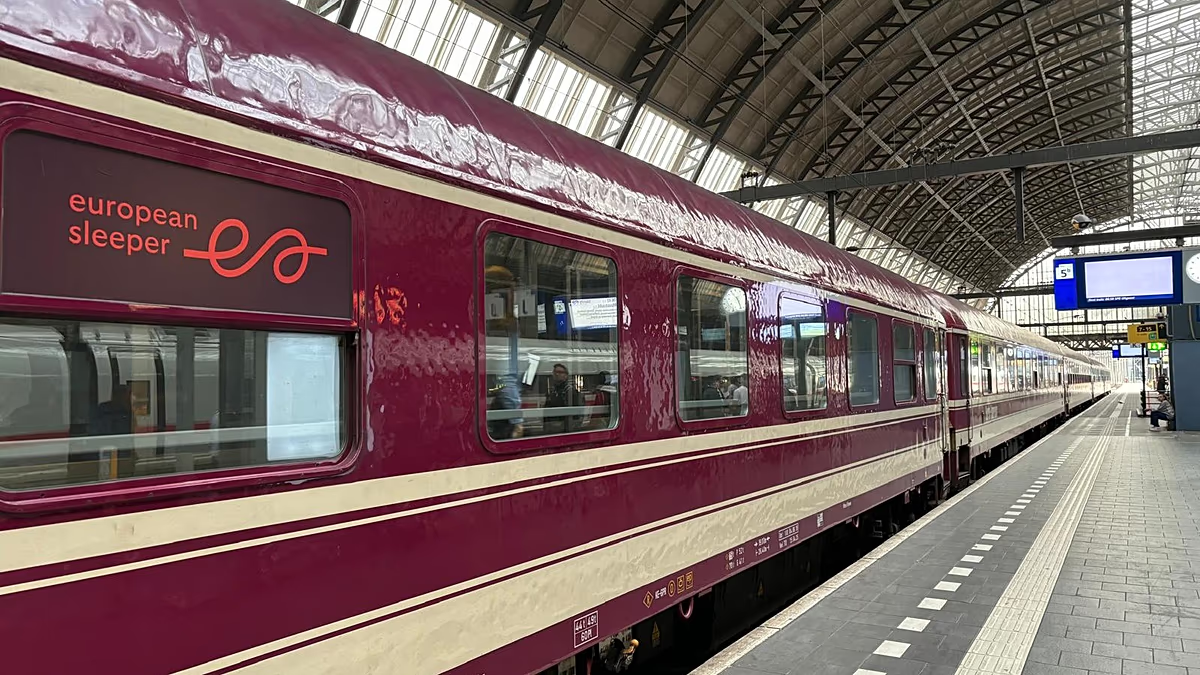
For anyone who has ever wished that Europe were just a little bit smaller — or at least that its distances could be swallowed up by a good night’s sleep — there is genuinely exciting news on the horizon. European Sleeper, the ambitious and increasingly beloved night train operator, has announced that its first overnight services into Scandinavia will begin in April 2028. This is not a distant dream or a vague ambition; it is a concrete plan, made possible by a new partnership with the German railway operator RDC. The new route will connect Brussels and Amsterdam with Copenhagen and Malmö, creating a seamless overnight link between the Benelux countries, Denmark, and southern Sweden. The meaning of this goes far beyond another train route. It represents a quiet revolution in how we travel across Europe, offering travelers the chance to board a train in the heart of the Low Countries in the evening, settle into a bunk or a soft seat, and wake up the next morning in a completely different part of Scandinavia. Instead of navigating crowded airports, dealing with baggage fees, and arriving exhausted, passengers will be able to enjoy a journey that feels almost magical: close your eyes in one city, open them in another. It is the kind of travel that restores a sense of wonder, and the announcement has already generated a great deal of excitement among night train enthusiasts, environmental travelers, and anyone who simply loves the romance of awakening somewhere new.
Paragraph 2
The Brussels–Malmö service is far more than a new line on a map; it is a bridge between two vibrant regions of Europe, and it expands European Sleeper’s growing network toward the northern reaches of the continent. By connecting Western and Northern Europe overnight, the route brings cities like Copenhagen and Malmö directly into reach for travelers from Belgium and the Netherlands. But the benefits ripple outward. From Copenhagen or Malmö, other major destinations — London, Paris, Stockholm, Oslo — can be reached with just one additional change. This makes the night train an increasingly practical alternative for both leisure and business travelers, allowing them to move across Europe with a single comfortable overnight journey instead of a stressful, fragmented itinerary of tight connections and waiting rooms. The announcement also signals a deepening relationship between European Sleeper and RDC, a partnership that has already proven valuable. RDC has been supporting European Sleeper’s existing Paris and Milan services by providing night train rolling stock, and the collaboration now appears to be entering a new, more ambitious phase. For passengers, this is excellent news: more choices, more connections, and more opportunities to experience the pleasure of travelling by night. It also says something important about the direction of European travel. The era of cheap flights and rigid transport networks is slowly giving way to something more thoughtful, more connected, and more respectful of both time and planet. Night trains are no longer a nostalgic curiosity; they are becoming a genuine, growing part of the continent’s mobility future.
Paragraph 3
The people behind this project speak about it with a palpable sense of excitement and purpose. Chris Engelsman, co-founder of European Sleeper, described Scandinavia as the natural next step in the company’s rapid expansion. “Our network is growing quickly, and Scandinavia is a natural next step,” he said, adding that the partnership with RDC will create a night train that directly connects the Benelux with Copenhagen and Malmö, bringing another part of Europe within a comfortable night’s journey. He also emphasized the importance of the deepening relationship with RDC, which has already supported European Sleeper’s Paris and Milan services through the provision of night train rolling stock. There is something genuinely heartening about hearing such collaborative language from two railway companies. Too often, transport is seen as a fiercely competitive business, but here we see two organizations combining their strengths, trusting each other, and building something larger than either could achieve alone. Markus Hunkel, chief executive officer of RDC, echoed this sentiment, noting that RDC has many years of experience operating night trains between Germany and Scandinavia. “Together with European Sleeper,” he said, “we can build on that experience and create a strong new connection between the Benelux, Denmark and Sweden. We see real potential in combining our operational expertise with European Sleeper’s growing network and customer reach.” These are not just corporate statements; they are words of genuine enthusiasm. It is refreshing to hear railway executives talk about potential, about experience, and about the simple joy of connecting people across borders. The partnership feels less like a business deal and more like a shared passion project, driven by people who truly believe in the romance and practicality of overnight rail travel.
Paragraph 4
What will the journey itself actually feel like? According to initial plans, the new service will feature departures from both Brussels and Malmö at around seven o’clock in the evening, with arrivals at the other end of the route at around ten o’clock the following morning. That timing is thoughtfully designed. It allows travelers to enjoy a relaxed evening, perhaps a last dinner in the city, before boarding and settling into their chosen accommodation. Then, instead of sitting upright for hours or scrambling for a taxi to an airport, they can sleep through the miles, waking up only when the train is approaching its destination, with the morning light filtering through the windows. The service is expected to offer a range of night train accommodation options, from European Sleeper and RDC, including comfortable seats for budget-conscious travelers, couchettes for those seeking a bit more comfort, and, for those who want the full night train experience, sleeper compartments with proper beds. There is even talk of deluxe sleeper options, with double beds and private en-suite bathrooms, as mentioned in the release. This is a thoughtful and inclusive approach, recognizing that not everyone wants the same level of comfort and that the appeal of night trains lies partly in their flexibility. A family might choose couchettes; a couple celebrating an anniversary might splurge on a deluxe compartment; a student might simply want a cheap, comfortable seat so they can spend their savings on experiences at the destination. Whatever the choice, the journey itself becomes part of the adventure. There is a particular pleasure in swaying gently to sleep, hearing the rhythmic sound of the rails, and knowing that you are crossing borders while you dream.
Paragraph 5
The Brussels–Malmö route is not an isolated project. It is part of a much larger vision that European Sleeper is steadily bringing to life. On September 9, 2026, the company’s first night train between Brussels and Milan will depart, connecting the Benelux with Switzerland and northern Italy. This is a significant milestone in its own right, opening up an overnight corridor across the Alps and into the Mediterranean region. And the ambitions do not stop there: preparations are continuing for a Brussels–Barcelona connection, also planned for 2028. This means that within just a few years, the map of European night trains will be transformed. Imagine being able to board a train in Brussels and travel south to Milan or Barcelona, or north to Copenhagen and Malmö, all while sleeping comfortably through the night. It is a vision of Europe as a truly integrated continent, where cities are linked not by expensive and polluting flights, but by comfortable, sustainable, and deeply human means of transport. The expansion also comes at a time when many travelers are questioning their flying habits. Night trains are increasingly seen as an elegant solution, reducing carbon emissions while also making travel itself a more meaningful experience. For European Sleeper, the strategy is clearly working. The demand for night travel is growing, partnerships are forming, and the network is expanding in a way that feels organic, logical, and genuinely exciting. It is hard not to feel a sense of anticipation when thinking about what the European railway map might look like in just a few years’ time.
Paragraph 6
In the end, this announcement is about much more than timetables and train carriages. It is about reimagining travel itself. There is a quiet, almost poetic beauty to the idea of a night train gliding through the European countryside while passengers sleep in cozy bunks, perhaps with a book lying open on the bedside shelf. It is about connecting cultures, not just cities, and about making distance feel less intimidating. The partnership between European Sleeper and RDC is a powerful reminder that when people work together — sharing experience, resources, and enthusiasm — they can create something that genuinely improves the way we live and travel. For those of us who have grown weary of crowded airports, security lines, and the sterile sameness of modern air travel, the night train offers a gentler alternative, one that respects our need for comfort, beauty, and connection. So mark your calendars, dream a little, and imagine yourself standing on a platform in Amsterdam or Copenhagen, suitcase in hand, watching as the dark blue carriages pull in. The conductor calls your destination. You climb aboard, settle into your compartment, and watch the station lights recede as the train glides into the night. When you wake, the landscape outside will be different — softer, perhaps, or more dramatic — and you will realize that the journey itself was part of the memory. This is what European Sleeper and RDC are promising, and it is a promise well worth celebrating.