


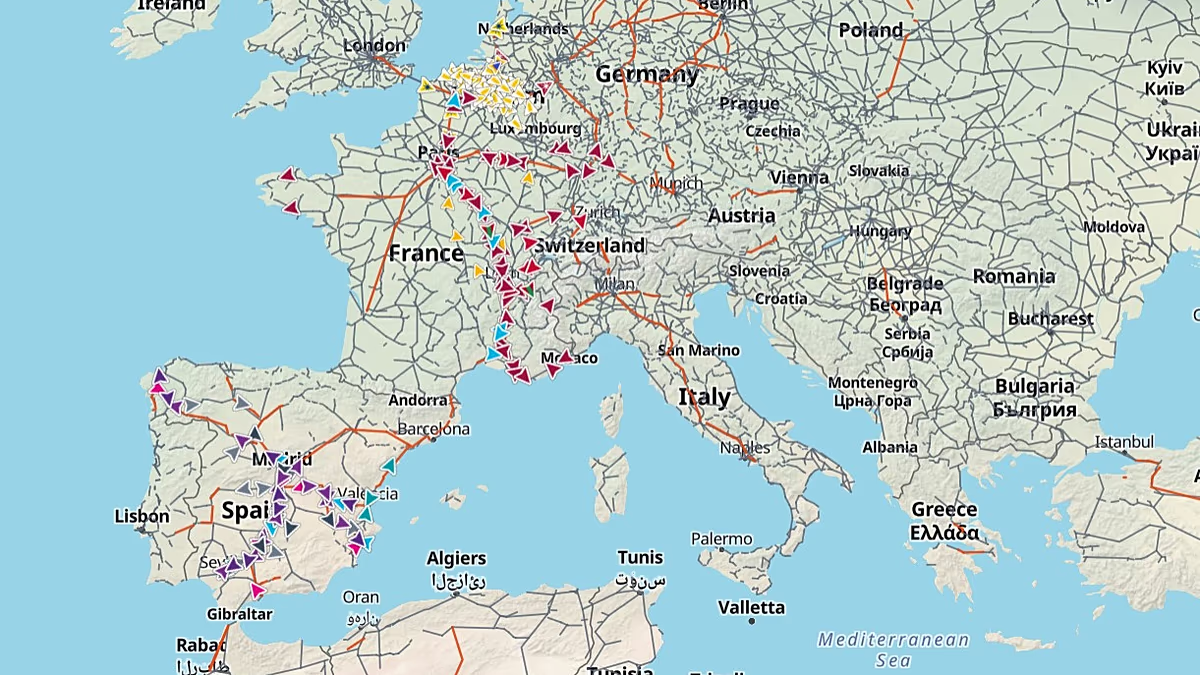
If you’ve ever stood on a railway platform, craning your neck and wondering whether the next train is actually coming, or if it’s going to be one of those days when the board flips to “delayed” and no one tells you why, then you already know the pain of modern rail travel. The age-old question of “where’s my train?” has never had a truly satisfying answer — until now. A new platform called TrainTracker24 is trying to change that by bringing the kind of live, visual tracking that aviation and shipping enthusiasts have enjoyed for years to Europe’s railways. Launched in August with an initial focus on France, Spain and Belgium, TrainTracker24 gives you a real-time map of rail traffic across these countries, letting you browse the network as if you were looking at a living organism. You can see how many trains are currently active, what the average delay is in minutes, what percentage of trains are running on time, and how many have been cancelled. The map itself is wonderfully interactive — you can rotate it, zoom in and out, and explore it to your heart’s content. It’s not just a dry data dashboard; it’s a way to finally see what’s actually happening on the tracks, in the moment, without having to rely on cryptic station announcements or social media rumors.
But TrainTracker24 is much more than a pretty map. It’s packed with filters that let you drill down into the specifics of railway operations. You can filter by train operator, so if you’re particularly interested in France’s SNCF, Belgium’s SNCB, or Spain’s Renfe, you can isolate their services and see how they’re doing. The platform also includes data on international high-speed services like Eurostar and Italy’s Frecciarossa, which is a nice touch for anyone planning cross-border trips. There are infrastructure filters too, which might sound nerdy at first but are actually fascinating: you can see stations that are currently without any rail service, identify which lines are high-speed, and even find stations that are technically operational but closed to the public. For the truly data-obsessed, there are widgets that rank the most delayed trains and the most disrupted stations live, so you can see at a glance where the worst trouble spots are on any given day. And if you happen to have a train number handy, you’re in for a treat. Train enthusiasts can look up scheduled runs, browse past journeys, and follow live tracking of specific services. There are also search functions for departures, arrivals, punctuality, and station facilities in France, Germany, Spain and Belgium, which makes the platform genuinely useful for travellers who want more than just a timetable.
While the basics of TrainTracker24 are free, the platform also offers a paid tier for those who want to go even deeper. Paid features include a personalised journey map, live data on interrupted services displayed directly on the map, and the ability to sort trains by delay so you can immediately see which services are causing the most headaches. There are also more detailed map layers that highlight infrastructure, track types, and an expert reading of the situation, whatever that may mean in the context of railway data. The platform pulls all of its information from open data supplied by train operators, regional authorities, and infrastructure managers, covering timetables, real-time updates, and disruption information. That means the data is as official as it gets, which is reassuring when you’re relying on it to make a decision about your journey. The entire network snapshot refreshes every 20 seconds, so you can quite literally watch rail dramas unfold in real time. If a train breaks down in the middle of nowhere, you’ll see it happen. If a station gets flooded with cancellations, you’ll know almost immediately. According to a post on X, the platform is already on track to expand further into Europe, which suggests that soon you might be able to track trains across more of the continent, not just the initial trio of countries.
This concept might sound familiar, and that’s because TrainTracker24 isn’t the only player in this space. It joins a growing family of live rail-tracking platforms, including one called TrainTracker.live, which bears a very similar name and offers a similarly free and accessible experience. TrainTracker.live gives users a live map with details on train positions, timetables, and punctuality statistics for rail networks around the world. When I last browsed the website, it boasted data on almost 11,000 live trains, with coverage spanning four continents, including Europe, the Americas, Asia and Oceania. That kind of global reach is impressive, and it suggests that the hunger for real-time train tracking is not just a European quirk. It’s a global phenomenon, driven by the same basic human desire to know what’s coming next. The fact that TrainTracker24 and TrainTracker.live share such similar names might be confusing at first, but they are actually complementary tools. Both offer live maps, but they have slightly different strengths and interfaces. If you’re a train enthusiast, there’s no reason not to use both, depending on which region you’re interested in and what kind of data you want to see.
And train enthusiasts are truly spoiled for choice these days. There are other available platforms, such as TrainsTracking, which offers live train information as well as fare comparisons, with links to official booking operator pages across 76 countries. TrainsTracking’s insights are most detailed in Europe, Japan, India, Pakistan and the United States, which makes it a great option for international travellers who want to compare trains and tickets in one place. Then there’s SignalBox, a live train map that focuses solely on the UK rail network. That’s perfect for British commuters who want a dedicated view of their own often chaotic railway system, without the distraction of international data. The existence of all these platforms shows just how far rail travel has come in terms of transparency. For years, railways were black boxes: you bought a ticket, waited on a platform, and trusted that the train would arrive. Now, you can open a website, see exactly where your train is, how late it is, and whether it’s even going to show up at all. It’s a dramatic shift that puts power back into the hands of passengers, and it’s made possible by the open data movement that has swept through the transport industry over the past decade.
It all feels a bit like Flightradar24, doesn’t it? You know, that incredibly popular app that lets you track any aircraft in the sky, see its flight path, altitude, speed and destination. Well, the resemblance is no coincidence. Elric Battello, TrainTracker24’s founder, put it perfectly in an interview with Luxembourg-based media outlet Virgule. He said: “When you’re flying, or waiting for someone at the airport, it’s easy to open Flightradar24 to track the flight live on a map; the same goes for shipping. With trains, it’s different. You’ll often see a display at the station or receive a notification in the event of a delay. But you don’t really know what’s going on.” That observation gets to the heart of why TrainTracker24 and similar platforms matter so much. They don’t just give you information; they give you context. They turn a frustrating wait into a moment of understanding. Instead of standing there helplessly, you can see that your train is stuck behind another service, or that a signal failure has disrupted the line, or that your train is actually on its way and you just needed to be patient. In that sense, TrainTracker24 is more than a tool — it’s a comfort. It reminds us that behind every delayed train, there’s a story, and for the first time, we can actually read it. So the next time you’re at a station, staring at a departure board, remember that the answer to “where’s my train?” might just be a few clicks away.